on sale
Price from
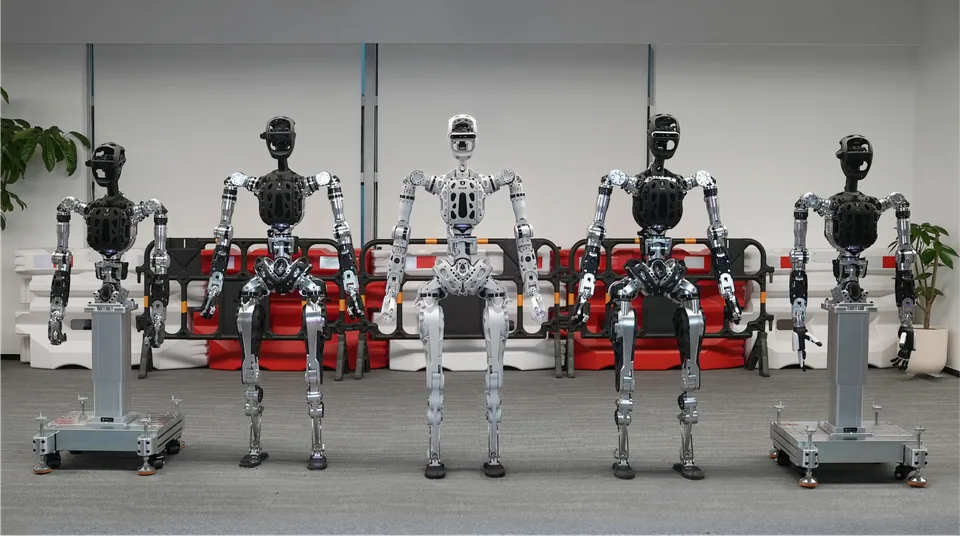
PNDbotics Adam is the base model of the Chinese Adam humanoid family (alongside the Lite, SP and Pro variants) and uses proprietary quasi-direct-drive actuators (PSA). The site quotes a price range of 100,000 to 115,000 USD, which is roughly 387,600 to 445,800 PLN (≈ EUR 102,150) at the official ECB/NBP rate; the exact variant this price refers to is not specified.
Unlike the Lite and SP variants, the manufacturer publishes no dimensions or weight for the base Adam. Those figures exist only for the derived variants, which makes it hard to place the model clearly against, say, the Unitree G1 or the Fourier GR-1.
The electric drive, degrees of freedom and other control details (reinforcement learning for balance, imitation learning for tasks) are known from material on the Adam family as a whole but are not confirmed specifically for this variant. Its strengths are membership in a broad, actively developed product family and an entry price that is relatively low for a humanoid.
Its weakness is the lack of a clear spec sheet for this particular model. The robot is not available in Poland and has no local representative here; the target audience is research centers and manufacturing plants looking for an entry platform to the Adam family.
Data checked: · Sources: 1
Price range of 100,000-115,000 USD for the base “Adam” model per a third-party aggregator; exact variant not specified.
Purchase. The site quotes a range of 100,000 to 115,000 USD for the base model, which at the October 1, 2026 rate (about 3.8762 PLN per USD) comes to 387,600 to 445,800 PLN (≈ EUR 102,150) net. The manufacturer did not specify which variant this price applies to, so treat it as indicative.
Import and taxes. The robot is not available in Poland. As a rough estimate, add shipping, customs duty and 23% VAT (deductible if you are an active VAT payer), plus the cost of conformity certification if the machine is to work around people; standards are covered in “Robot Safety Standards”.
Operation. The manufacturer's published sources give no runtime or power consumption for this variant, so we cannot estimate electricity costs; for humanoids of this class they are a small fraction of the total. Service matters far more: with no representative in Poland, repairs require working with the manufacturer.
Training and integration. Imitation learning requires AI engineers; as a rough estimate, count on a team working for several months before the robot performs a repeatable task.
The full cost methodology is in “Humanoid Robot TCO: How to Calculate Total Cost”.
No confirmed distributor in Poland
The Adam is the base model of the Chinese PNDbotics humanoid family (alongside the Lite, SP and Pro variants). Its distinguishing feature is proprietary quasi-direct-drive actuators (PSA), which are meant to give the robot soft, compliant movement and good force control. Control relies on reinforcement learning (keeping balance) and imitation learning (tasks). An important caveat: for the base Adam the manufacturer does not publish dimensions or weight, so our description of uses rests on what is known about the whole family.
Factory. The manufacturer names manufacturing as the main field of action. The idea is that a humanoid works at stations designed for people, without rebuilding the line for carts. That is the logic behind the whole industry, described in “Humanoid Robots in Factories 2026” and in the factory section. We found no public data on the base Adam's payload, however, so we cannot plan specific tasks.
Laboratory. The second audience is research centers. Imitation learning means an operator demonstrates a task and the robot learns to repeat it, a typical approach in embodied AI research. Lab uses are covered in “Laboratories”; general background comes from “VLA Models: How AI Controls Humanoid Robots in 2026”.
Entry platform to the family. With a price of 100,000 to 115,000 USD, the Adam is a way for a team to try out the PNDbotics ecosystem before buying a pricier variant. Industrial teams can treat it as a machine for piloting and data collection, not as a ready-made worker. Technical universities, meanwhile, get a platform for research on gait and control, described in “Universities and research”.
Worth considering for: research centers that want to enter the PNDbotics ecosystem and have a budget in the range of several hundred thousand zloty; R&D departments in manufacturing plants looking for a platform to pilot a humanoid on the shop floor; and integrators who want to know the competitors of Unitree or Fourier and compare drive solutions.
Probably not for: companies that must plan a task from a spec sheet, because the manufacturer does not disclose dimensions, weight or a full specification for this variant. We do not recommend it to teams without a software background, since imitation learning means working with data. It is not suited to small firms looking for a ready-made worker: there is no representative in Poland, so service means importing and long logistics.
We explain how to read such spec sheets in “How to Read a Robot Datasheet”; gaps in the data call for particular caution.
PNDbotics has no distributor or representative in our country, and we found no public customer references for the base Adam in the sources.
Humanoids are being tested in factories by, among others, Apptronik Apollo at Mercedes (“Apptronik Apollo in Mercedes-Benz Factories”) and Agility Digit in warehouses (“Agility Digit in Warehouses”). That means the first industrial pilots are already under way, though mostly on Western platforms. Chinese platforms, for their part, are winning the research and education market; for an overview of factories, see “Humanoid Robots in Factories 2026”. Local contacts matter for teams in Poland too: we have compiled a map of robotics companies and institutions in “Polish Robotics Companies”.
PNDbotics Adam SP is a variant of the same family with 41 degrees of freedom, five-fingered hands and a payload of about 5 kg, for about 100,000 USD. If manipulation matters to you, it is a more logical choice than the base version, because it comes with a full specification.
PNDbotics Adam Lite is a lighter variant (160 cm, 60 kg, 25 actuators) at about 120,000 USD, paradoxically pricier than the SP.
Unitree G1 EDU costs about 286,500 PLN (≈ EUR 65,650) and is a competing research platform with a broader software ecosystem.
Fourier GR-1 is Fourier's humanoid; if PNDbotics does not convince you, it is worth checking its data sheet.
AgiBot A2 is a Chinese platform priced at about 213,200 PLN (≈ EUR 48,850), an alternative for customers who want a different manufacturer.
For a panorama of Chinese manufacturers, see “Chinese Humanoid Robots”. All of these platforms are aimed at teams with a research budget. When comparing, count not only price but also the availability of documentation: in this group it is often what matters most.

Robot Era (Beijing Xingdong Epoch Technology / Robotera)
PNDbotics is a Chinese company that has built the Adam humanoid family in four versions: base, Lite, SP and Pro. The common denominator is proprietary PSA quasi-direct-drive actuators, meant to deliver mechanical compliance and good force reproduction. We found no launch date for the base Adam and no documented history of earlier generations, so we will not guess.
The variants differ in profile: the Lite is lighter, and the SP has five-fingered hands for tools. The backdrop shows how quickly the number of competitors in China is growing; for an overview see “Chinese Humanoid Robots” and “Humanoid Robot Market Forecasts”. The story of other manufacturers racing for the same spot is told in “Unitree H1, G1, R1 and H2”.
No. The manufacturer PNDbotics (China) names no Polish shop or official distributor for the PNDbotics Adam; enquiries go through the manufacturer's website (pndbotics.com). Price from an aggregator: approx. 387,600 PLN* (≈ EUR 88,820). Confirm service in Poland before buying.
According to a third-party aggregator the price falls between 100,000 and 115,000 USD, or roughly 383,000-445,800 PLN (≈ EUR 87,760–102,150) at the ECB rate of 3.8762 (1 October 2026).
Electric, proprietary quasi-direct-drive actuators (PSA).
No. The manufacturer does not publish them for this specific variant; the data is available only for the Lite and SP variants.
Author, source and licence of the photo are given in the caption. Shop links may become affiliate links in future, details: How we make money · How we check