discontinued
Pros
- 71 degrees of freedom and 25 kg payload
- Hot-swappable battery, about 4 h runtime
- Modular: stationary, on a mobile base or bipedal
- Pilots with Mercedes-Benz, GXO Logistics and Jabil
Cons
- No unit price published
- Commercial pilots only, no confirmed mass deployment
- About 4 h runtime is less than some rivals claim
- Not offered in Poland
- 173cmHeight
- 25kgPayload
- 71DOFDegrees of freedom
- 4hRuntime
Key facts
- Specificationsheight 173 cm · payload 25 kg · degrees of freedom 71 DOF
- Statuspilot
- Availability in Polandnot confirmed
- VerdictFor large industrial and logistics groups planning a humanoid pilot; not for firms wanting a ready product.
Summary
- ManufacturerApptronik
- CategoryHumanoid robots
- Statuspilot
- Availability in PolandNo confirmed distributor in Poland
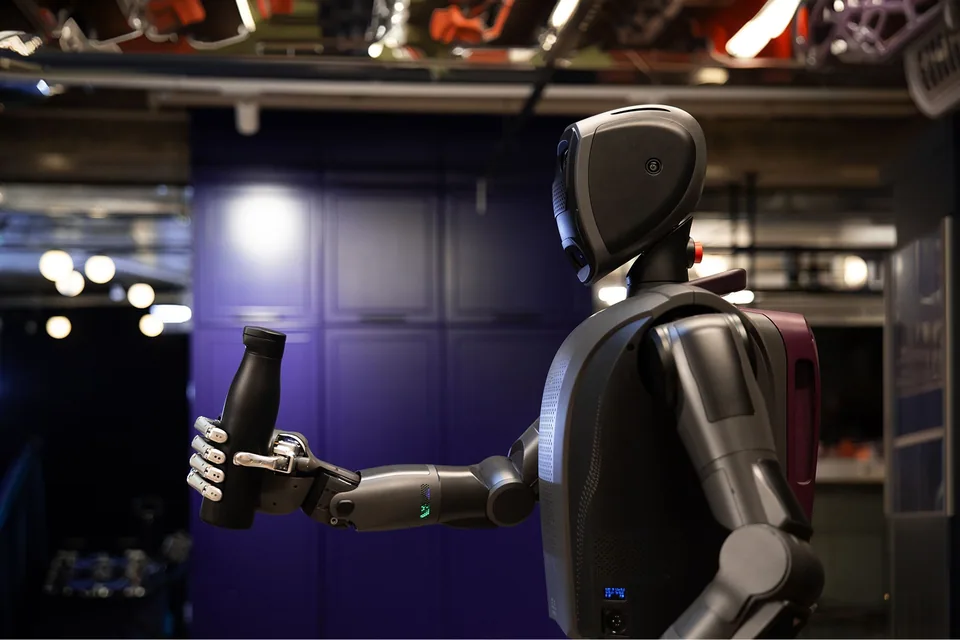
Seventy-one degrees of freedom and a swappable battery are Apollo's calling card. It is a humanoid robot from Texas-based Apptronik, a University of Texas at Austin spin-off founded in 2016.
At 173 cm tall, it lifts up to 25 kg and runs about 4 hours on one battery pack, which can be swapped without downtime - a practical advantage over designs with a fixed battery, though runtime is shorter than some industrial rivals claim. Its modular build lets Apollo be mounted stationary, on a mobile platform, or as a fully bipedal walking robot, which sets it apart from single-configuration competitors.
The company publishes no unit price - Apollo reaches customers only through commercial pilots, including at Mercedes-Benz, at a GXO Logistics distribution center and at Jabil plants. In February 2026 Apptronik raised USD 520 million at a USD 5 billion valuation, which suggests strong investor confidence but does not yet translate into confirmed mass deployments.
The robot is not offered in Poland - the manufacturer runs neither sales nor pilots here. Apollo is of interest mainly to large industrial and logistics groups weighing humanoid pilots, not to companies looking for a ready-made product to buy.
- Apollo Tote PickingApptronik · Load in the player above
- PalletizationApptronik · Load in the player above
Photo gallery
-
Photo: Apptronik, product page (apptronik.com) -
Photo: Apptronik, manufacturer's website (apptronik.com) -
Photo: Apptronik, manufacturer's website (apptronik.com)
Specs
Data from manufacturer datasheets and product pages; median over the models of this category in the database.
-
Height173 cmin line with the category median (169 cm, n=220)
-
Degrees of freedom71+141% vs. the category median (29.5, n=200)
-
Payload25 kg+257% vs. the category median (7 kg, n=166)
-
Runtime4 hin line with the category median (4 h, n=135)
- category medianA higher value doesn't always mean a better robot; it depends on the application.
Dimensions and weight
- Height
- 173 cm
Motion and manipulation
- Degrees of freedom
- 71
- Payload
- 25 kg
Power
- Runtime
- 4 h
Electronics and AI
- Drive
- electric
Price and availability in Poland
no data
Running and deployment costs
Purchase. There is no price: Apollo reaches customers only through commercial pilots and B2B contracts, and the manufacturer publishes no unit value. We therefore give no figure.
Deployment costs (estimates, no amounts): the cost of a pilot as an agreement with the manufacturer, integration with the internal transport system, preparation of work zones, a stock of swappable batteries and charging stations, and training for the maintenance team. A swappable battery reduces downtime but increases the number of packs to buy and maintain.
Training. This mainly covers safe collaboration and emergency procedures; we recommend the frameworks described in “Robot Safety Standards”.
Since Apollo is not offered in Poland, this is largely a theoretical topic; always leave the assessment to a tax adviser.
Dealers in Poland
No confirmed distributor in Poland
Applications
What it's for
Seventy-one degrees of freedom, 25 kg of payload and a battery you can swap without stopping production - that, in short, is Apollo, the humanoid from Texas-based Apptronik. The robot stands 173 cm tall and runs about 4 hours on one pack; the pack can be swapped in moments instead of waiting hours for a recharge. That is a practical feature that makes a difference in a plant running three shifts.
Car manufacturing. Apptronik has a commercial agreement with Mercedes-Benz for an Apollo pilot in production plants; we covered the details in “Apptronik Apollo in Mercedes-Benz Factories”. The tasks are internal logistics at the line: delivering components to assembly stations and moving crates and bins. This kind of work is also described under “Factories and manufacturing”.
Distribution centers. GXO Logistics is evaluating Apollo at one of its distribution centers - an evaluation stage, not a mass rollout. For Polish logistics readers this is a signal of what will be coming to market, so warehouses and “Humanoid Robots in Factories 2026” are the natural further reading.
Electronics plants. Jabil, a manufacturing company where the robot is meant to handle material movement in the plant and warehouse, is also named among the partners.
Modularity. This is the differentiator: Apollo can be mounted stationary, on a mobile platform, or as a fully bipedal walking robot. A customer can start with a stationary or wheeled version and add walking later. Unlike single-variant designs, it can be fitted to a hall where the floor and station layout are far from textbook.
Today, though, each of these uses is a pilot. The manufacturer publishes no price and runs no sales or tests in Poland.
Typical applications
Who it's for
Who it is for. Large industrial and logistics groups with a pilot budget, an integration team and the appetite to be early adopters. Car makers where a humanoid is to work alongside existing processes in internal transport. R&D departments that want to see whether modularity (stationary, wheeled, bipedal) makes it easier to enter humanoids step by step.
Who it is not for. Small and mid-sized companies looking for a ready-made product with a price and a warranty - Apollo reaches customers only through B2B pilots. Polish businesses, because the manufacturer runs neither sales nor pilots here. Anyone expecting long work without breaks - four hours per pack requires organized battery swaps.
A practical tip: a high company valuation is not proof of a mature product. In February 2026 Apptronik raised USD 520 million at a USD 5 billion valuation, which shows investor confidence but not mass deployments. We explain how to read such news in “Humanoid Robot Market Forecasts”, and how to count the total cost in “Humanoid Robot TCO: How to Calculate Total Cost”.
Deployments
Pilots and evaluations are confirmed: Mercedes-Benz (production plants), GXO Logistics (a distribution center, evaluation) and Jabil (plant and warehouse operations). The manufacturer does not disclose unit numbers or the scale of deployments. In Poland Apptronik runs neither sales nor pilots. Chinese research designs are on the market, for example Unitree G1, as is the American Agility Digit under a subscription model, though not in Poland. Context on industrial deployments: “Humanoid Robots in Factories 2026” and “Apptronik Apollo in Mercedes-Benz Factories”.
Comparison
- Figure 03 - the rival from the Apollo vs. Figure 03 comparison: Mercedes and GXO on one side, BMW on the other. Figure has the bigger buzz; Apptronik has modularity and a swappable battery.
- Agility Digit - logistics-specialized and currently the best commercially documented, but with a smaller payload (15.9 kg).
- Agility Digit 5 - Digit's successor, 22.7 kg payload, early access from 2027; close to Apollo on specs, but with a single use case.
- Atlas - the electric Atlas, aimed at industry; greater motion ambition, an equally closed program.
- Unitree H2 - research hardware available on the market, if you want to start with experiments rather than a pilot.
For a complete overview of the category: “Humanoid robots”.
Similar models
- discontinued
- pilot
- pilot
 prototype
- prototype
History
Apptronik is a University of Texas at Austin spin-off founded in 2016. Apollo was unveiled in August 2023. The company signed a commercial agreement with Mercedes-Benz for a pilot in production plants, then began an evaluation at a GXO Logistics distribution center; Jabil is also named among the partners. In February 2026 Apptronik raised USD 520 million at a USD 5 billion valuation, and in September 2026 it announced a further USD 520 million in an extension of its Series A-X round: total Series A funding exceeds USD 935 million, and total capital raised is approaching one billion dollars. The capital is earmarked for scaling Apollo production.
Model unveiled
Apptronik unveils the Apollo humanoid Apptronik
Apptronik raises $520 million at a $5 billion valuation to develop its Apollo humanoid Apptronik
Apptronik raises $520 million in a Series A-X extension; total Series A funding exceeds $935 million and total capital raised approaches $1 billion, to scale Apollo production Apptronik
Sources
Frequently asked questions
How much does the Apptronik Apollo robot cost?
The manufacturer does not publish a price - Apollo is available only through commercial pilots with selected partners such as Mercedes-Benz and GXO Logistics.
Is Apollo available in Poland?
No, the robot is not offered on the Polish market and there are no deployment pilots here.
What are Apollo's payload and runtime?
The robot lifts up to 25 kg and runs about 4 hours on a swappable battery pack.
Author, source and licence of the photo are given in the caption. Shop links may become affiliate links in future, details: How we make money · How we check