In this article
- Why robot datasheets need more careful reading than consumer electronics specs
- 1. Torque: peak vs continuous
- 2. Payload: static vs dynamic
- 3. Battery life: under load vs at idle
- 4. Where the number comes from: manufacturer or third party
- 5. Missing fields do not always mean a worse product
- 6. Variants of the same model can have different specifications
- 7. The measurement date matters
- Summary: five questions before comparing two robots
Key facts
- Models coveredAgility Digit, Agility Digit 5, Tesla Optimus Gen 3
- Covered models available in Poland0 of 3
- Number of sources3
- Reading time5 min
- As of2 October 2026
Why robot datasheets need more careful reading than consumer electronics specs
The market for humanoid and industrial robots is evolving faster than the standardization of how manufacturers describe their products. Unlike smartphones, where well-established measurement conventions have long existed (battery life in a standard test, camera resolution in megapixels), in robotics the same parameter name, whether "payload", "runtime" or "torque", can be measured in several different ways depending on the manufacturer. Below are seven places where misinterpretation is easiest, with concrete examples from real datasheets.
1. Torque: peak vs continuous
Electric motors deliver their highest torque near zero rotational speed, and torque falls as speed rises; this is basic electric-drive physics. Robot makers usually give one figure for a joint's "maximum torque", but do not always specify whether it is the peak value, reached for only a fraction of a second before thermal protection intervenes, or the continuous value, which the drive can sustain without a break. The Unitree G1 lists, according to Unitree, the maximum knee joint torque as "90 N·m" in the standard version and "120 N·m" in the EDU version. The datasheet does not say explicitly whether that is peak or continuous, a typical example of information that needs extra context rather than being taken at face value as the full picture of a drive's endurance. The way the drive mechanisms that generate these values work is described in “Actuators in Humanoid Robots”.
2. Payload: static vs dynamic
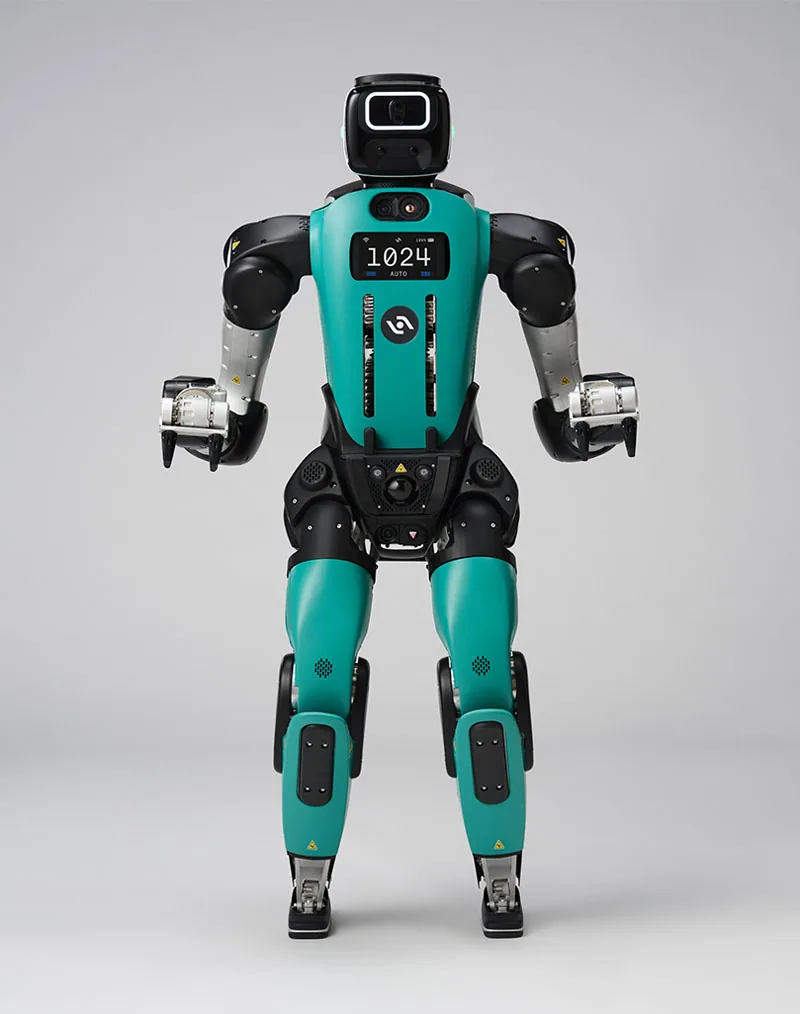
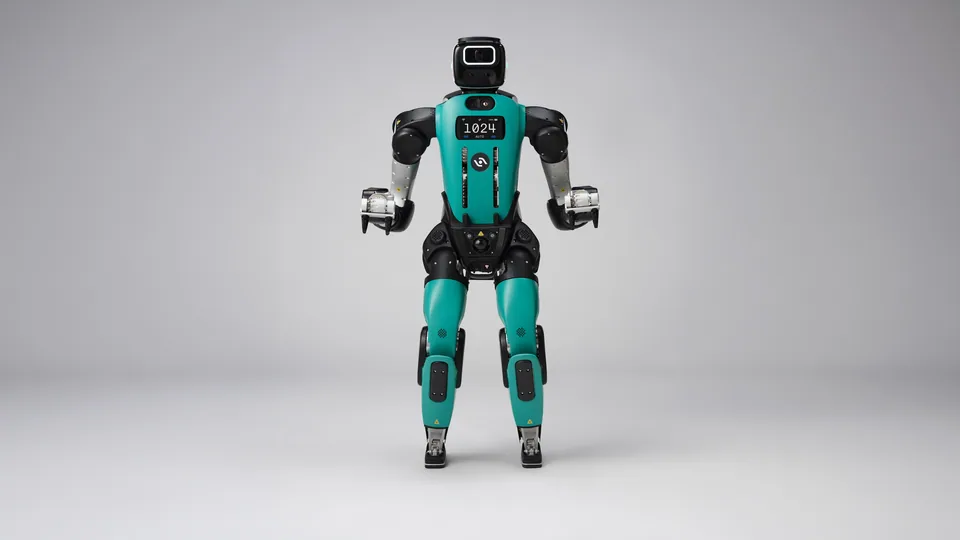
"Payload" is one of the most commonly confused parameters. Static payload means how much the robot can hold motionless, for example an object held still in an outstretched arm. Dynamic payload refers to carrying an object while moving, with acceleration, and is usually lower because inertial forces act on the whole mechanism. A good real-world illustration is the Agility Robotics product line: according to The Robot Report the Agility Digit has a stated payload of 35 lb (about 15.9 kg), while the announced fifth generation, the Agility Digit 5, claims 50 lb (about 22.7 kg), an increase of about 40%, with redesigned legs and upgraded batteries. Before comparing such numbers across models from different manufacturers, check whether both refer to the same measurement scenario (holding at rest or carrying while walking), because without that context a bare number is easy to misread.
3. Battery life: under load vs at idle
Battery runtime depends heavily on the test scenario, and datasheets rarely specify it. The Unitree G1 states, according to the Unitree page, a 9,000 mAh battery and a runtime of "about 2 hours", without saying whether that applies to a standing robot, one walking at typical speed or one carrying its maximum load. The Digit case is even more instructive: according to The Robot Report the announced fifth version (Agility Digit 5) is to run for 90 minutes and charge in 9 minutes, a run-to-charge ratio of 10:1 (2:1 for Digit 4, Agility Digit), allowing more than 20 hours of work in a 24-hour day. The shorter runtime between charges is thus offset by fast charging; these are the manufacturer's claims. "Battery life" taken out of the context of the charging cycle says nothing about the robot's real availability over a production shift, so both parameters have to be read together.
4. Where the number comes from: manufacturer or third party
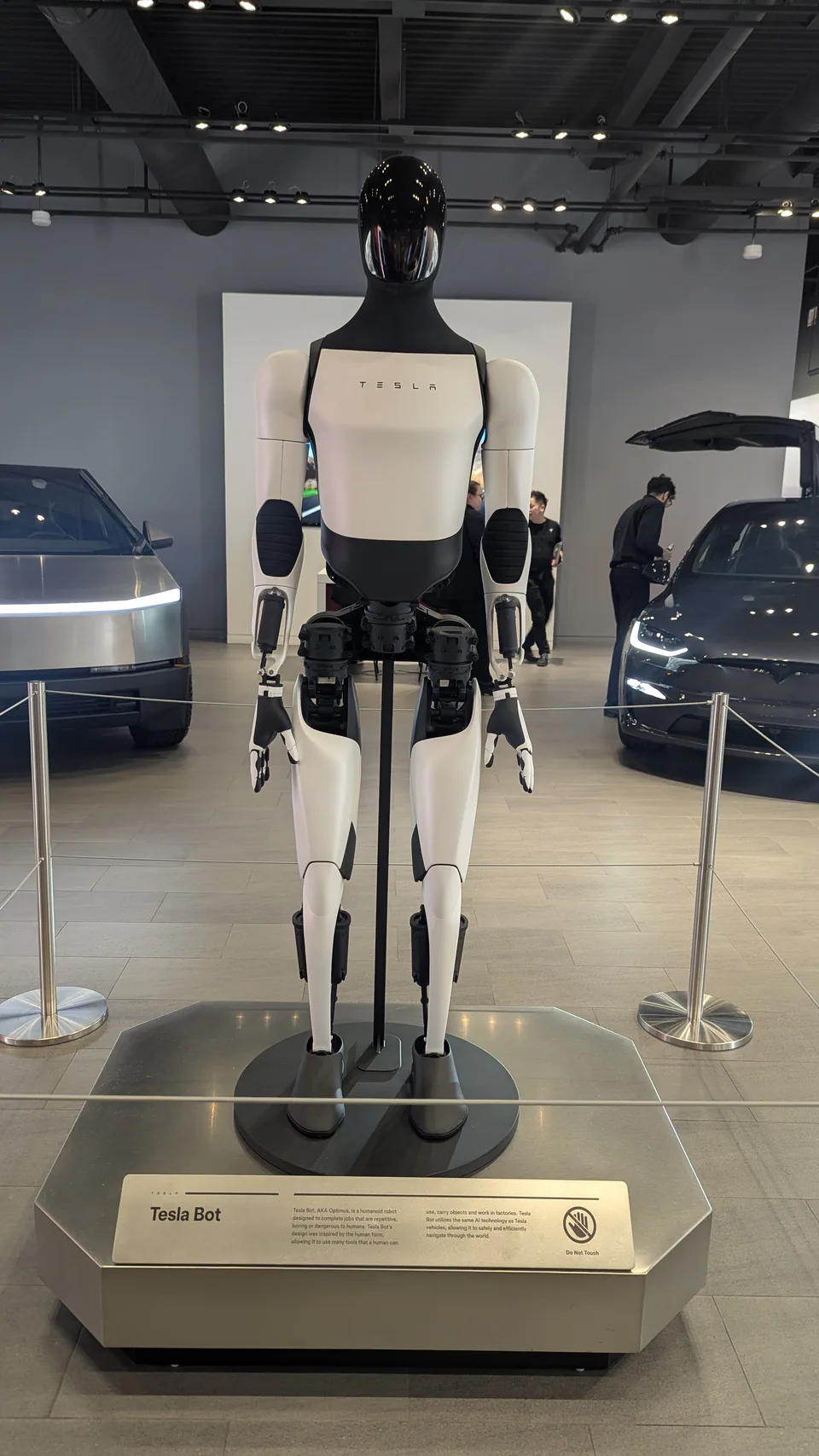
Not every number circulating online about a given robot comes from its manufacturer. A good example is the Tesla Optimus Gen 3: figures such as height (173 cm), mass (57 kg), 28 whole-body degrees of freedom, 22 DOF per hand or a 20 kg payload appear on many industry sites, but we found no official Gen 3 datasheet in Tesla's materials and no direct confirmation of these numbers. They come from third-party sites (aggregators and industry blogs), not from a manufacturer press release, and should be treated as estimates rather than confirmed specifications until Tesla publishes its own data. This does not mean the numbers are false, only that they cannot be verified at the source today, so it is worth noting this explicitly each time they are used, rather than presenting them as certain.
5. Missing fields do not always mean a worse product
When a datasheet leaves out a parameter, such as the exact mass, walking speed or actuator type, it most often means the manufacturer has not published it, not that the robot "lacks" it or that the value is zero. Treating an empty field as a hidden flaw leads to faulty comparisons. A better practice is to mark missing data explicitly, which is exactly how we handle it in our catalog: where a parameter is not confirmed by any source, we say plainly that the data is missing instead of estimating.
6. Variants of the same model can have different specifications
The same base model is often offered in several variants with clearly different parameters, as the comparison of the standard and EDU (education/research) versions of the Unitree G1 shows: differences in knee torque (90 vs 120 N·m), arm payload (2 kg vs 3 kg), range of degrees of freedom (23 vs 23-43, depending on optional equipment) and warranty (8 vs 18 months, per Unitree) show that a model name without the variant suffix is not enough to compare specifications. More on how the number of degrees of freedom affects a robot's capabilities in “Degrees of Freedom (DOF) in Humanoid Robots”.
7. The measurement date matters
Humanoid robotics changes month by month; a new generation can replace the previous one within a year, as with successive generations of the Tesla Optimus or the Unitree G1/H1/H2. A datasheet without an update date may describe an outdated version of the product, or a price from before several increases or cuts. That is why every model page in our humanoid robots catalog shows the date of the last data update, and for prices, the date the value comes from.
Summary: five questions before comparing two robots
Before comparing two models number to number, ask yourself five questions: is the torque a peak or a continuous value; is the payload static or dynamic; does the battery life refer to typical use or full load; does the number come from the manufacturer or from an independent source; and does it apply to the variant currently on sale, rather than an older or announced version. The context of the whole robot architecture to which these parameters relate is explained in “How Does a Humanoid Robot Work”.
Frequently asked questions
What is the difference between peak torque and continuous torque?
Peak torque is the maximum a motor can deliver for a very short time before it overheats or a protection circuit kicks in. Continuous torque is the value a drive can sustain without interruption over a longer period. Datasheets sometimes give only one of the two without saying clearly which.
What do static and dynamic payload mean?
Static payload is the maximum weight a robot can hold motionless, for example an object in an outstretched arm. Dynamic payload applies to carrying, lifting with acceleration or working while moving, and is usually lower than the static value because inertial forces come into play.
Why does battery life differ from the datasheet figure?
Because runtime is usually measured at idle or in a typical, light test scenario, not under full load. A robot carrying its maximum payload or moving at top speed will drain its battery faster than the simplified specification suggests.
How can I tell whether a number in a datasheet is reliable?
Check whether it comes directly from the manufacturer's site or from a third-party source (a blog, an aggregator), whether it carries a measurement date, and whether it can be confirmed in at least one independent source. The absence of these does not necessarily mean the number is false, but it is a signal for caution.
Sources
Links to the material this text is based on. Before you base a decision on a figure from the article, check it at the source.
About the authors
A chief engineer by profession (technical head of a ship's machinery plant, licensed). Sets the site's editorial rules and is responsible for them; he does not read every page before publication.
Texts are prepared by the editorial team using AI tools. We compare data with primary sources on a sample basis, not page by page. Our rules are described here: How we check · About us