In this article
Key facts
- Models coveredFigure 03
- Covered models available in Poland0 of 1
- Number of sources5
- Reading time5 min
- As of2 October 2026
From teleoperation to models that "understand" a command
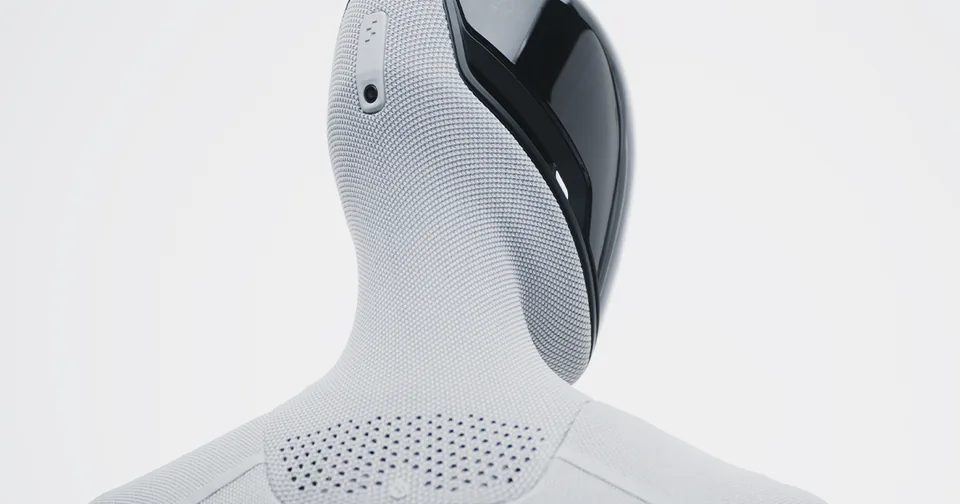
Until recently, a humanoid robot performing a specific task had to have that task programmed by hand or demonstrated by an operator through teleoperation. The breakthrough of recent years is vision-language-action (VLA) models — AI systems that take camera images from the robot and a natural-language command ("pick up the red cup and put it on the shelf") and directly return a sequence of movements. They are the reason a robot like Figure 03 can grasp an object it has never seen before without separate programming for that particular grasp. How this fits with the rest of the robot's architecture — sensors, actuators and the onboard computer — is described in “How Does a Humanoid Robot Work”.
How a typical VLA model works
Most of today's VLA models rely on a two-layer architecture that resolves a basic conflict: models that understand language and images are large and slow, while motion control has to be fast.
This is clearly visible in Figure Helix, created by Figure AI and described in February 2025: "System 2" is a 7-billion-parameter vision-language model running at 7–9 Hz, which analyzes the scene and the command and translates them into an internal semantic vector. "System 1" is a much smaller, 80-million-parameter transformer model running at 200 Hz, which uses that vector to generate continuous control signals in real time for the entire upper half of the body — 35 degrees of freedom, including individual fingers, wrist, torso and head. Both systems are trained end to end together, and Figure states that the model learned this behavior from roughly 500 hours of teleoperated demonstrations; the company publishes no independently verified task success rate beyond its own materials.
The key players in the VLA market in 2026
NVIDIA Isaac GR00T. According to NVIDIA, an open reference platform for humanoid robots, combining open data, data-processing pipelines and a trained foundation model that takes images and language and returns actions. It is trained on real-world data, synthetic data and internet-scale video, built around the NVIDIA Omniverse and Cosmos simulators and the CUDA-X library, with Jetson Thor as the target hardware for real-time inference. GR00T can perform manipulation tasks — grasping, carrying objects with one or two hands, handing an object from one hand to the other — as well as multi-step tasks in applications such as material transport, packing and inspection. NVIDIA describes GR00T as an open platform; the extent to which the code and weights of individual versions are available has to be checked in NVIDIA's repository.
Google DeepMind Gemini Robotics. According to DeepMind the family has three variants: Gemini Robotics 2 (a full VLA model with whole-body humanoid control and dexterity on the level of, for example, tying a knot), Gemini Robotics-ER 2 (specialized in spatial reasoning and multi-step planning) and Gemini Robotics On-Device 2 (a lightweight version to run locally on the robot's own hardware, with no cloud connection). DeepMind is recruiting 100+ trusted testers through a waitlist, and the research partners it names include Agile Robots, Apptronik and Boston Dynamics — so the model is not yet openly available to any integrator.
Physical Intelligence — pi0 / pi0.5. The company Physical Intelligence develops the pi0 and pi0.5 family of generalist VLA models. The architecture, the scope of released code and the test results are described in the company's original publications; read them directly before quoting any figures.
Open and academic models. OpenVLA is a 7-billion-parameter open model trained on 970k robot episodes from the Open X-Embodiment dataset, combining the SigLIP and DinoV2 vision encoders with a Llama 2 7B language model. According to its authors it outperforms the closed RT-2-X (55 billion parameters) in most multi-robot control tests, but RT-2-X does better on hard semantic-generalization tasks that need internet knowledge. The AgiBot World project provides a dataset (Beta version: 1,003,672 trajectories, about 43.8T as the repository states) and the GO-1 model; the model was open-sourced on 19 September 2025.
What these models can already do
- Grasping previously unseen objects from a language command alone, without separate training on that specific object — one of the flagship abilities demonstrated by both GR00T and Helix.
- Two robots cooperating on a single task from natural-language commands — demonstrated by Figure using Helix.
- One set of model weights for many tasks, with no need to fine-tune separately for each new task — the direction the whole industry is heading, moving away from the earlier "one task = one trained model" approach.
- Spatial reasoning and multi-step planning — according to DeepMind this is the job of the Gemini Robotics-ER 2 variant.
What these models cannot do yet
None of the manufacturers' publicly available materials gives an independently verified task success rate under production conditions, beyond controlled demonstrations — which in itself signals that the industry is still at the proof-of-concept stage in selected applications rather than universal operational readiness. The openly unsolved problems most widely cited in the literature include:
- Generalizing beyond the training data distribution — a model trained on typical household or warehouse objects may fail on unusual shapes, materials or lighting that were not in the data.
- Long-horizon multi-step planning — chains of more than a few consecutive steps are still harder than single grasping or carrying actions.
- Safe unsupervised autonomy — most current industrial deployments, such as Figure 03 at the BMW plant in Spartanburg, run in a supervised, pilot mode rather than full operational autonomy.
- The quantity and quality of training data specific to a given robot body (embodiment) — models such as GR00T or GO-1 partly address this by pooling data from many robots, but transferring skills between different mechanical designs remains an active research area, not a solved problem.
Why this matters when choosing a robot
The VLA model a robot runs on in practice determines how flexibly it can be deployed to new tasks without costly, individual programming. When comparing models in the humanoid robots category, it is worth checking whether the manufacturer states at all which AI model the robot runs on (its own, like Helix, or based on a reference platform, like GR00T), and whether it backs that with a concrete source — and not just the marketing slogan "artificial intelligence". Market context and forecasts for the whole humanoid category can be found in “Humanoid Robot Market Forecasts”, and the number of degrees of freedom such a model actually controls is explained in “Degrees of Freedom (DOF) in Humanoid Robots”.
Frequently asked questions
What is a VLA (Vision-Language-Action) model?
It is an AI model that takes camera images from the robot and a natural-language command as input, and outputs a sequence of concrete movements (an action trajectory) — unlike classic language models, which generate only text.
Is a VLA model the same as ChatGPT installed in a robot?
No. Language models (LLMs) generate text and have no direct access to motor control. VLA models are trained specifically on robotics data — motion recordings paired with images and commands — and their output is concrete motion parameters, not words.
Which VLA models are the most advanced today?
On the commercial market the standouts are NVIDIA Isaac GR00T (an open reference platform), Figure Helix (a proprietary model built in-house by Figure AI) and Google DeepMind Gemini Robotics 2 (partner access / waitlist). In academia and open source, OpenVLA and AgiBot World's GO-1 model matter most.
What can VLA models still not do in 2026?
The biggest open problems are: generalizing to entirely new, unforeseen situations outside the training data, long-horizon planning of multi-step tasks, and operating safely without human supervision in an unstructured environment. The companies themselves rarely publish hard numbers on task success rates outside controlled demonstrations.
Sources
Links to the material this text is based on. Before you base a decision on a figure from the article, check it at the source.
About the authors
A chief engineer by profession (technical head of a ship's machinery plant, licensed). Sets the site's editorial rules and is responsible for them; he does not read every page before publication.
Texts are prepared by the editorial team using AI tools. We compare data with primary sources on a sample basis, not page by page. Our rules are described here: How we check · About us