prototype
How many degrees of freedom does a humanoid need to handle objects almost like a human? The Fourier GR-2 has 53, 12 of them in each of its tactile hands, and its individual joints deliver up to 380 N·m of torque. The robot stands 175 cm tall, weighs 63 kg and reached the market in September 2024 as a development of the GR-1: larger, heavier and clearly better equipped with tactile sensing in the hands.
Fourier Intelligence, a Shanghai manufacturer previously known for rehabilitation robotics and exoskeletons, aims the GR-2 at research centers and industry, selling it mainly through corporate contracts. There is no official price; the figure of “USD 150,000 and up” circulating online comes from outside estimates, not from the manufacturer, and applies to enterprise sales with no channel for North America.
Compared with the GR-3, which adds a soft shell with 31 pressure sensors for care applications, the GR-2 remains the more general-purpose research-and-industrial model. Its strengths are high joint torque and hand tactile sensing useful for manipulation; its weaknesses are the lack of a confirmed price and a limited sales channel outside China. Not available in Poland.
Data from manufacturer datasheets and product pages; median over the models of this category in the database.
no data
Purchase: there is no official price from Fourier. The estimate of “USD 150,000 and up” comes from outside sources and applies to enterprise-only sales with no distribution in North America; we do not treat it as a confirmed price. As a rough order of magnitude, we are talking about an amount in the hundreds of thousands of zlotys, but that is not an offer. Current comparisons in “How Much Does a Humanoid Robot Cost in 2026”.
Operation and training: as an estimate, annual service and replacement of wear parts run from a few to a dozen or so percent of the purchase price; the manufacturer does not publish this. Add infrastructure: a safety enclosure, network, an operator computer. Training engineers takes several weeks before a team can program grasps smoothly.
Work out the total cost using “Humanoid Robot TCO: How to Calculate Total Cost”.
No confirmed distributor in Poland
The Fourier GR-2 has 53 degrees of freedom, including 12 in each of its tactile hands, and its joints produce torque of up to 380 N·m. It is a robot 175 cm tall and weighing 63 kg, on the market since September 2024, aimed at research centers and industry.
Start with the lab (laboratories): here the hands with tactile sensors make it possible to study precision manipulation, learning from demonstration and touch-in-the-loop control. For universities it is a platform for testing the whole body instead of yet another arm on a bench; this direction is described in the context of universities and the article “Educational Robots for Schools and Universities”.
The second direction is industry (factories): sorting small parts, operating workstations designed for people, inspection work that needs a sense of touch. Sources point to the GR-2 as a general-purpose research-and-industrial model, unlike the Fourier GR-3, which is designed for care. For exhibitions and shows (events) it works as an eye-catching stage piece, though that is not its main purpose; if you are thinking of renting a robot for an event, see “Renting a Humanoid Robot for an Event”. How such a humanoid works on the inside is explained in “How Does a Humanoid Robot Work”.
A good fit: research teams that need manipulation with tactile sensing and have an enterprise-class budget; R&D departments at large companies that want to test a humanoid on precision tasks; universities running their own humanoid robotics programs.
Who it doesn't: small businesses looking for a ready-made robot to start working right away. The GR-2 is a platform for engineers, not an out-of-the-box product. We also don't recommend it if you need a clear price, because the manufacturer doesn't give one and sales go through an enterprise channel. If budget matters, check the Unitree G1; if caring for people matters, the Fourier GR-3. The model is not officially available in Poland.
Sources point to research and industrial applications but do not name customers or unit counts, so we don't invent them. What exists in the category: humanoids working in factories around the world, described in “Humanoid Robots in Factories 2026”, and Chinese research platforms covered in “Chinese Humanoid Robots”.
Fourier GR-3: the cousin with a soft shell and 31 pressure sensors, for care and rehabilitation; choose it when the robot is meant to touch people.
Fourier GR-1: the predecessor with 40 degrees of freedom, now retired; relevant mainly for centers that already have one.
Tesla Optimus Gen 3: an announcement versus the GR-2, which is available on the enterprise market; we compare them in a separate roundup.
Unitree G1: far cheaper, with an open research ecosystem, about PLN 52,300 (≈ EUR 11,960 at NBP rate 4.3716 of 20 October 2026) in the base version.
AgiBot A2: a Chinese platform with a different design philosophy, worth comparing when buying for a university.
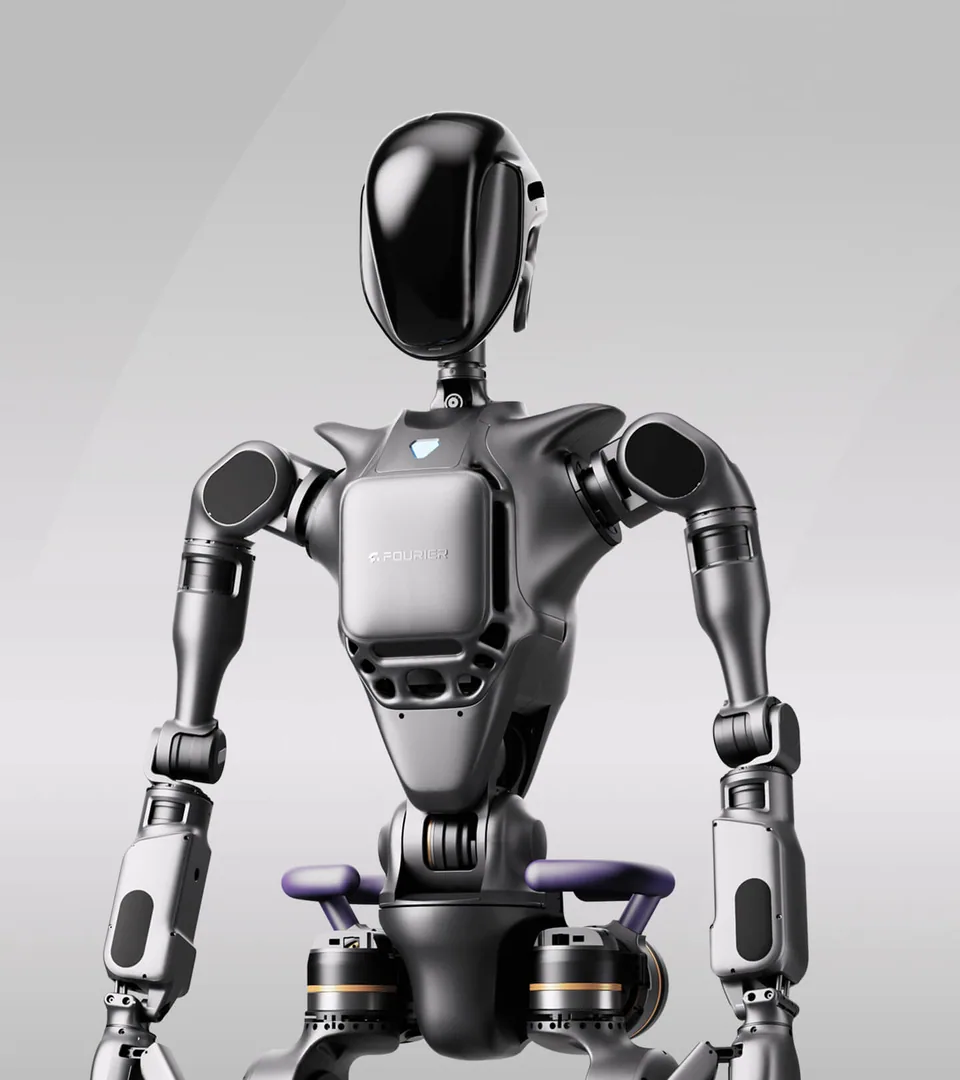
Fourier Intelligence entered humanoids with the Fourier GR-1 at WAIC in Shanghai in July 2023. In September 2024 the company presented the GR-2: larger (175 cm, 63 kg), with 53 degrees of freedom and hands with tactile sensors, a clear step toward precision manipulation. In August 2025 the Fourier GR-3 joined, with a soft shell and 31 pressure sensors, intended for care. The company's roots go back to rehabilitation robotics; in November 2023 it launched the MetaMotus Galileo platform. Everything about the manufacturer: Fourier Intelligence.
Fourier Intelligence launches the MetaMotus Galileo rehabilitation platform Fourier Intelligence
Xi Jinping meets Fourier Intelligence leadership during a visit to Shanghai Fourier Intelligence
Model unveiled
Fourier Intelligence unveils the GR-2 humanoid with 53 degrees of freedom Fourier Intelligence
Fourier Intelligence unveils GR-3, a care-oriented humanoid with a soft outer shell Fourier Intelligence
No. The manufacturer Fourier Intelligence (China) names no Polish shop or official distributor for the Fourier GR-2; enquiries go through the manufacturer's website (fftai.com). Confirm service in Poland before buying.
In September 2024.
12 degrees of freedom with tactile sensors in each hand.
No, the manufacturer does not publish one; the figures available online are unofficial estimates.
Author, source and licence of the photo are given in the caption. Shop links may become affiliate links in future, details: How we make money · How we check