on sale
Price from
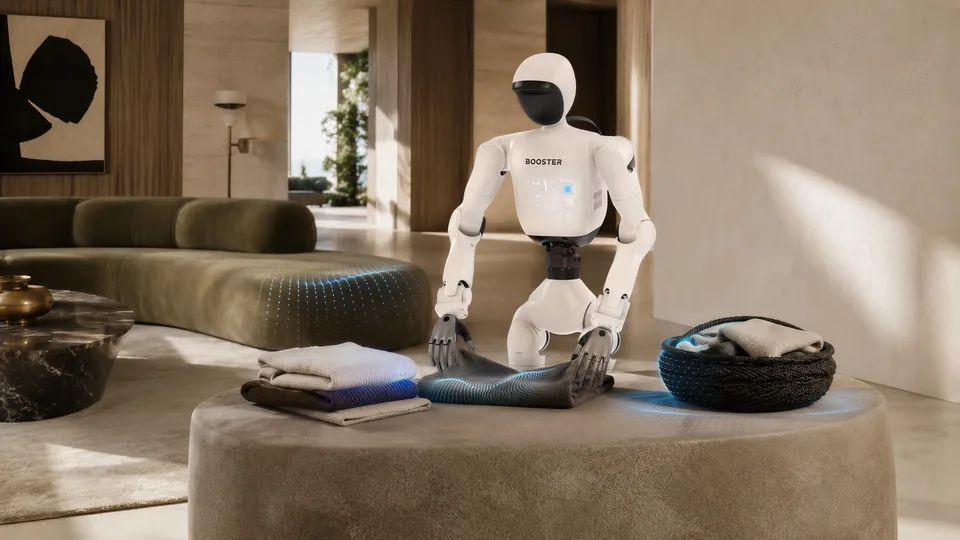
The winner of RoboCup 2025 in the AdultSize category is the strongest endorsement a research platform can have. The Booster T1, a humanoid robot from Beijing's Booster Robotics, stands 118 cm tall, weighs 30 kg and in its base configuration offers 23 degrees of freedom, expandable to 31 with grippers or 41 with more dexterous hands; the surcharge for these variants is not given.
Some sources cite a top speed of up to 5 m/s (about 18 km/h), which for a humanoid stands out against slower industrial platforms such as Apollo. The weak spot is runtime: only 2 hours, typical of small research platforms but shorter than many competitors in the segment. The onboard computer is an NVIDIA Jetson AGX Orin (up to 200 TOPS) backed by a 14-core i7-class processor. The price is about USD 33,949.
The T1 is not offered in Poland and remains a platform for research labs and RoboCup teams, not a commercial product.
Data checked: · Sources: 6
Data from manufacturer datasheets and product pages; median over the models of this category in the database.
Base configuration 23 DOF; expandable to 31 DOF with grippers or 41 DOF with dexterous hands (surcharge not specified).
Purchase price: about USD 33,949, or PLN 131,593.11 (≈ EUR 30,150) at the rate of 3.8762 from 1 October 2026 (source: botmarket24.com). That is the price of the base 23 DOF configuration. The variants with grippers (31 DOF) and with dexterous hands (41 DOF) cost more, but the surcharge has not been given.
Additional costs, estimated: transport and customs duty (a few percent of the value), 23% VAT, spare batteries given only 2 hours of runtime, a workstation with fall protection and measurement tools. Set aside about 10 to 15% of the price for small items.
Operation: energy hardly counts. The cost is people: a doctoral student or a robotics engineer working with the robot day to day, roughly a few months of learning until proficient.
Funding: universities can buy equipment from research grants.
No confirmed distributor in Poland
The Booster T1 is a humanoid that won gold where what counts is what can be measured: on the pitch. In 2025 it won the RoboCup championship in the AdultSize category, and a year earlier, in July 2024, its debut at the World Robot Conference brought the company two IEEE-RAS Humanoids championships. It is 118 cm tall, weighs 30 kg and in the base configuration offers 23 degrees of freedom (DOF), expandable to 31 with grippers or to 41 with dexterous hands.
The first use is competing in robotics tournaments. The T1 is built for competition such as RoboCup: it is meant to keep its balance on contact, get up quickly after a fall and allow testing of strategy algorithms. Its speed of up to 5 m/s (about 18 km/h), cited by some sources, stands out in this class.
The second use is research into bipedal gait and whole-body control. The onboard computer is an NVIDIA Jetson AGX Orin (up to 200 TOPS) backed by a 14-core Intel i7-class processor, so there is room to run your own neural networks on the robot, not just a factory controller.
The third: developing manipulation software. The versions with grippers and with dexterous hands let you move from the question "will the robot fall over" to "can it pick something up". The surcharge for these variants is not given, so it has to be clarified with the manufacturer.
What the T1 does not do: it does not work a shift, since runtime is about 2 hours, and it has no confirmed payload. It is not a commercial product for a factory or a store, but a research platform.
Best suited to: academic and student teams aiming at RoboCup and similar competitions, labs studying locomotion and whole-body control, and robotics companies that want a proven platform, well described in the community, for prototyping. The championship title is not an advertising gimmick: in this industry, competitions are one of the few objective tests.
Who it doesn't: business owners looking for a robot to take over an employee's tasks. Two hours of runtime and no declared payload are clear limitations. Nor is it for primary and secondary schools as a first platform: a sum of around PLN 131,800 (≈ EUR 30,200) (roughly USD 34,000) is too high for an entry point, and a smaller Booster K1 is the better start.
Note: the T1 is not officially available in Poland, so buying means importing and handling support yourself. It is worth budgeting for a second battery and service.
The T1 is not officially offered here, and Booster's presence in the country has not been confirmed.
Worldwide, the confirmed "deployments" are sporting and research in nature: the 2025 RoboCup championship in the AdultSize category and two IEEE-RAS Humanoids championships from 2024. We found no described commercial deployments in factories or warehouses, which matches the company's positioning as a supplier of research platforms.
If you are looking for examples of humanoids in industry, see the article “Humanoid Robots in Factories 2026”.
Booster K1: smaller (95 cm, 19.5 kg), with 22 DOF and a price of about PLN 48,500 (≈ EUR 11,110) (roughly USD 12,500), nearly three times lower. If the goal is learning rather than competing in the AdultSize category, it is the more sensible option from the same family.
Unitree G1 (132 cm, 35 kg, 23 DOF, about PLN 51,900 (≈ EUR 11,890), roughly USD 13,400) gives a similar number of degrees of freedom for less than half the price of the T1, has a 2 kg payload and a widely documented ecosystem. The T1 defends itself with its sporting results.
LimX Oli (165 cm, 31 DOF, about PLN 84,500 (≈ EUR 19,360), roughly USD 21,800, about 1.5 to 2 hours of runtime) is a taller research humanoid with more DOF. And Booster T2 is the flagship platform from July 2026 with an NVIDIA Jetson Thor computer (2070 TFLOPS), but with no stated price and no full motion specification, so a comparison with the T1 is for now incomplete.
Booster Robotics of Beijing was founded in 2023 and, according to the data, raised USD 150 million in funding. The T1 debuted in July 2024 at the World Robot Conference, where the company won two IEEE-RAS Humanoids championships. That is a very fast start for a company that was then about a year old.
In 2025 the T1 won RoboCup in the AdultSize category. That result built the brand and is today its main selling point.
In July 2026 Booster unveiled the flagship T2 Professional Edition with an NVIDIA Jetson Thor computer. The smaller K1 also belongs to the family. The T1 remains the mid-range model: larger than the K1, cheaper than the new flagship, but with the best-documented sporting record.
Model unveiled
Booster Robotics debuts the T1 humanoid at the World Robot Conference and wins two IEEE-RAS Humanoids championships Booster Robotics
Booster Robotics launches its flagship T2 Professional Edition, built on NVIDIA Jetson Thor (2070 TFLOPS) Booster Robotics
No. The manufacturer Booster Robotics (China) names no Polish shop or official distributor for the Booster T1; enquiries go through the manufacturer's website (boosterobotics.com). Price from an aggregator: approx. 131,600 PLN* (≈ EUR 30,160). Confirm service in Poland before buying.
The platform won the 2025 RoboCup championship in the AdultSize category, which confirms its physical capability under competitive conditions.
Only about 2 hours, a typical limit for small research platforms of this size.
About USD 33,949 in the base 23 DOF configuration.
Author, source and licence of the photo are given in the caption. Shop links may become affiliate links in future, details: How we make money · How we check