In this article
Key facts
- Models coveredFigure 03, Tesla Optimus Gen 3, Agility Digit
- Covered models available in Poland0 of 3
- Number of sources3
- Reading time6 min
- As of2 October 2026
Degree of freedom: a definition without jargon
A degree of freedom (DOF) is the number of independent ways in which a given element can move. In classical mechanics a single rigid body in space has at most six degrees of freedom: three translational (forward-back, left-right, up-down) and three rotational (roll, pitch, yaw). In robotics the counting is simpler in practice: every powered revolute joint that the robot can move independently of the others is usually one DOF.
A classic humanoid arm is described as a kinematic chain with 7 DOF: three rotation axes in the shoulder, one in the elbow and three in the wrist. That is more than the theoretical minimum of 6 DOF needed to place and orient the hand freely in space. The surplus seventh degree of freedom is called redundant, and it lets the arm, for example, avoid an obstacle with the elbow without changing the position of the hand itself.
Why one robot has 23 DOF and another 43
A whole robot's DOF count is the sum of the DOF of all its powered joints: legs, torso, arms, neck and hands. A good example of the difference within a single product line is the Unitree G1. According to the manufacturer the standard version has 23 degrees of freedom (6 per leg, 5 per arm, 1 in the waist), while the EDU version has 23 to 43 DOF. The difference comes from optional additional 2 DOF in the waist, optional two wrist DOF and optional dexterous hands (7 DOF per hand) (Unitree).
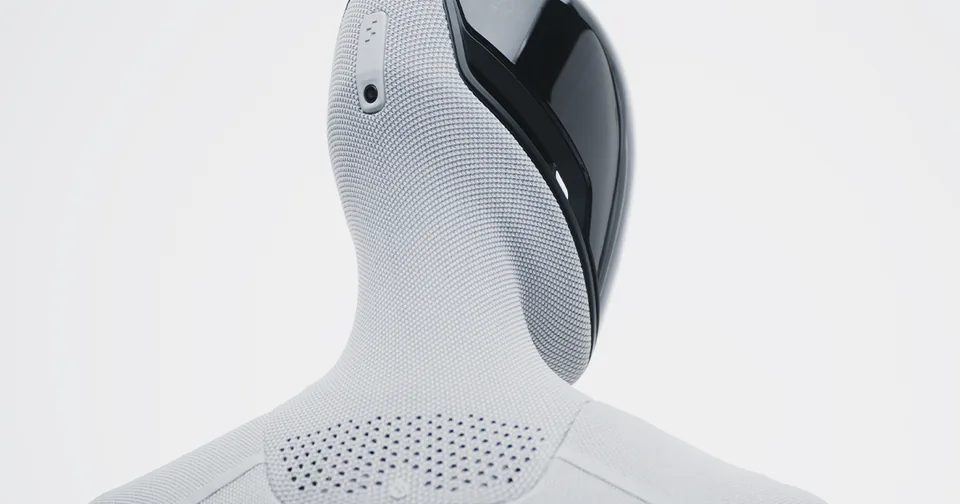
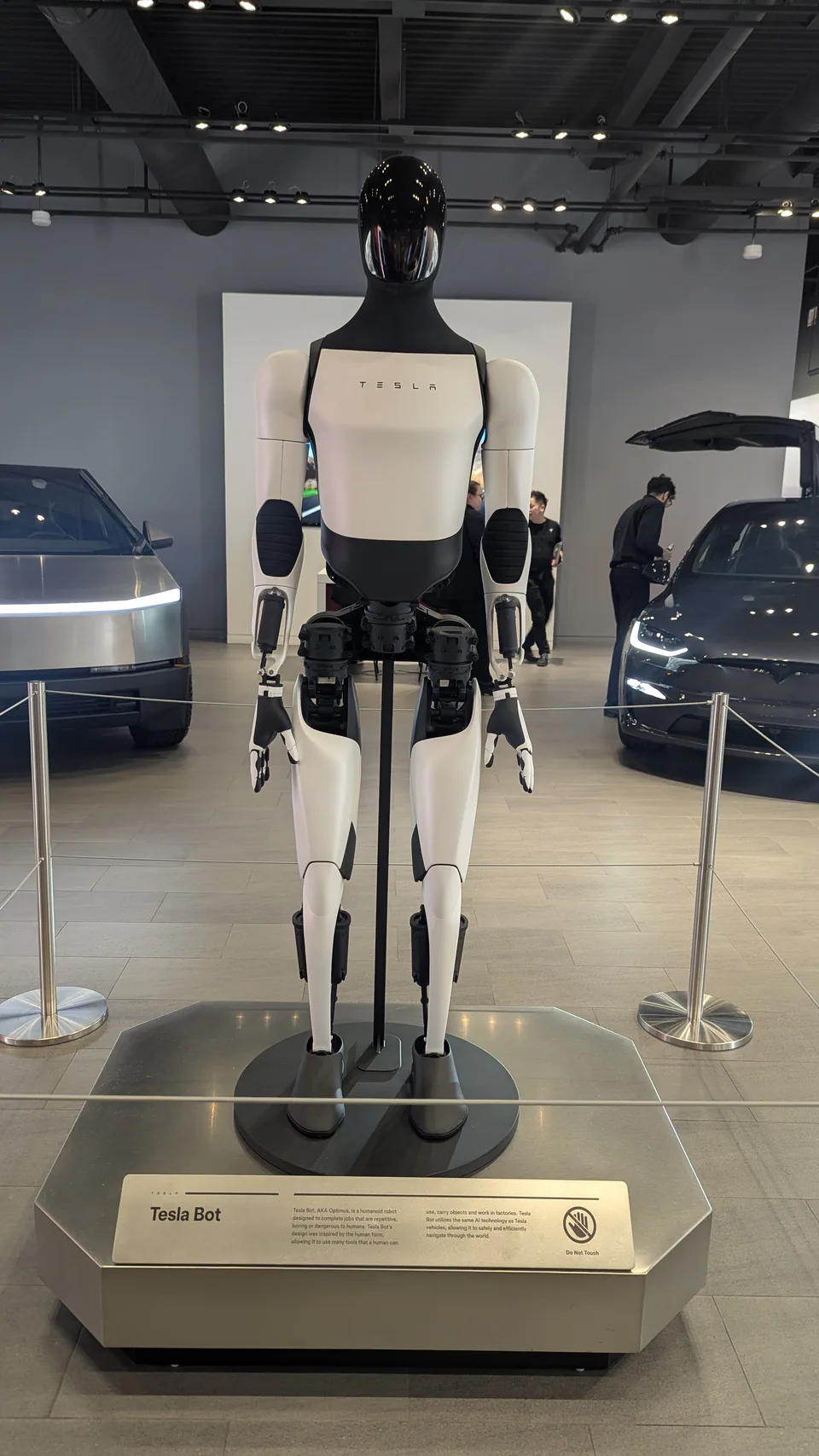
Other models go even further toward the upper body. Figure 03 has, in Figure AI's description, a redesigned hand system with a palm camera and tactile fingertip sensors, and the Helix model that controls it coordinates a 35-DOF action space of the upper body, from individual fingers to head and torso (Figure AI — Helix); we do not attribute that number directly to the whole robot or to the hands alone, because the manufacturer does not give them in a verified specification. For the competing Tesla Optimus Gen 3 we give no DOF count, because Tesla has not published a Gen 3 specification; details in “Tesla Optimus: What We Actually Know (as of September 2026)”.
The takeaway: the DOF count is not a fixed trait of "humanoid robots" as a category, but a specific design decision for each model, often different even between variants of the same product (as with the G1 standard versus EDU).
DOF in hands and fingers: why it is a separate number
Datasheets usually give whole-body DOF and hand DOF separately, because they are two different engineering problems. The DOF of the legs and torso mainly govern walking, balance and arm reach. The DOF of the hands govern manipulation, and manipulation is what separates "a robot that can walk" from "a robot that can do a job".
A simple industrial gripper may have 1 DOF (open/close). A hand described as dexterous, with independently controlled fingers and an opposable thumb, needs according to designers from a few (for example 7 DOF in the Dex3-1) to a dozen or two dozen DOF to reproduce both precision grips (for example holding a pen) and power grips (for example holding a tool) with the same mechanism. More DOF in the hand usually also means more room for tactile sensors at every finger joint, which raises the cost further. This ties directly to the choice of actuators, described in “Actuators in Humanoid Robots”.
More DOF is not always better
It is worth resisting the temptation to treat DOF as a simple ranking of "the more, the better the robot". Every additional degree of freedom is:
- an additional motor, gearbox and encoder, and therefore extra mass, cost and a potential point of failure,
- an additional dimension in the control space that the software has to manage in real time (see: “How Does a Humanoid Robot Work”),
- a greater need for training data for the models that control movement, because the space of possible configurations grows exponentially with the number of DOF.
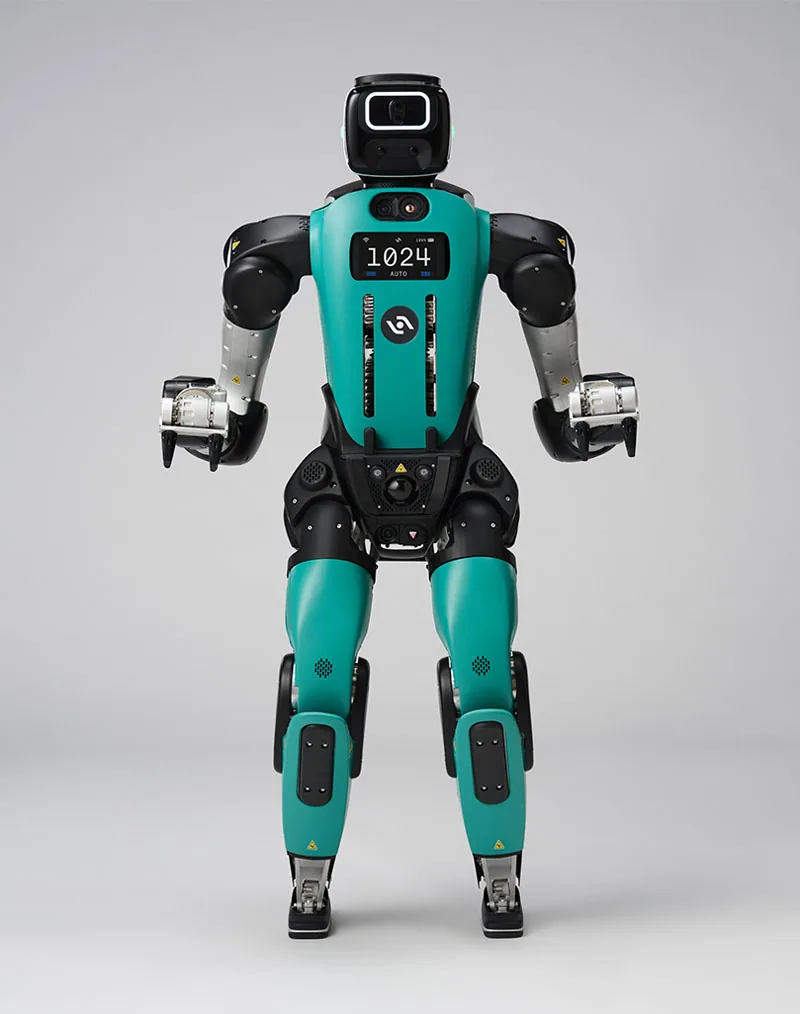
That is why a robot optimized for a specific, repetitive warehouse task, such as Agility Digit, may have a less elaborate hand than a robot designed for general household manipulation, and it is by no means a worse product in its category for that.
DOF and the kind of work being done
The DOF count only makes sense in relation to the task the robot is designed for. A warehouse robot that spends the whole day moving cartons from a shelf to a pallet needs, above all, a stable gait and sufficient grip strength. Extra DOF in the wrist or individual fingers give it little here, while raising the purchase price and the cost of maintaining a fleet. A robot meant to work in food service, care or the assembly of small electronic parts, on the other hand, needs a much more elaborate hand, because it is grip precision, not mobility alone, that decides how useful it is for the task. So when choosing a robot for a specific application it makes more sense to ask "how many DOF does this task need" than to look for the model with the maximum number of DOF overall.
How the DOF count affects training the AI that controls movement
There is one more, less obvious reason why the DOF count does not grow without limit along with manufacturers' ambitions: every additional degree of freedom increases the dimensionality of the space in which the model controlling the robot has to operate. Vision-language-action models, such as Figure Helix, described in “VLA Models: How AI Controls Humanoid Robots in 2026”, must generate a coherent, smooth control signal for all 35 DOF of the upper body at once, as in Figure AI's Helix, in real time and without collisions between individual movements. The more independent axes of motion, the more training data is needed for the model to learn safe, natural movement patterns instead of unpredictable, abrupt corrections. Collecting such data (most often by teleoperation) is time-consuming and expensive no matter how good the model itself is.
How to read DOF in practice
When comparing models in our humanoid robots catalog, check three things. (1) Whether the stated DOF count covers the whole body or only the upper half, since a model focused on stationary manipulation (like some industrial robots) may not count legs at all. (2) Whether hand DOF is given separately; if not, it may mean a simple gripper rather than a dexterous hand. (3) Whether the number comes from the manufacturer's official datasheet or from third-party estimates, as with the data on Tesla Optimus Gen 3, which we mark as unconfirmed until the manufacturer publishes an official specification. We expand on the method of reading such data in “How to Read a Robot Datasheet”.
Frequently asked questions
What is a degree of freedom (DOF) in a robot?
It is the number of independent parameters needed to fully describe the motion of a given element. In robotics, in practice, it is most often the number of rotation axes that a given drive can move on its own. One powered revolute joint is usually one degree of freedom.
Does more DOF always mean a better robot?
Not directly. More DOF widens the range of possible movements and makes walking or grasping more natural, but it also raises cost, control complexity and the number of parts that can fail. What matters is fit to the task, not the number itself.
How many DOF does a typical humanoid robot hand have?
It depends on the model: from a few DOF in simple grippers to a dozen or two in hands described as dexterous. For example, the Dex3-1 dexterous hand offered with the Unitree G1 EDU has 7 DOF (plus up to 2 optional wrist DOF — Unitree). Figure AI says its Helix model controls a 35-DOF action space of the upper body, from individual fingers to head and torso (Figure AI); Tesla has not officially published figures for Optimus Gen 3.
Why does the human hand have more DOF than most robots?
The human hand is usually counted at about 20+ degrees of freedom, plus additional ones in the wrist, along with muscles and tendons that give subtle force control in every joint at once. Reproducing that mechanically in a similar size and at a reasonable price remains one of the hardest tasks in humanoid robot engineering.
Sources
Links to the material this text is based on. Before you base a decision on a figure from the article, check it at the source.
About the authors
A chief engineer by profession (technical head of a ship's machinery plant, licensed). Sets the site's editorial rules and is responsible for them; he does not read every page before publication.
Texts are prepared by the editorial team using AI tools. We compare data with primary sources on a sample basis, not page by page. Our rules are described here: How we check · About us