on sale
Manufacturer
Booster Robotics: a Beijing startup founded in 2023, with USD 150 million in funding and the 2025 RoboCup champion with its T1 platform.
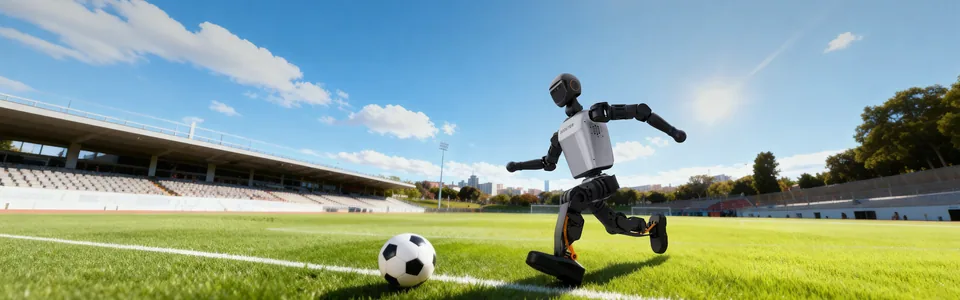
Booster Robotics of Beijing has existed only since 2023, yet it has already raised USD 150 million in funding and won the 2025 RoboCup championship in the AdultSize category with its T1 platform.
The portfolio has three models, the T1, T2 and K1, positioned as development and research platforms rather than finished commercial products for industry, which distinguishes Booster from Unitree, where the line between "research" and "commercial" is blurrier.
The sporting success at RoboCup works as technical marketing: it demonstrates walking stability and reaction speed under competitive conditions, but says nothing about readiness to work in a warehouse or factory. The company's valuation, headcount and detailed technical data for the models are not given. Presence in Poland is unconfirmed.
For research centers and universities, it is one of the more interesting, cheaper Chinese platforms for experiments with bipedal locomotion.
Booster Robotics of Beijing has existed only since 2023, but in that short time it has raised USD 150 million and won the 2025 RoboCup title in the AdultSize category with its T1 platform. The first serious appearance on the scene came in July 2024: the T1 debuted at the World Robot Conference, and the company won two IEEE-RAS Humanoids championships. Robot football championships are not just sport: on the pitch you can see walking stability, reaction speed and resistance to falls, qualities that no trade-show demo can test. In July 2026 the company launched its flagship T2 Professional Edition, based on an NVIDIA Jetson Thor computer rated at 2,070 TFLOPS. The portfolio is narrow: three models, all positioned as development, research and educational platforms, not as a finished product for a factory. Our sources lack the company's valuation, headcount and customer names, so we do not provide such information. It is worth bearing in mind that sporting success shows technical potential but says nothing about readiness to work in a warehouse. From a university's perspective, and that seems to be the right target group, something else counts: affordable, low-cost hardware for experiments with bipedal locomotion.
The three models run from the cheapest to the most powerful. Booster K1 is a compact educational humanoid: 95 cm, 19.5 kg, 22 degrees of freedom, about USD 12,500. Booster T1 is the championship platform from RoboCup 2025: 118 cm, 30 kg, 23 degrees of freedom, speed up to 5 m/s, a runtime of only 2 hours, about USD 33,949; it was unveiled in July 2024. Booster T2, from July 2026, is the flagship development platform with a Jetson Thor computer; the manufacturer gives neither a price nor motion specifications. The compute hardware is described in the profile NVIDIA Jetson, and the principles for judging such datasheets in “How to Read a Robot Datasheet”. We explain degrees of freedom in “Degrees of Freedom (DOF) in Humanoid Robots”. By theme: humanoid robots, educational robots and universities. The T1's runtime, a mere two hours, is the typical price of a light, agile design: hardware for research and competition does not have to work three shifts. For a university, what matters more is that it lets teams test gait, balance and reinforcement learning without the cost of an industrial humanoid. All three models are electrically powered and on sale, although for the T2 the manufacturer has not yet disclosed a price.
Booster Robotics operates in the niche of cheap research humanoids. Its rivals are Unitree Robotics, where the line between "research" and "commercial" is blurrier, EngineAI Robotics, Fourier Intelligence and UBTECH Robotics. Funding of USD 150 million is small next to Figure AI's (USD 1.9 billion), but for university hardware the scale does not have to be as large. We have no confirmed valuation or customer list. A good reference point is prices: the T1 at about USD 33,949 and the K1 at about USD 12,500 are the range in which research teams work. The success at RoboCup 2025 works as technical marketing, but it is not proof of usefulness in industry. For a comparison of the Unitree series, see “Unitree H1, G1, R1 and H2”. The strongest argument remains the sporting result: RoboCup is one of the few places where robots from different manufacturers compete under the same rules.
Booster's presence in Poland is not confirmed: none of the three models has a Polish distributor, and all are unavailable in the country. We also do not know of any Polish universities that use these robots. For centers that want to start with a research humanoid, a sensible path is to review what is available locally in “Educational Robots for Schools and Universities” and “How to Start Learning Robotics in Poland”. Anyone who wants to buy the platform despite the lack of a distributor should ask the manufacturer about export terms, warranty and technical support, and also factor in import costs and customs duties. For a university purchase, it is worth checking whether the university's procurement rules allow delivery from outside the EU.
Booster Robotics is an interesting, cheaper Chinese platform for experiments with bipedal locomotion, with a documented success at RoboCup 2025. The T1 lasts only 2 hours, and the T2 has no price yet. It is the wrong direction for a factory; for a laboratory, it is worth an inquiry, though without a Polish distributor it will mean an import. Recommendation: yes for universities with a research budget, no for manufacturing companies. An important caveat: the T2 is very new and does not yet have complete data.
Booster Robotics