on sale
Price in Poland
Price from an aggregator: approx. 48,500 PLN* (≈ EUR 11,110) (converted from 12,500 USD, NBP rate 3.8762, as of 1 October 2026). In Polish shops this model costs less.
We mark shop links as sponsored (rel=sponsored); today we receive no commission. How we make money
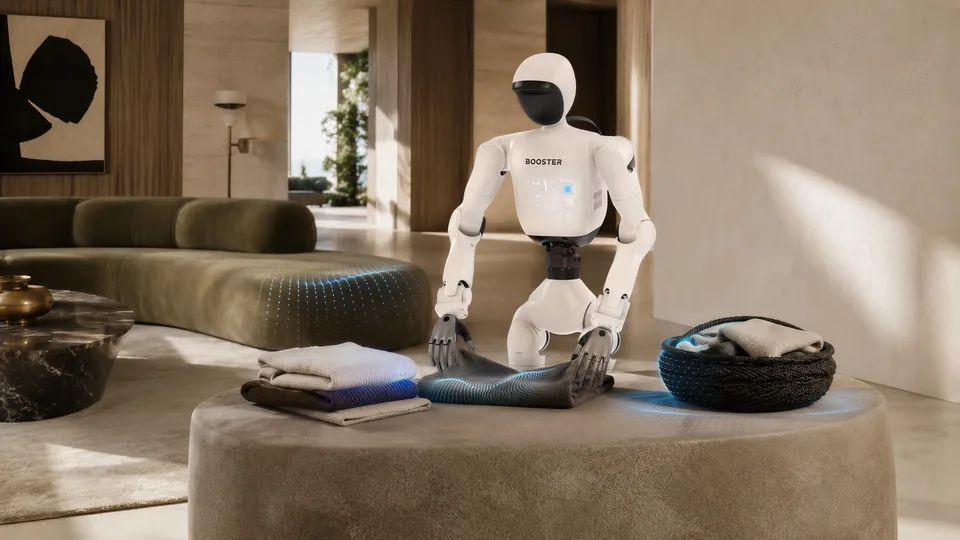
Available in PolandSmaller, lighter and cheaper than the T1: that is the simplest way to describe the Booster K1, a humanoid robot from Beijing's Booster Robotics aimed at education and robotics competitions. It costs about USD 12,500, clearly less than the pricier T1 from the same brand. Battery life: the Geek edition has 2 Ah and 30 minutes at 0.4 m/s, while the Education/Professional edition has 5 Ah and 80 minutes.
Payload remains officially unconfirmed. Booster Robotics, founded in 2023, has raised USD 150 million and built its reputation on the T1's successes at RoboCup. The K1 is not offered in Poland. The robot is aimed at universities, technical schools and teams preparing for robotics competitions that need an affordable development platform, not at commercial or industrial uses.
Data checked: · Sources: 4
Data from manufacturer datasheets and product pages; median over the models of this category in the database.
Geek edition 48 TOPS, EDU edition 117 TOPS, Pro edition 200 TOPS. Battery/runtime: Geek 2 Ah/30 min at 0.4 m/s; Education/Professional 5 Ah/80 min (per booster.tech/booster-k1). The price of USD 12,500 comes from a third-party site and is not confirmed by the manufacturer; at RobotShop UK the Education edition costs GBP 12,922 and the Professional edition GBP 16,614 (as of 2 October 2026).
Purchase price: about USD 12,500, or PLN 48,452 (≈ EUR 11,100) at the rate of 3.8762 from 1 October 2026 (source: a third-party aggregator). The price refers to one of the editions; the Geek, Education and Professional editions differ in computing power (48, 117 and 200 TOPS) and in the battery, so ask exactly what is in the box.
Additional costs, estimated: import from China and customs duty (a few percent of the value), 23% VAT, a spare battery (nearly a necessity with 30 to 80 minutes of runtime; price unknown), classroom accessories and a workstation with a soft surface. It is worth setting aside about 10 to 15% of the price for small items.
Operation: energy is negligible. The main cost is the time of the teacher or club supervisor, who has to master the software; roughly several dozen hours of preparation before the first classes.
Funding: schools and universities can look for funds in education programs and research projects, and companies doing R&D have access to tax reliefs.
| Date | Price (PLN) | Variant | Source |
|---|---|---|---|
| 2026-10-09 | 29,900 PLN (≈ EUR 6,850) | K1 Geek, cena netto | shop.deltarobots.com |
The Booster K1 is 95 cm tall and weighs 19.5 kg: a humanoid you can carry to a passenger car and set up on a workshop table. It has 22 degrees of freedom (DOF): 6 in each leg, 4 in each arm and 2 in the head. The manufacturer aims it at education and robotics competitions, and those are the uses worth breaking down.
A technical school or a high school with a mechatronics class. It lets you program a robot's gait instead of only covering inverse kinematics on slides. The K1 is small enough that a fall is not a disaster, and complex enough to show real problems: balance, step planning, control latency. The onboard computer is an NVIDIA Jetson Orin NX, in editions from 48 to 200 TOPS, so vision models can run on it too.
A university and a student research club. A cheaper platform lets you buy several units and compare control algorithms on the same hardware. A team preparing for robotics competitions gets a machine from the same brand that built its reputation on the T1's RoboCup successes.
Workshops and demonstrations. Its small size makes the K1 suitable for open days, science fairs and shows for children.
What it does not do: it does not carry loads (payload is not confirmed), does not work shifts and is not designed for commercial or industrial use. Runtime depends on the edition: 30 minutes at 0.4 m/s in the Geek edition, about 80 minutes in Education and Professional. In practice that means class sessions with charging breaks, not all-day work.
Makes sense for: technical schools, universities, student clubs and competition teams that want to buy a real humanoid for about PLN 48,500 (≈ EUR 11,110) (roughly USD 12,500) instead of several hundred thousand. Makers who want to learn bipedal control from the ground up. Organizers of STEM workshops.
Who it doesn't: companies looking for a robot to work, for example in a warehouse or on a line. The lack of payload and the short runtime rule out production use. It is not a toy for children either: it is a developer platform that demands programming and patience.
A practical note: the K1 is not officially offered in Poland. Buying means importing, so you have to account for after-sales support, delivery time and customs formalities. If a school needs a warranty in Poland, it is better for now to ask local integrators about alternatives.
The K1 is not officially offered here, and Booster's presence in the country has not been confirmed. Nor have we found any named schools or universities described as using the K1.
What is confirmed across the family: the T1 won RoboCup in 2025 in the AdultSize category, and the company took two IEEE-RAS Humanoids championships in 2024. That shows Booster platforms are used in scientific competition, but it says nothing yet about the K1 in schools. If you are interested in educational deployments in Poland, see “Educational Robots for Schools and Universities”.
Unitree R1 is the closest rival on price: 123 cm, 29 kg, 26 DOF, about PLN 19,000 (≈ EUR 4,350) (roughly USD 4,900) for the base version. It is clearly cheaper than the K1 and aimed at developers and hobbyists, and it is also taller (123 cm versus 95 cm). If budget is the main criterion, start with it.
Unitree G1 (132 cm, 35 kg, 23 DOF, about PLN 51,900 (≈ EUR 11,890), roughly USD 13,400) costs about the same as the K1 but is larger and widely used at universities, so it is easier to find materials and code. The K1 wins on compactness.
Noetix N2 (118 cm, 30 kg, 18 DOF, about 5 kg payload, about PLN 21,300 (≈ EUR 4,880), roughly USD 5,500) is a cheaper offer with a payload stated in the data. It has fewer degrees of freedom. And Booster T1 is the K1's pricier sibling from the same company: larger and with a RoboCup championship title, for teams that want to compete in a higher category.

Booster Robotics of Beijing was founded in 2023 and quickly raised USD 150 million in funding. The breakthrough came in July 2024: the company debuted with the T1 humanoid at the World Robot Conference and won two IEEE-RAS Humanoids championships. In 2025 the T1 won RoboCup in the AdultSize category, which made Booster a name known in the research community.
The K1 is a younger, smaller and cheaper addition to this lineup. Its launch date is not given, so we do not guess it. What we know is that, according to the manufacturer and documentation, the K1 has 22 DOF and its editions differ in computing power and battery.
In July 2026 the company widened its range with the flagship T2 Professional Edition, with an NVIDIA Jetson Thor computer (2070 TFLOPS). Booster's portfolio today covers three lines: T1, T2 and K1. The K1 serves as the entry point to the ecosystem.
Booster Robotics debuts the T1 humanoid at the World Robot Conference and wins two IEEE-RAS Humanoids championships Booster Robotics
Booster Robotics launches its flagship T2 Professional Edition, built on NVIDIA Jetson Thor (2070 TFLOPS) Booster Robotics
According to the latest available data (as of September 2026) the price is approx. 48,452 PLN (≈ EUR 11,100).
Yes, the model is available through the retailers in Poland listed on this page.
The K1 is smaller (95 cm versus 118 cm), lighter (19.5 kg versus 30 kg) and cheaper (about USD 12,500 versus about USD 33,949), and it is aimed mainly at education.
An NVIDIA Jetson Orin NX, in variants from 48 TOPS (Geek) through 117 TOPS (EDU) to 200 TOPS (Pro).
Payload is not confirmed. Runtime depends on the edition: 30 minutes at 0.4 m/s for Geek and about 80 minutes for Education/Professional.
Author, source and licence of the photo are given in the caption. Shop links may become affiliate links in future, details: How we make money · How we check