Compare
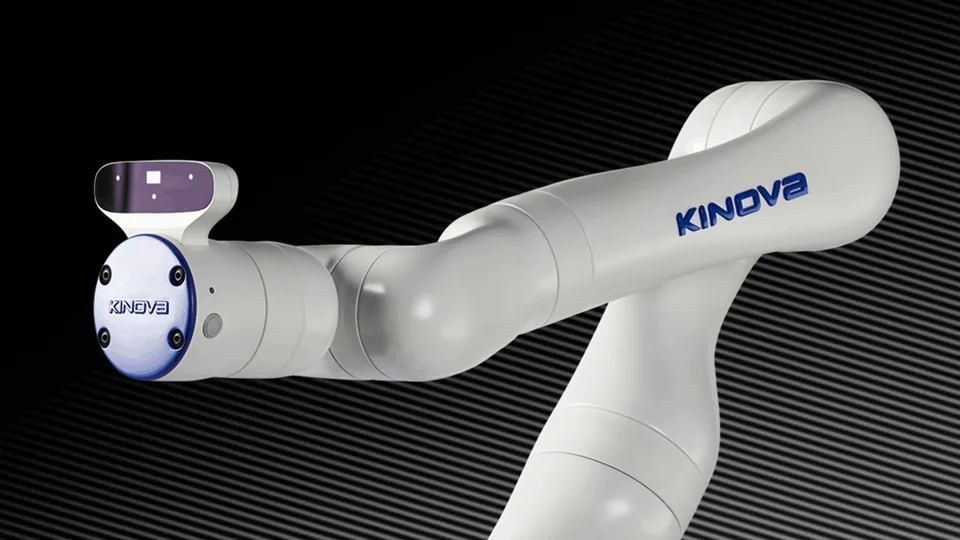
Kinova Gen3 (7DoF) vs Franka FR3: Two Seven-Axis Research Arms
Key facts
- Price in PolandKinova Gen3 (7DoF): approx. 135,700 PLN* (≈ EUR 31,090 at NBP rate 4.3641 of 21 October 2026) · Franka Research 3 (FR3): approx. 116,300 PLN* (≈ EUR 26,650)
- PayloadKinova Gen3 (7DoF): 4 kg · Franka Research 3 (FR3): 3 kg
- WeightKinova Gen3 (7DoF): — · Franka Research 3 (FR3): 18 kg
- StatusKinova Gen3 (7DoF): on sale · Franka Research 3 (FR3): on sale
- In PolandKinova Gen3 (7DoF): no · Franka Research 3 (FR3): no
A comparison of the Kinova Gen3 and the Franka Research 3. Both arms have seven axes, built-in torque sensing and a software environment tailored to researchers, so they sit side by side in catalogues. The Canadian Kinova Robotics has long built its image on light research and assistive arms, while the German Franka Robotics, founded in 2016, popularised the Panda, of which the FR3 is the successor. Laboratory teams ask above all two things: which has more payload, and which suits their way of working. Let us look at the numbers and at what is missing from them.

| Feature | Kinova Gen3 (7DoF) | Franka Research 3 (FR3) |
|---|---|---|
| Manufacturer | Kinova Robotics | Franka Robotics GmbH |
| Price (PLN) | approx. 135,700 PLN* (≈ EUR 31,090)(converted from 35,000 USD, NBP rate 3.8762, as of 1 October 2026) | approx. 116,300 PLN* (≈ EUR 26,650)(converted from 30,000 USD, NBP rate 3.8762, as of 1 October 2026) |
| Height (cm) | no data | 110.0 |
| Weight (kg) | no data | 18.0 |
| Degrees of freedom | 7 | 7 |
| Payload (kg) | 4.0 | 3.0 |
| Status | on sale | on sale |
Design and specifications
Both arms have seven “Degrees of Freedom (DOF) in Humanoid Robots”, so the same mechanical flexibility in avoiding obstacles and reaching awkward spots. The Gen3 has a 4 kg payload and a 902 mm reach, the FR3 a 3 kg payload and an 855 mm reach. The Gen3 is thus a kilogram stronger and about 47 mm longer in reach. Kinova stresses closed-loop control at 1 kHz, joints with unlimited rotation and a station set-up in under 30 minutes. It also has integrated torque sensors and an optional 2D/3D vision module, which is not listed as standard for the FR3. The FR3 has a torque sensor in each of its seven joints, force regulation at 1 kHz, ±0.1 mm repeatability, a mass of 18 kg and a height of 110 cm; for the Gen3 we have no confirmed repeatability or mass.
The differences in philosophy matter more than the numbers. The FR3 is meant for researchers: a controller based on an Intel processor with Linux, the open libfranka library and ROS integration make it easy to write your own controllers, including learning-based approaches that “VLA Models: How AI Controls Humanoid Robots in 2026” discusses. The Gen3 is closer to assistive and medical uses, and Kinova also offers a lighter variant, the Kinova Gen3 Lite. The strain-wave gears used in such arms are made by firms like Harmonic Drive, and force sensors are also a market of their own, for example ATI Industrial Automation. How to pull only comparable items from datasheets is shown in “How to Read a Robot Datasheet”.
Price and availability in Poland
The prices of the two arms are similar, but neither comes from an official price list. For the Gen3, sources give a standard B2B range of 30,000–35,000 USD and special configurations up to 50,000 USD; for comparison we take the top of the standard range, 35,000 USD, which converts to roughly 130 thousand zloty. For the FR3 the spread is about 25,000–35,000 USD, and one European reseller gives 25,250 EUR with a delivery time of 17 days. These are estimates, not manufacturer offers, so treat the figure as a guide before you enquire.
Neither company has confirmed a Polish representative. Kinova sells most often through international distributors of research equipment, Franka through European resellers such as Vention. For a Polish university this usually means a scientific-equipment tender with enquiries to several suppliers, and time and formalities may weigh more than the price difference. It is worth writing the requirement for documentation, training and delivery time into the enquiry at once; general tips for purchases of this kind are collected in “How to Buy a Cobot Step by Step”.
Which model for which job
The Gen3 is more often pointed to for medical and assistive robotics and for laboratory automation. A team that wants to build a station with built-in vision will save on integrating an extra camera, and the lightweight design suits projects where the arm rides on a cart or platform. For research on the edge of healthcare, for example assistive robots for people with limited mobility, it is also considered in the context of the hospital — check in the documentation whether a particular configuration has the necessary approvals and certificates.
The FR3 dominates where the study of manipulation and force interaction counts: teams at the university and in the laboratory readily reach for it to teach robots by demonstration and for experiments with impedance control. If you plan a mobile platform with two arms, see the Franka Mobile FR3 Duo; if you want an alternative with a stronger emphasis on force control, compare with the Flexiv Rizon 4.
Conclusion
Both arms have exactly seven axes, which makes them direct competitors in research and medical robotics. The Gen3 has a somewhat higher payload, 4 kg versus 3 kg for the FR3, and an optional 2D/3D vision module, which is not listed as standard for the FR3. Prices are close: the Gen3 costs up to USD 45,000 according to market listings (B2B variants from as little as USD 25,000), while the FR3 falls in the USD 25,000-35,000 range. Both figures are market estimates, however, not official manufacturer price lists. The Gen3 is more often cited for medical and assistive applications, while the FR3 dominates manipulation and force-interaction research thanks to its Franka Emika heritage. For labs that need built-in vision, the Gen3 saves integrating extra hardware; for force-control research, the FR3 has a longer academic track record.
A laboratory that needs a built-in vision module and a kilogram more payload, with rather assistive or medical applications — the Kinova Gen3. A team doing research on force control and robot learning that wants open software and a large base of publications — the Franka FR3. The price difference is too small and too uncertain to be decisive: both valuations come from market estimates.
Before you sign an order, do three things: ask for an official quotation with the configuration, check that the controller and software work with your research environment, and ask about warranty and service in Poland.
Frequently asked questions
How many axes do the two arms have?
Seven each, an identical mechanical configuration in both cases.
Which model has an optional vision module?
The Gen3, with an optional 2D/3D vision module that the FR3 does not list as standard equipment.
Are the prices of both robots officially confirmed?
No. Both figures come from market estimates and reseller listings, not from official manufacturer price lists.
How many axes do both arms have?
Seven each — an identical mechanical configuration. They differ in payload: Gen3 4 kg, FR3 3 kg.
Which model has the optional vision module?
The Gen3, with an optional 2D/3D vision module. The catalogue does not list such standard equipment for the FR3.
Are the prices officially confirmed?
No. For the Gen3 it is a standard range of 30,000–35,000 USD, for the FR3 reseller estimates of 25,000–35,000 USD, not manufacturer price lists.
Does either have a Polish distributor?
Neither has a confirmed representative in Poland. Kinova most often sells through international distributors of research equipment.
Sources
- Kinova Gen3 (7DoF) · kinovarobotics.com
- Kinova Gen3 (7DoF) · roscomponents.com
- Franka Research 3 (FR3) · franka.de
- Franka Research 3 (FR3) · franka.de
- Franka Research 3 (FR3) · unchainedrobotics.de