In this article
Key facts
- Models coveredmyCobot 280, UR3e, KUKA LBR iisy 6 R1300
- Prices of the models covered3,990 PLN (≈ EUR 915 at NBP rate 4.3641 of 21 October 2026) – 135,667 PLN (≈ EUR 31,090)
- Covered models available in Poland4 of 4
- Number of sources9
- Reading time9 min
Two worlds of automation
A company considering automating a production workstation for the first time sooner or later hits the question: buy a cobot (collaborative robot) or a classic industrial robot? The answer is not a matter of fashion or budget alone; it is a set of technical and organizational criteria to be worked through in turn. Below we describe six of them (safety, production rate, flexibility, floor space, costs and typical applications) and close with a simple decision matrix.
“Cobot” and “industrial robot” are not two separate categories of hardware in a mechanical sense: many manufacturers (FANUC, ABB, KUKA, Yaskawa) sell both types of arm in one range. The difference lies in the safety design, the control system and the way the robot is integrated.
Criterion 1: Safety, fencing or risk assessment
A classic industrial robot usually works in a fenced zone (light curtains, barriers, interlocked gates) because it moves fast and with great force, and contact with a person during motion can be dangerous. In the EU the legal basis is currently the Machinery Directive 2006/42/EC, to be replaced from 20 January 2027 by Regulation (EU) 2023/1230, and the technical standard is ISO 10218 (part 1 covers the robot itself, part 2 the integrated robot system, 2025 editions: -1 and -2) “Robot Safety Standards”.
Cobots are designed to work close to people: they have torque sensors, force and speed limiting, and a stop function on detecting contact. The technical basis of this category was the ISO/TS 15066 specification from 2016, which supplements ISO 10218 and describes, among other things, four modes of human-robot collaboration (safety-rated monitored stop, hand guiding, speed and separation monitoring, and power and force limiting). According to industry commentary, most of its requirements were incorporated into ISO 10218-2:2025 — the details are in our article on the standards.
This does not, however, automatically mean “no fence.” Whether a given workstation can run without a cage is decided by a formal risk assessment of the whole application, which considers not only the robot arm but also the gripper, the object being carried, the speed and the geometry of the workstation. A sharp pneumatic gripper or a heavy part on the end of a cobot may require additional fencing despite the arm's collaborative design. In short, a cobot gives you the option of dropping the fence, not a guarantee. For fuller coverage of the standards and legal requirements, see “Robot Safety Standards”.
Criterion 2: Production rate and cycle time
This is often the deciding criterion. Industrial robots reach higher working speeds and shorter cycle times; they are designed for large batches and a high takt rate (hundreds or thousands of cycles a day). Cobots work more slowly because of the built-in speed and force limits required for safe collaboration with people, although newer models are blurring that line. For example, the Universal Robots UR15 is presented by its maker as the fastest UR cobot, with a maximum TCP speed of up to 5 m/s and a 15 kg payload (Universal Robots announcement of 12 May 2025), and the ABB SWIFTI CRB 1300 claims a speed of up to 6.2 m/s and is positioned by ABB as bridging industrial and collaborative robots (ABB).
A practical rule: for low and medium volumes with frequent product changes, a cobot is usually enough; for large, stable runs that demand maximum takt rate, a classic industrial robot is the safer investment choice.
Criterion 3: Flexibility and changeover
Cobots are designed for frequent changeovers: a lighter arm, simpler programming (often by hand guiding, known as direct teach), a mobile base, and quick task changes without a programming engineer. That makes them attractive to small and medium-sized companies that make many different parts in short runs.
Industrial robots are usually programmed in the manufacturer's dedicated language (for example RAPID at ABB, KRL at KUKA), which calls for a trained programmer or integrator at every major process change. The upside is repeatability and stability when the process does not change.
Criterion 4: Floor space
A cobot takes up less room: it needs no safety cage (as long as the risk assessment allows), it can stand right at the operator's workstation, and some models come in a version on a mobile platform. This matters in halls with limited floor space, typical of many mid-sized Polish plants.
An industrial robot needs a fenced zone, often with extra service space and a safety buffer around the whole cell; the real footprint can be several times larger than the arm's base alone.
Criterion 5: Costs, purchase, integration and TCO
Here three levels of cost must be separated, because the arm's list price alone rarely reflects the real spend.
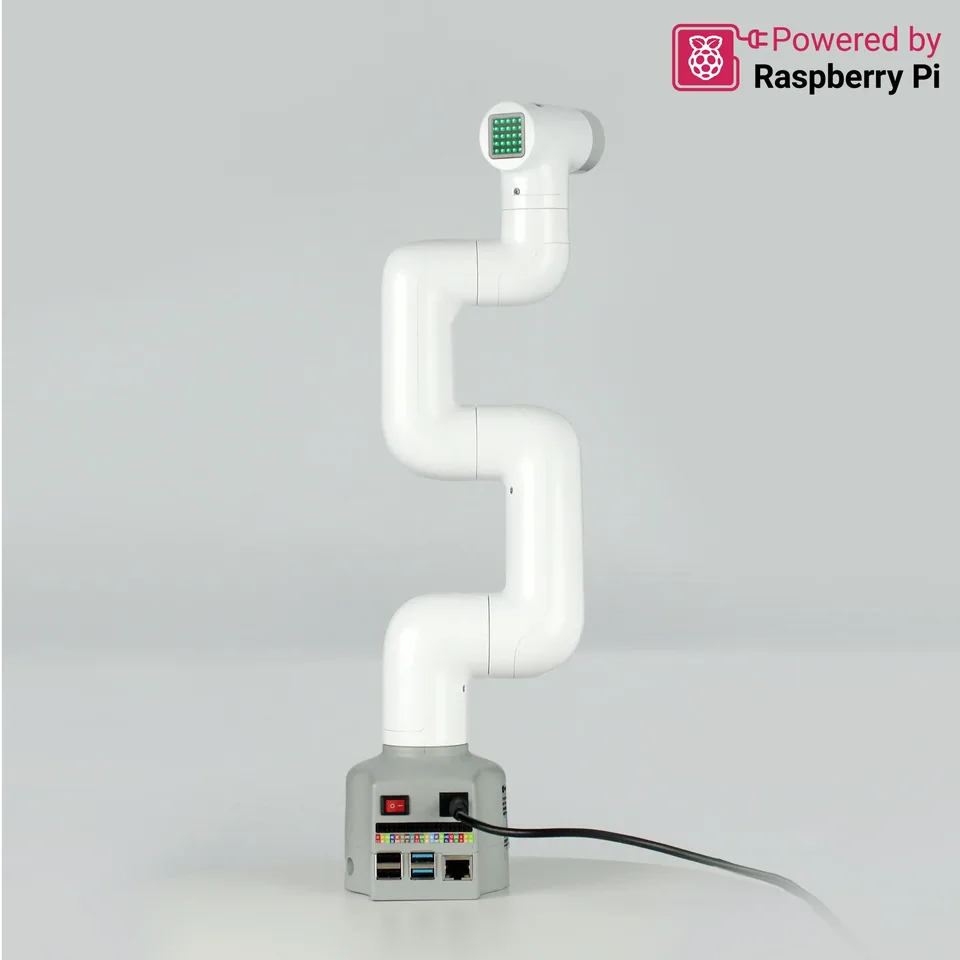
Price of the arm alone. Manufacturers rarely publish price lists, so we rely on an external comparison by Standard Bots (not a manufacturer price list): according to it, cobot prices typically fall in the range of USD 25,000 to 60,000 for standard models, and specialist configurations (for example for welding or spray painting) can exceed USD 90,000. The spread is wide: a small educational model such as the myCobot 280 from Elephant Robotics myCobot 280 costs in the range of a few hundred dollars, while industrial UR or ABB models are priced in the tens of thousands — for example the ABB GoFa CRB 15000 is priced by the German reseller Unchained Robotics at EUR 30,000-37,500 net (Unchained Robotics). For classic industrial robots there are practically no public price lists: sales go through project quotes from integrators and distributors (this also applies to the Polish branches of FANUC, ABB, KUKA and Yaskawa Polska), so there is no confirmed data on typical prices in Poland for this segment.
Integration. On top of the arm's price you must add the end-of-arm tool, the gripper, any vision system, and installation and commissioning of the cell. Standard Bots estimates tooling and accessories at USD 5,000 to 30,000; that is an external estimate, and the cost of integrating the cell depends on the application and has to be quoted individually.
Total cost of ownership (TCO). Beyond purchase and integration, TCO includes annual maintenance (estimated in the same source at 5 to 10% of the purchase value per year), spare parts, operator training, any software license fees, and customs duty and transport when importing from outside the EU (per the same source an additional 10 to 30% outside the US market; for Poland this needs a separate customs check). The typical service life of an arm is, according to this comparison, 6 to 10 years or 30,000 to 50,000 hours of work before a major overhaul. When comparing offers, it pays to calculate the cost per production cycle over the whole service life, not just the purchase price.
The question of subsidizing the purchase (Poland's robotization tax relief, ulga na robotyzację) is covered separately; see “Poland's Robotization Tax Relief”.
Criterion 6: Typical applications
Cobots work well for: assembling small parts and electronics (for example the UR3e as a compact tabletop model), machine tending, quality control, packing in short runs, applications with a varying product mix, and wherever the operator and robot share the same workstation. An example of a broader range is the KUKA LBR iisy series KUKA LBR iisy 6 R1300 or the Yaskawa Motoman HC10 Yaskawa Motoman HC10, both designed for safe collaboration in assembly.
Industrial robots dominate in: large automotive runs, high-takt arc welding, spray painting, palletizing heavy loads, and anywhere maximum speed and repeatability count and safety is provided by a fenced zone. In Poland this segment is represented by, among others, the local branches of FANUC, ABB, KUKA CEE and Yaskawa Polska, and higher-speed classic arms are offered by, for example, the FANUC CRX-10iA series FANUC CRX-10iA — formally a cobot, but the CRX family includes models with payloads of up to 30 kg (FANUC), which brings them close to applications typical of industrial robots.
The market context is worth remembering too. According to International Federation of Robotics data (World Robotics 2025), as cited by Polish media, Poland installed 2,344 new industrial robots in 2024, and at the end of 2024 about 26,400 robots were operating in the country, a density of 81 machines per 10,000 industrial employees; in 2025 almost 2,400 new robots were added (+2% year on year). These figures cover the whole industrial robot market, cobots included, and do not break out the share of each category; there is no confirmed data on the share of cobots alone in new Polish installations.
Decision matrix: a quick orientation
The matrix below does not replace a formal risk assessment or a TCO calculation for a specific case, but it lets you narrow the choice at the start.
Choose a cobot if: - The run is short or medium and the product mix changes often. - The workstation is to share space with an operator (human-robot collaboration). - Floor space is limited and there is no room for a fenced cell. - The team has no dedicated robot programmer and needs quick changeovers. - The initial budget is limited and the process is to be tested before a larger investment is decided.
Choose an industrial robot if: - Production is high-volume and stable, with a high required takt rate. - The application needs a large payload (above roughly 30 kg) or very high speed. - The process (such as arc welding, painting or cutting) creates hazards independent of the arm itself and needs a fenced zone anyway. - The company has a technical team able to maintain and reprogram a classic robot system. - Maximum precision and repeatability matter, with the process unchanged for years.
An intermediate situation: consider both options, or models of “fast cobots” (for example ABB SWIFTI, UR15), if production is growing in leaps, the process is not yet stable, and the company wants to keep flexibility without giving up speed altogether.
The final decision should always rest on a documented risk assessment of the specific workstation (not just the “cobot” or “industrial robot” label) and on a TCO calculation covering the whole life cycle of the investment, not only the arm's purchase price. For a practical step-by-step guide to the whole purchasing process, see “How to Buy a Cobot Step by Step”. A full overview of cobot models is available in the category “Cobots”.
Frequently asked questions
Can a cobot always work without a fence?
Not automatically. Going without guarding follows from a specific risk assessment of the given application (the tool on the end of the arm, speed, weight of the part being handled), not from the mere fact that the robot is labeled a cobot. Cobot makers design their arms in line with ISO 10218 (2025 edition) and ISO/TS 15066, but it is the integrator who is responsible for assessing the risk of the specific workstation.
Is a cobot always cheaper than an industrial robot?
The unit itself is often cheaper to buy, but once integration is added the difference shrinks, and on large production runs a classic industrial robot often works out cheaper per part because it runs faster. What decides is total cost of ownership (TCO), not the arm's list price.
How much does deploying a cobot cost in a Polish company?
There are few public price lists on the Polish market — most cobot makers sell through distributors with individual quotes. An external comparison by Standard Bots (not a manufacturer price list) gives about USD 25,000–60,000 for the arm alone in standard cobots; there is no confirmed data on final prices in PLN.
Can I start with a cobot and later move to an industrial robot?
Yes, that is a common path: a cobot lets you test automating a process at low risk and without rebuilding the hall, and once the production rate grows and the process stabilizes, the company moves it to a faster, fenced industrial robot.
Is a cobot suitable for welding and heavy loads?
Yes, there are cobot-based welding solutions and models with payloads of up to 30 kg (the FANUC CRX series, for example, reaches 30 kg), but for truly heavy and fast applications classic industrial arms still dominate because of their higher speeds and payloads reaching hundreds of kilograms.
Sources
Links to the material this text is based on. Before you base a decision on a figure from the article, check it at the source.
- iso.org/standard/73933.html
- iso.org/standard/73934.html
- iso.org/standard/62996.html
- eur-lex.europa.eu/eli/reg/2023/1230/oj
- universal-robots.com/news-and-media/news-center/universal-robots-introduces-i…
- new.abb.com/products/robotics/robots/collaborative-robots/swifti/crb-1300-swifti
- fanuc.eu/eu-en/crx-series
- standardbots.com/blog/collaborative-robot-prices-the-ultimate-guide
- spidersweb.pl/2026/09/polska-zostaje-w-tyle-robotyzacja-fabryk.html
About the authors
A chief engineer by profession (technical head of a ship's machinery plant, licensed). Sets the site's editorial rules and is responsible for them; he does not read every page before publication.
Texts are prepared by the editorial team using AI tools. We compare data with primary sources on a sample basis, not page by page. Our rules are described here: How we check · About us