In this article
- How does a cobot detect a person?
- Typical uses in Polish companies
- Cobot vs. industrial robot: the key differences
- Four modes of human-robot collaboration
- The risk assessment covers the whole workstation, not just the robot
- Payload, reach and repeatability: what to look for in the data
- Programming without a programmer
- When a cobot does not pay off
- Subsidies
Key facts
- TopicBasics
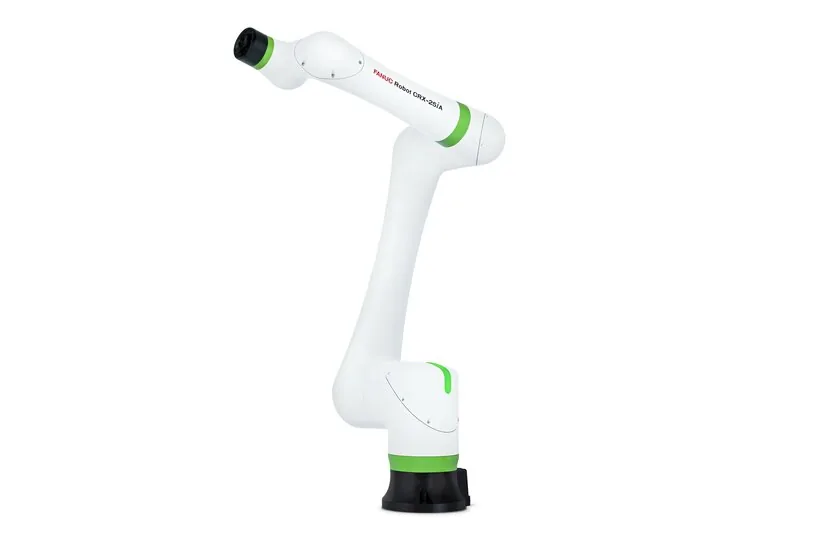
- Models coveredUR3e, UR30, FANUC CRX-30iA
- Prices of the models covered135,667 PLN (≈ EUR 31,030 at NBP rate 4.3716 of 20 October 2026) – 159,645 PLN (≈ EUR 36,520)
- Covered models available in Poland4 of 4
- Number of sources7
A collaborative robot (cobot) is a robotic arm designed to work right next to a person, without the safety cage required for classic industrial robots. This is the feature that most sets it apart from the traditional welding and assembly robots familiar from large production lines.
How does a cobot detect a person?
The key is force and torque sensors in each joint of the arm. When a cobot meets unexpected resistance, such as the touch of an operator's hand, it immediately slows down or stops moving. Some models also use 3D cameras that monitor the work zone so they can slow down before any contact happens.
Typical uses in Polish companies
The most common uses are palletizing, CNC machine tending, simple quality checks with cameras, and packing. A cobot works especially well in companies that have neither the space nor the budget for full line automation but want to relieve staff of repetitive, monotonous tasks while keeping flexibility (it is easy to reprogram for a different task).
Cobot vs. industrial robot: the key differences
A classic industrial robot is usually faster, lifts more and works fully isolated from people behind a safety cage, which makes it more productive at large, repetitive volumes. A cobot is slower and lifts less, but it needs no separate zone, is easier for a non-specialist employee to reprogram, and pays back faster on smaller production runs.
Four modes of human-robot collaboration
The safety standards (ISO 10218-1 and -2 in their 2025 editions and the ISO/TS 15066 specification, covered in our article on “Robot Safety Standards”) describe four ways a robot can work next to a person. The first is a safety-rated monitored stop: the robot stops when someone enters the zone and resumes after they leave. The second is hand guiding: the operator grabs the arm and teaches it a path, which is the basis of fast programming. The third is speed and separation monitoring: the closer the person, the slower the robot moves, down to a stop. The fourth, the one most associated with cobots, is power and force limiting: the robot's limits are set so that accidental contact does not exceed permissible loads on the body. A cobot usually combines several of these modes, but the manufacturer does not relieve the user of the risk assessment.
The risk assessment covers the whole workstation, not just the robot
The most common beginner's mistake runs: "I bought a cobot, so I do not need safeguards". Yet safety is decided by the whole application: a sharp gripper, a hot or sharp workpiece, the speed of motion, the mounting position, and whether a person can be trapped between the arm and a wall. A force limit at the joint does not help when the gripper holds a knife or a freshly welded part. That is why the risk assessment is done for the finished workstation, ideally with an integrator, and it often turns out that the cobot works in a fast mode with guards or scanners, like a classic robot. How to plan for this in the budget is described in the guide “How to Buy a Cobot Step by Step”.
Payload, reach and repeatability: what to look for in the data
On the market there are cobots from 3 kg payload (for example the UR3e, according to Universal Robots) to 30 kg (for example the UR30, UR30, and the FANUC CRX-30iA, as the FANUC CRX family reaches 30 kg). The middle of the range is 10-16 kg models, such as the UR10e (12.5 kg), FANUC CRX-10iA or Doosan M1013. When comparing, look not only at the nominal payload but at the payload with a gripper: the tool's mass has to be subtracted from the stated value, so a "10 kg" cobot often carries 7-8 kg of workpiece net. The second parameter is reach, which decides how many machines or pallets one arm can serve. The third is positioning repeatability, important in assembly and inspection and of little significance in palletizing. How to read datasheets and what to watch for in manufacturers' claims is explained in “How to Read a Robot Datasheet”.
Programming without a programmer
A large part of the popularity of cobots comes from how easy they are to start up. A typical cobot has a tablet with a graphical program editor: motions are set by guiding the arm by hand and saving points, and the logic (conditions, loops, signals from machines) is built from blocks. For simple tasks, such as palletizing or tending one machine, an employee can reprogram the robot for a new batch after short training. For tasks involving a camera, contact force or integration with a production system an integrator is still needed, because it is not the robot's motion that is hard, but everything else.
When a cobot does not pay off
A cobot is not the answer to everything. With large batches, high cycle speed and heavy loads, a classic robot in a guard is faster and cheaper per part. With highly variable, unrepeatable tasks (every part different, no fixed position) the cost of preparing the workstation can exceed the labor saving. With a single workstation running one shift the payback is longer than with two or three shifts. A good practice is to work out the total cost: robot, gripper, tooling, integration, training and service, and then compare it with the cost of labor per shift. A comparison of the two classes of machine is in the article “Cobot or Industrial Robot”, and an overview of models in the category “Cobots”.
Subsidies
In Poland, buying a cobot may qualify for the robotization tax relief (ulga na robotyzację) and for programs under FENG, the European Funds for a Modern Economy. Details and current conditions are in our section on subsidies.
Frequently asked questions
Does a cobot need a safety cage?
Usually not. Force sensors let a cobot detect contact with a person and stop, so it can work without a physical barrier once a risk assessment has been carried out.
How much does deploying a cobot cost in a small company?
Most manufacturers do not publish price lists, and the cost depends on the model, the tooling and the integration, so a quote has to be obtained from a distributor or integrator. Besides the price of the robot itself, tooling, integration and training count — it is also worth checking which subsidies are available.
Sources
Links to the material this text is based on. Before you base a decision on a figure from the article, check it at the source.
About the authors
A chief engineer by profession (technical head of a ship's machinery plant, licensed). Sets the site's editorial rules and is responsible for them; he does not read every page before publication.
Texts are prepared by the editorial team using AI tools. We compare data with primary sources on a sample basis, not page by page. Our rules are described here: How we check · About us