on sale
Franka Robotics GmbHCobots
Franka Research 3 (FR3)
- 3 kgpayload
- 7 DOFdegrees of freedom
- 116,300*price (PLN)
Manufacturer
German (Munich) maker of cobots with joint force sensing, FR3; strong in research, distribution in Poland unconfirmed.
Franka Robotics of Munich, until recently known as Franka Emika, has operated since 2016 and specializes in cobots with torque sensors in every joint, which give precise force control. The research model Franka Research 3 (FR3) established the brand in labs and universities worldwide.
Its price is relatively accessible for a class with force sensing in every joint, comparable in segment to China's Flexiv Rizon. Data on funding, headcount and commercial presence in Poland has not been confirmed.
For integrators and technical universities in Poland that already use the research version of the Franka, the FR3 is a natural path to production deployments, provided a local sales channel is confirmed. The FR3's price remains competitive against other cobots with force sensing in every joint.
Munich, 2016. That is where the company the robotics world knew as Franka Emika comes from, now operating as Franka Robotics GmbH. Its trademark is cobots with torque sensors in every joint: the robot feels a touch along the whole length of the arm and can set contact force with great finesse. That trait shaped the brand's fate. Franka Research 3 established the company in labs and universities around the world, where repeatability of experiments and precise control matter. Our sources show no confirmed funding rounds, valuation or headcount, so we do not reach for figures that cannot be checked. The last publication from the manufacturer that we know of is the datasheet of the Mobile FR3 Duo prototype, a mobile dual-arm manipulator. Newcomers to the topic should start with “What Is a Cobot and How Does It Differ from an Industrial Robot” and cobots, and safety standards for a robot working beside a human are covered in “Robot Safety Standards”. The rename from Franka Emika to Franka Robotics did not change the essence of the product: it is still an arm that can feel.
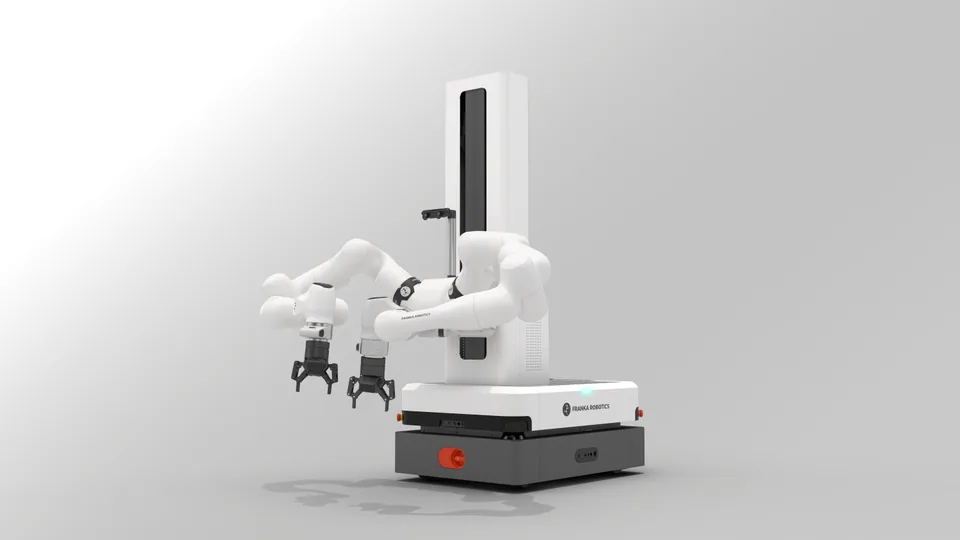
There are two models. Franka Research 3 is a seven-axis cobot: 110 cm, 18 kg, 3 kg payload, 855 mm reach and torque sensors in every joint. Its price of around $30,000 (about 116,300 PLN (≈ EUR 26,600 at NBP rate 4.3716 of 20 October 2026)) places it above many industrial arms, and the manufacturer gives it as a range of $25,000 to $35,000. Tasks named in sources are force-controlled assembly, research and prototyping. The second item, Franka Mobile FR3 Duo, is a prototype: a dual-arm mobile manipulator with a mass of 225 kg, 18 degrees of freedom and a payload of 125 kg, intended for research on embodied AI and teleoperation. It is not a product you can buy off the shelf. Anyone who wants to turn seven axes into practice should read “Degrees of Freedom (DOF) in Humanoid Robots”, and to compare parameters look at “How to Read a Robot Datasheet”. Applications in the laboratory are the natural environment for this arm. For a robotics team what counts is that the FR3 arm has seven degrees of freedom, which gives it agility in tight spaces and lets it avoid obstacles. It is not, however, equipment for heavy loads: with a 3 kg payload, heavy parts call for another class, for example an arm from the UR family. The Mobile FR3 Duo prototype shows the direction of development: two arms on a mobile base, that is, a manipulator meant to travel around the lab and work with both hands.
Franka plays a league above budget cobots and low in volume: it sells precision and feel, not cheap labor. The closest competitor on record is Flexiv Robotics with the Flexiv Rizon 4, also with force sensors in every joint. Kassow Robots also belongs to the seven-axis class, and Kinova Robotics sits in the neighboring lab segment. Against big players such as Universal Robots with its UR5e series or FANUC with the FANUC CRX-5iA, Franka competes not on payload but on finesse of control. Our sources name no industrial customers; its strong side is the academic community. Its strength is identity: it does not try to be the cheapest or the fastest arm, only the most sensitive. In the class with force sensors in every joint, price can be an argument in its favor, though our sources do not allow an exact comparison of competitors' price lists. A purchase decision should include the cost of the gripper, software and integration, which in research projects often exceeds the price of the arm itself. For a comparison of the classes, see “Cobot or Industrial Robot”.
We found no confirmed distributor or Polish deployments of the Franka, and neither model has a recorded availability in the country. Market logic suggests the most natural buyers are technical universities and labs, but that is our judgment, not a fact from documents. Before asking for a quote, read “How to Buy a Cobot Step by Step” and check how “Poland's Robotization Tax Relief” works, Poland's robotization tax relief (ulga na robotyzację). We map Polish centers and integrators in “Polish Robotics Companies”. That is why the first step should be to ask the manufacturer for an authorized partner in Central Europe and the terms of service, warranty and spare parts. Without that information, planning the budget and the rollout schedule would be guesswork, not calculation.
Franka is a precision tool for labs and teams that want to control contact force, not equipment for a small company's first automation. A 3 kg payload is enough for assembling small parts, not for pallets. The biggest question mark remains the Polish sales channel. Compare Franka Research 3 with Flexiv Rizon 4 before asking for a quote. For a lab it is often the first choice; for a factory only after a careful cost calculation and a check on who will provide service.
Franka Robotics GmbH
Franka Robotics GmbHCobots