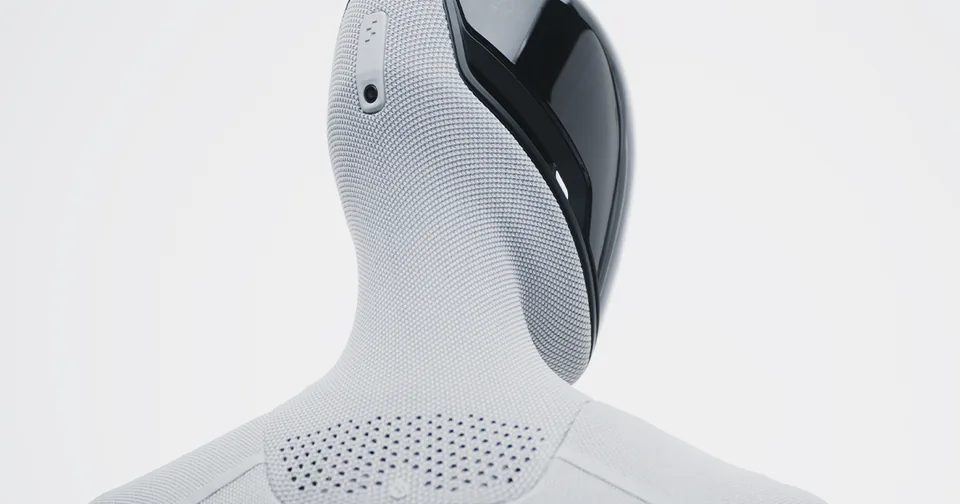
Figure AI
Compare
The Figure 03 and the Unitree G1 EDU are put side by side by those who see that the humanoid market has split into two business models and want to know which side of the divide their project falls on. The Figure 03 from Figure AI works in a fleet as an industrial robot under B2B contracts. The Unitree G1 EDU from Unitree Robotics is a platform for researchers and universities that you can buy from resellers. Below we compare the parameters, but above all who can get either robot at all, and on what terms.
Figure AI
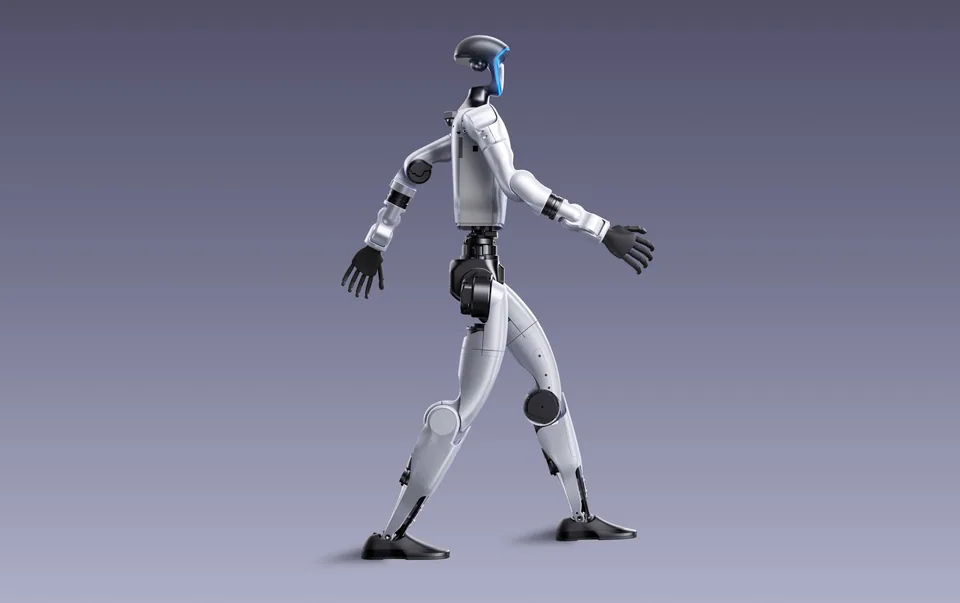
Unitree Robotics
| Feature | Figure 03 | Unitree G1 EDU (several configurations up to Ultimate D) |
|---|---|---|
| Manufacturer | Figure AI | Unitree Robotics |
| Price (PLN) | no data | approx. 286,500 PLN* (≈ EUR 65,540)(converted from 73,900 USD, NBP rate 3.8762, as of 1 October 2026) |
| Height (cm) | 172.0 | 132.0 |
| Weight (kg) | 61.0 | 35.0 |
| Degrees of freedom | 35 | 43 |
| Payload (kg) | 20.0 | 3.0 |
| Speed (m/s) | no data | 2.0 |
| Runtime (h) | 5.0 | 2.0 |
| Status | on sale | on sale |
The Figure 03 is bigger and stronger: 172 cm and 61 kg, 35 degrees of freedom (DOF), a 20 kg payload, up to 5 hours of runtime and 2 kW fast charging. The G1 EDU is 132 cm and 35 kg, with 43 DOF, a 3 kg payload, a walking speed of up to 2 m/s and about 2 hours of runtime. At first glance the G1 EDU wins on joint count, but in the hand the picture reverses: the Figure 03 has 16 DOF in the hand and touch sensors with 3 g resolution on each fingertip, the G1 EDU 7 DOF (the top “Ultimate D” configuration adds hands with a sense of touch). How to read these numbers is explained in “Degrees of Freedom (DOF) in Humanoid Robots”. The “brains” differ too: the G1 EDU runs on an NVIDIA Jetson Orin computer (NVIDIA Jetson) with SDK access, while the Figure 03 runs its own Helix, a vision-language-action (VLA) model that the company develops after ending its cooperation with OpenAI; wider background is in “VLA Models: How AI Controls Humanoid Robots in 2026”. The Figure 03 has cameras in the palms and a wide-angle camera system, the G1 EDU a 3D LiDAR, a depth camera and a microphone array.
The G1 EDU has no official Unitree price list. US resellers quote twelve configurations from about USD 43,900 to 73,900 (at 3.8762 zloty that is roughly PLN 170,200–286,500 (≈ EUR 38,930–65,540)), and in Poland in late September 2026 they were offered from about PLN 149,900 (≈ EUR 34,290) (U1, Ceneo) through PLN 190,000 (≈ EUR 43,460) (U2, Botland) to PLN 250,000 (≈ EUR 57,190) (Edu Ultimate A, x-kom). These prices come from sellers, not the manufacturer. The Figure 03 has no public price; it goes to customers under fleet contracts, for example BMW, and the robot is not offered in Poland; nor is there any information about sales to research institutions outside industry. The difference is therefore fundamental: you can order the G1 EDU today in a Polish shop, whereas the Figure 03 you can at most negotiate for as a partner of a large plant. A total-cost calculation is shown in “Humanoid Robot TCO: How to Calculate Total Cost”.
The G1 EDU is a tool for a university and laboratories that develop their own control algorithms; it also suits the teaching projects described in “Educational Robots for Schools and Universities”. The Figure 03 works in BMW’s factories in Spartanburg under the Physical AI project, and the manufacturer also names logistics (warehouses). That is work alongside people, so the requirements in “Robot Safety Standards” count. With a 3 kg payload the G1 EDU is not a substitute for an industrial robot, and the Figure 03 is not an open research platform. For a school the G1 EDU is an outlay of roughly PLN 150,000–250,000 (≈ EUR 34,310–57,190), and the Figure 03 is not available at all.
Two entirely different business models in the humanoid segment. Figure 03 works in a fleet at BMW under a B2B contract with no public unit price, while the G1 EDU is sold directly to researchers and universities, with reseller prices for its configurations running from USD 43,900 to USD 73,900. On performance, Figure 03 is bigger and more powerful: 172 cm, 61 kg, 35 degrees of freedom and a 20 kg payload, against 132 cm, 35 kg, 43 degrees of freedom (but a smaller 3 kg payload) for the G1 EDU. The G1 EDU makes up for its smaller size with its number of degrees of freedom, including in the hand alone, and with its openness to Secondary Development, which the Figure model, geared to closed industrial deployments, does not offer in the same form. For an academic lab the G1 EDU remains a realistic purchase; Figure 03 is available only through fleet partnerships with large manufacturers.
A laboratory that wants to run its own code should buy the G1 EDU; it is the only one of the two options that can be ordered and programmed at all. An industrial company with a serious pilot plan and a budget for a fleet contract should talk to Figure AI, though be aware that for now the robot goes to a handful of large customers. For a Polish company that is only testing whether humanoids make sense in its processes, a sensible start is available research hardware rather than waiting for a contract. Anyone who first needs a cheaper start for learning can reach for the Unitree G1, but without SDK access.
Yes, though without an official Unitree price list. EDU configurations are available from resellers at roughly USD 43,900 to 73,900.
Figure 03, at 20 kg, far exceeds the G1 EDU, which states a 3 kg payload.
No such sales channel is confirmed. Figure 03 deployments so far involve the industrial fleet at BMW.
The G1 EDU has up to 43 DOF against 35 for the Figure 03, but the Figure 03’s hand has 16 DOF and the G1 EDU’s 7.
There is no information about such a sales channel; deployments so far are fleet contracts with industrial customers, including BMW.