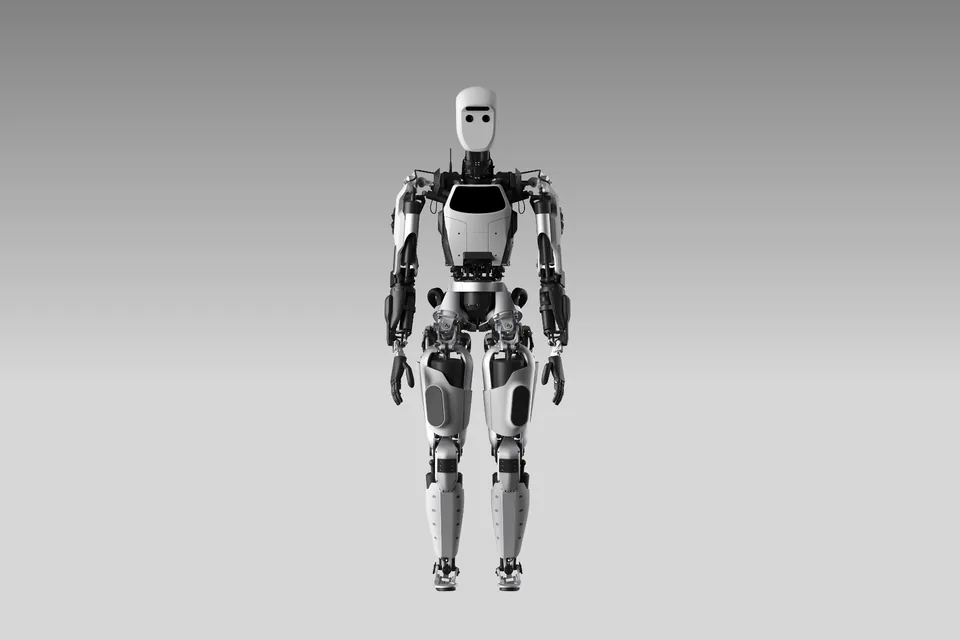
Apptronik
Compare
Apollo and Figure 03 are two American answers to the same question: how to bring a humanoid into a plant and a warehouse. The pairing usually comes up in the innovation department of a large corporation that has been asked by its board with whom to start a pilot. Both robots have almost the same height, both operate in pilots with big brands and neither has a public price. Apptronik Apollo from Apptronik bets on modularity and degrees of freedom, Figure 03 from Figure AI on production scale and its own AI model. The wider background is described in “Humanoid Robot Market Forecasts”.
Apptronik
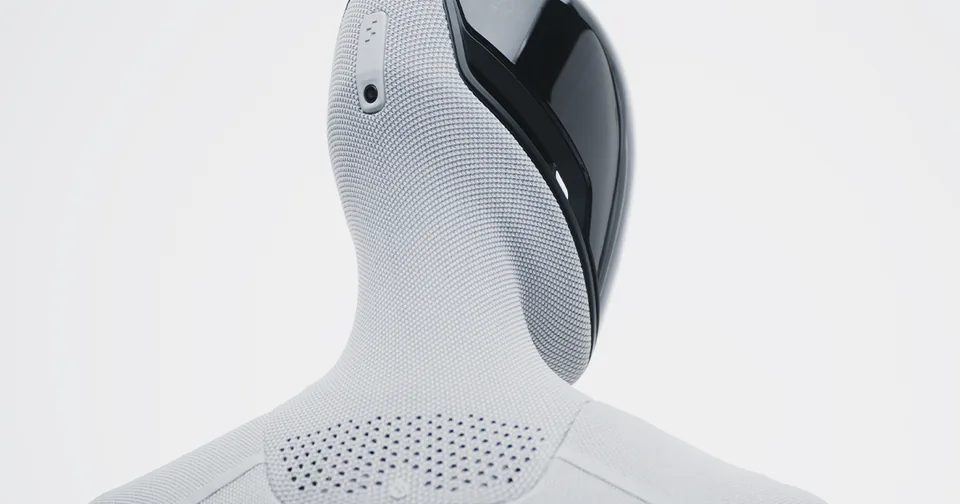
Figure AI
| Feature | Apptronik Apollo | Figure 03 |
|---|---|---|
| Manufacturer | Apptronik | Figure AI |
| Price (PLN) | no data | no data |
| Height (cm) | 173.0 | 172.0 |
| Weight (kg) | no data | 61.0 |
| Degrees of freedom | 71 | 35 |
| Payload (kg) | 25.0 | 20.0 |
| Runtime (h) | 4.0 | 5.0 |
| Status | pilot | on sale |
Apollo is 173 cm tall with 71 degrees of freedom (DOF), the most in this comparison; Figure 03 is 172 cm with 35, 16 of them in the hand. Apollo’s payload is 25 kg, Figure 03’s 20 kg. Runtime is about 4 hours against up to 5 hours. Apollo has a swappable battery that can be changed without downtime, so four hours on a pack call for organised swaps rather than long continuous work. Figure 03 shortens breaks with 2 kW fast charging. Neither manufacturer states Apollo’s mass or either robot’s walking speed.
Apollo’s most interesting feature is modularity: the robot can be mounted stationary, on a wheeled platform or as a fully bipedal machine. A customer can therefore start with a stationary or wheeled version and add walking later, which suits plants with non-standard floors. Figure 03 is a single-variant walking humanoid, but it has a richer hand: fingertip tactile sensors at 3 g resolution, cameras in the palms and a wide-angle vision system. It runs on its own Helix model (“VLA Models: How AI Controls Humanoid Robots in 2026”). More degrees of freedom mean greater freedom of movement but also mechanical complexity, as we explain in “Degrees of Freedom (DOF) in Humanoid Robots”.
Neither robot has a public price. Apollo reaches customers only through pilots and B2B contracts, and the manufacturer does not publish a unit value. Figure 03 is sold through fleet agreements, and the home lease announced in May 2026 at USD 600 a month concerns a different product, the Figure 03 version.
What do we know about capital? In February 2026 Apptronik raised USD 520 million at a USD 5 billion valuation, and in September 2026 a further USD 520 million was announced in an extension of its Series A-X round; total Series A funding exceeds USD 935 million. Figure AI is valued at USD 39 billion and, according to the company, built more than 350 units by April 2026 and the 1,000th in July. A high valuation is not proof of a mature product, however. Neither robot is offered in Poland. When planning a pilot budget, allow for integration, spare batteries and charging stations, training and service; the method is described in “Humanoid Robot TCO: How to Calculate Total Cost”.
Apollo has three publicly named pilots: Mercedes-Benz production plants (in-plant logistics at the line, that is delivering components to workstations and carrying crates), the GXO Logistics distribution centre (an evaluation stage, not a deployment) and Jabil, a manufacturer with material movement in plant and warehouse. The manufacturer discloses neither unit numbers nor scale. The pilot is described in “Apptronik Apollo in Mercedes-Benz Factories”. For the factory and the warehouse it is a signal of what will enter the market.
Figure 03 has the best-documented deployment: BMW in Spartanburg. BMW and Figure AI say that Figure 02 and 03 robots supported production of more than 30,000 X3 cars over ten months. Beyond BMW the company speaks of unnamed corporate customers and its own fleet of 740 robots. A fuller picture: “Figure 03: What We Know About Figure AI's Third-Generation Robot” and “Humanoid Robots in Factories 2026”. For a Polish company that wants a humanoid straight away, the realistic option is the Unitree H2, which is on sale.
Both makers already have real industrial pilots: Apollo is being tested at Mercedes-Benz plants, at a GXO Logistics distribution center and at Jabil, while Figure 03 works at BMW in Spartanburg. Apollo stands out with its degrees of freedom, as many as 71, the most of any humanoid in this comparison, at a height of 173 cm, almost identical to Figure 03's 172 cm. The two have a similar payload, 25 kg for Apollo against 20 kg for Figure 03, and a similar runtime of around 4 to 5 hours. Neither model has a public sale price; both operate through pilots and B2B contracts. In February 2026 Apptronik raised a USD 520 million round at a USD 5 billion valuation, which suggests an aggressive pace of scaling similar to Figure AI's. The choice between them today depends mainly on which maker a company already works with on a pilot.
The choice between them today depends mostly on which manufacturer a company already works with on pilots. If you work with Mercedes, GXO or Jabil, or need a robot that can be fitted to a non-standard plant (stationary, on a platform, bipedal), ask about Apollo. If a documented deployment at a carmaker, production pace and an in-house AI model matter, ask about Figure 03.
For small and medium-sized firms looking for a finished product with a price and a warranty, neither is an offer, and Poland has neither sales nor pilots from the two manufacturers. For a large corporation with a pilot budget, both are a sensible direction for talks. Before the meeting, prepare questions about references and service; “How to Read a Robot Datasheet” will help.
At Mercedes-Benz production plants, at a GXO Logistics distribution center and in Jabil's warehouse operations.
Apollo, with 71, far more than the 35 given for Figure 03.
In February 2026 the company raised USD 520 million at a valuation of USD 5 billion.
Modularity: the robot can be stationary, mounted on a wheeled platform or fully bipedal, and it has a swappable battery.