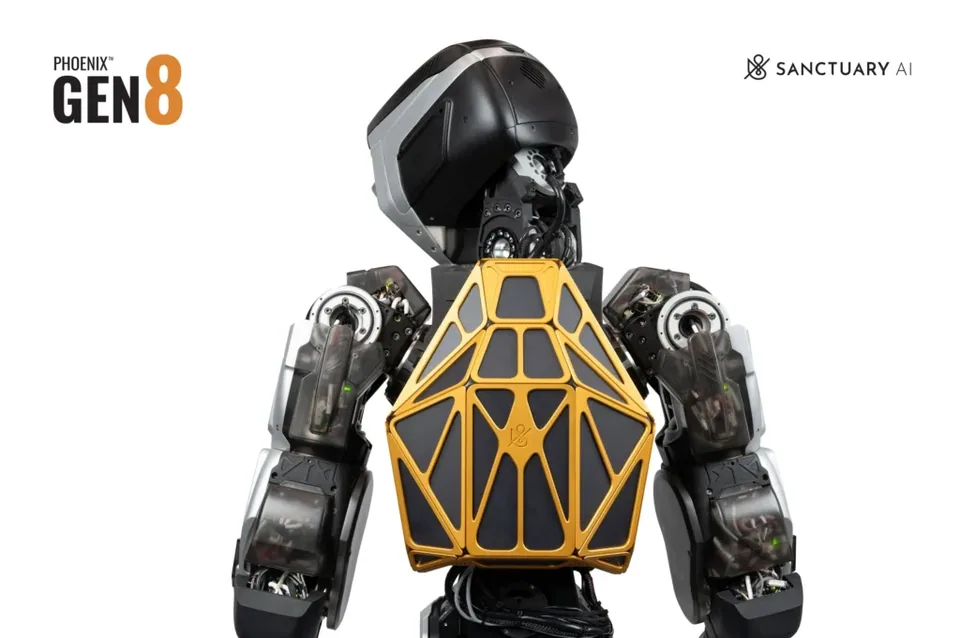
Sanctuary AI (Sanctuary Cognitive Systems Corporation)
Compare
Phoenix and Figure 03 stand on opposite sides of one debate: does a humanoid have to walk to be useful in industry. Sanctuary AI Phoenix from Sanctuary AI bets on hands and an unusual cognitive system. Figure 03 from Figure AI is a fully electric walking humanoid developed as a fleet. We set them side by side to see how much of that difference can be backed by facts. The whole subject sits within the humanoid robots category.
Sanctuary AI (Sanctuary Cognitive Systems Corporation)
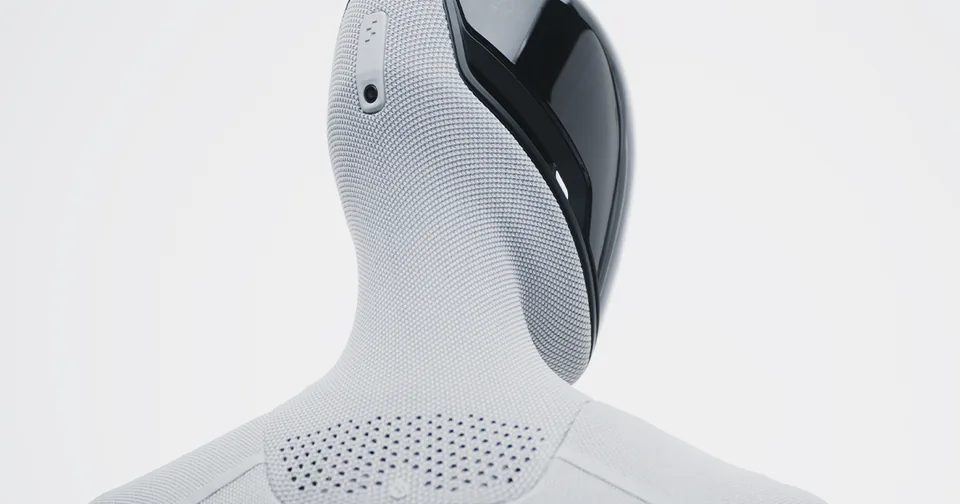
Figure AI
| Feature | Sanctuary AI Phoenix (Generation 8) | Figure 03 |
|---|---|---|
| Manufacturer | Sanctuary AI (Sanctuary Cognitive Systems Corporation) | Figure AI |
| Price (PLN) | no data | no data |
| Height (cm) | 170.0 | 172.0 |
| Weight (kg) | 70.0 | 61.0 |
| Degrees of freedom | 20 | 35 |
| Payload (kg) | 25.0 | 20.0 |
| Speed (m/s) | 1.34 | no data |
| Runtime (h) | no data | 5.0 |
| Status | pilot | on sale |
Phoenix in its eighth generation (described in December 2024) is 170 cm and 70 kg, Figure 03 is 172 cm and 61 kg. Phoenix has a payload of 25 kg, Figure 03 20 kg. Phoenix’s top speed is 1.34 m/s (3 miles per hour), while the manufacturer gives none for Figure 03. Phoenix’s data lists 20 degrees of freedom and the same number again for the hands, so a full count for the whole body cannot be established from it. Figure 03 has 35 degrees of freedom (DOF), 16 of them in the hand.
The most important difference is how they move. In the eighth generation Sanctuary dropped bipedal walking in favour of a wheeled base; the company explains this by signals from customers that legs are too delicate for the force needed in precise work. Figure 03 walks on two legs. Phoenix, for its part, has hydraulic hands (the rest of the robot is electric) whose tactile sensors detect forces from about 5 mN. Figure 03 answers with fingertip sensors at 3 g resolution, cameras in the palms and a wide-angle vision system. Phoenix is run by the Carbon system, which combines symbolic reasoning, language models and reinforcement learning, Figure 03 by its own Helix model (“VLA Models: How AI Controls Humanoid Robots in 2026”). Figure 03’s runtime is up to 5 hours; for Phoenix the manufacturer does not state it.
Neither robot has a public price. Sanctuary AI does not state Phoenix’s price. We know only the scale of the company’s funding: according to sources USD 100–147 million, including CAD 30 million from Canada’s Strategic Innovation Fund. As an order of magnitude, humanoids of this class cost an estimated several hundred thousand zlotys or more, but that is not an offer. On top of the price come shipping from outside Europe, line integration, a licence for the control software and servicing of hydraulics, which nobody in Poland yet offers.
Figure AI sells Figure 03 through B2B fleet agreements. According to the company, more than 350 units left the BotQ plant by April 2026 and the 1,000th was built in July, at a pace of about one an hour. The home lease announced in May 2026 at USD 600 a month concerns the Figure 03 version, not a robot for Polish companies. Neither robot is available in Poland, and Phoenix has no distributor here. For budget calculations use “Humanoid Robot TCO: How to Calculate Total Cost”.
Figure 03 has the best-documented deployment: the BMW plant in Spartanburg. BMW and Figure AI say that Figure 02 and 03 robots supported production of more than 30,000 X3 cars over ten months. What we know and do not know is covered in “Figure 03: What We Know About Figure AI's Third-Generation Robot”. The company’s own facilities, with 740 robots, are also documented. The direction the data points to is industry and logistics (factories, warehouses).
Phoenix has pilot status with no named customers in verified sources. The manufacturer points to precise industrial work: placing small, delicate parts such as connectors, cables and gaskets, and collecting training data. In August 2026 Sanctuary began selling the Carbon system for other companies’ hardware too. It does not suit places where you must negotiate stairs, thresholds and uneven terrain; there a bipedal Agility Digit 5 or Figure 03 is better. The industry picture of deployments is in “Humanoid Robots in Factories 2026”.
Phoenix (generation 8), in development since May 2023, stands out with hydraulically driven hands with touch sensitivity from 5 mN and a proprietary cognitive system called Carbon, an unusual approach among humanoids dominated by purely electric drives. Figure 03 is fully electric and has worked in a fleet at BMW since October 2025. Phoenix has pilot status with no publicly named industrial customers, whereas Figure 03 has a concrete, documented deployment. Physically the two are close in height (170 cm versus 172 cm), but Phoenix is slower, at a walking speed of about 1.34 m/s (3 mph), and heavier with the same payload of around 20 to 25 kg. Neither Phoenix nor Figure 03 has a public sale price. For companies judging technology readiness for deployment, Figure 03 has a more mature, documented industrial track record than Phoenix.
For a company judging technology readiness, Figure 03 has the more mature industrial record: a named customer, production figures and a clear fleet model. Phoenix is the most interesting attempt to prove that a humanoid does not have to walk, and its hands are a strong asset, but without a price, customers and a presence in Europe it remains an observation.
Choose Phoenix’s approach when your task is a precise grip in a single hall, with no stairs or uneven ground, and you have a pilot budget and access to the manufacturer. Choose Figure 03 when you need a robot that moves freely and you are a large plant ready for a fleet contract. For a typical Polish company both are topics to watch. Ask each manufacturer for a list of pilots and servicing terms outside North America; the rules for assessing datasheets are in “How to Read a Robot Datasheet”.
A hydraulic drive with touch sensitivity from 5 mN, a rare solution among mostly electric competitors, Figure 03 included.
It is listed at pilot status with no publicly named customers, unlike Figure 03's documented collaboration with BMW.
Figure 03, though its exact walking speed is not given. What is known is that Phoenix moves at about 1.34 m/s (3 mph).
No. Since the eighth generation it has a wheeled base because, according to Sanctuary, customers found legs too delicate for the force needed in precise work.
For Phoenix the manufacturer states a maximum of 1.34 m/s. For Figure 03 it states no speed, so the two cannot be compared numerically.