Compare
Neura MAiRA S vs UR7e: A Cognitive Cobot Versus the Classic Industrial Standard
Key facts
- Price in PolandNeura MAiRA S: approx. 164,100 PLN* (≈ EUR 37,600 at NBP rate 4.3641 of 21 October 2026) · UR7e: —
- PayloadNeura MAiRA S: 18 kg · UR7e: 7.5 kg
- WeightNeura MAiRA S: — · UR7e: 20.6 kg
- StatusNeura MAiRA S: on sale · UR7e: on sale
- In PolandNeura MAiRA S: no · UR7e: yes
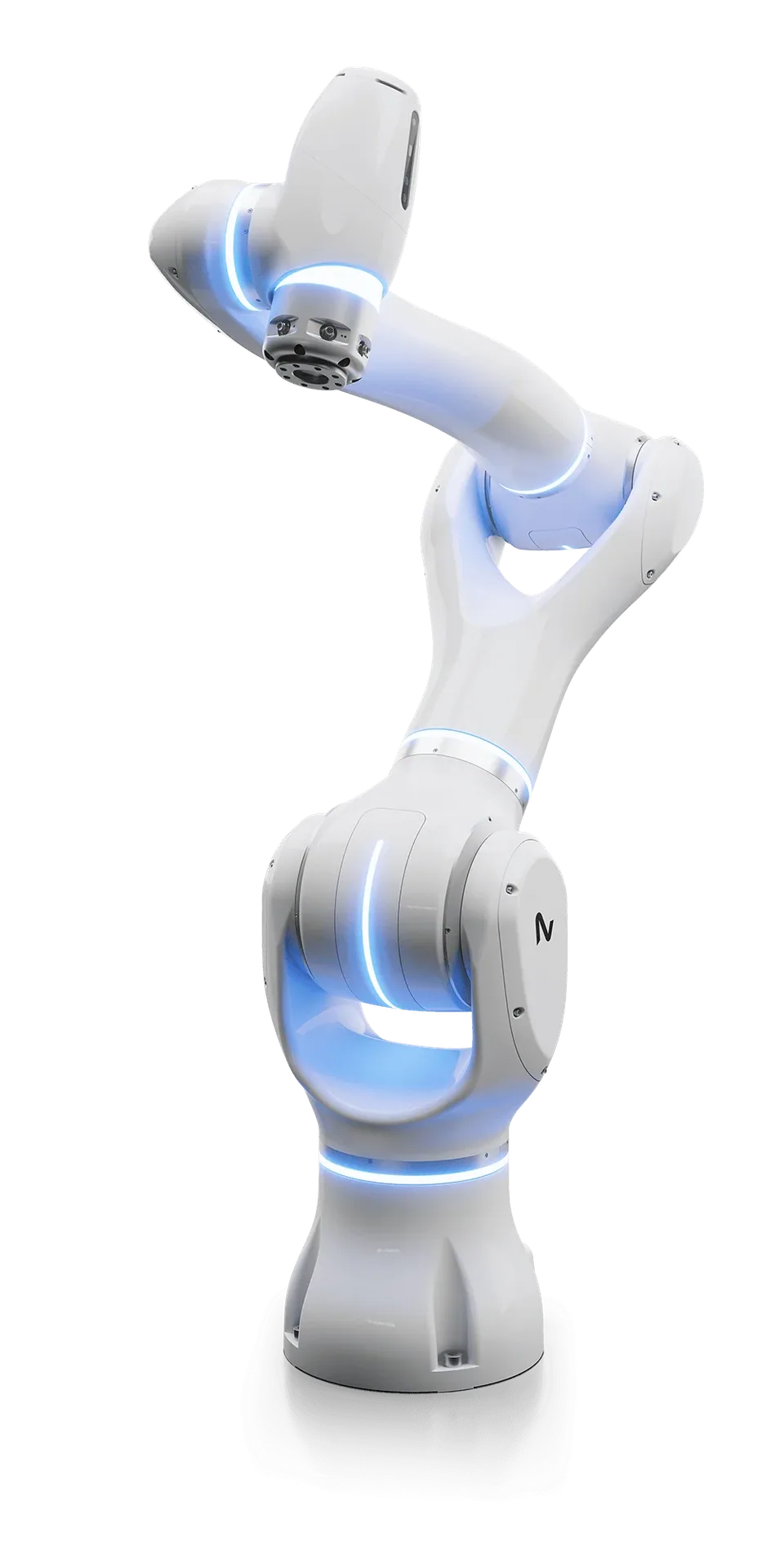
Setting the Neura MAiRA S against the UR7e is unusual, because it compares two philosophies, not two similar products. On one side stands the German company Neura Robotics, founded in 2019, which sells a „cognitive” cobot with a 3D camera and object recognition. On the other, Universal Robots with its classic six-axis arm, which in May 2025 replaced the popular UR5e. Engineers usually ask this when wondering whether to pay extra for artificial intelligence in the arm or buy proven mechanics and add a camera separately. We note at once: these robots belong to different payload classes, so the comparison makes sense mainly when the task fits both.
Universal Robots A/S
UR7e
—| Feature | Neura MAiRA S | UR7e |
|---|---|---|
| Manufacturer | Neura Robotics | Universal Robots A/S |
| Price (PLN) | approx. 164,100 PLN* (≈ EUR 37,600)(converted from 37,500 EUR, NBP rate 4.3770, as of 1 October 2026) | no data |
| Weight (kg) | no data | 20.6 |
| Degrees of freedom | 7 | 6 |
| Payload (kg) | 18.0 | 7.5 |
| Status | on sale | on sale |
Design and specifications
The MAiRA S has seven axes and an 18 kg payload, the UR7e six axes and 7.5 kg, more than two and a half times less. Reach is 1,100 mm against 920 mm. The S variant is the shortest in reach and the strongest in the MAiRA family, which makes it attractive where working space is limited, for example at palletising stations. The UR7e keeps the reach of its predecessor, the UR5e, and the ±0.03 mm repeatability, while raising the payload from 5 to 7.5 kg; it weighs 20.6 kg. For the MAiRA S we have no confirmed mass or repeatability. The extra axis gives the MAiRA S more freedom to avoid obstacles (see “Degrees of Freedom (DOF) in Humanoid Robots”).
The key difference is perception. The MAiRA S has a built-in 3D camera, AI-based object recognition and voice command handling within the Neura Cognitive Platform. The UR7e has a force and torque sensor at the tool end but does not offer object recognition in its standard configuration. Depth cameras and on-board computers for such tasks are made by specialist firms such as Orbbec and NVIDIA Jetson; with the UR7e you add and integrate them yourself. If the task involves non-standardised objects, this very difference decides. Reading datasheets from this angle is described in “How to Read a Robot Datasheet”, and how control models work is covered in “VLA Models: How AI Controls Humanoid Robots in 2026”.
Price and availability in Poland
The price of the MAiRA S is, according to a reseller aggregation, about 37,500 EUR net, or roughly 164 thousand zloty at the rate of 4.3770. The figure has not been confirmed directly at the manufacturer's shop, however, so treat it as a guide. For the UR7e no price is given; the manufacturer reveals it in partner quotations. A comparison with a conventional cobot of similar payload suggests that the MAiRA S can be up to about twice as expensive, a result of the additional AI perception layer.
Availability is the reverse. The UR7e can be bought in Poland off the shelf through authorised partners such as elmark.com.pl; it has been on sale since May 2025. For the MAiRA S, sales and support in Poland have not been confirmed, which means an enquiry to the manufacturer or a European partner. With such a cost difference, ask about the full package: software licence, cognitive platform updates, training and service response time. The rules for preparing an enquiry are collected in “How to Buy a Cobot Step by Step”.
Which model for which job
The MAiRA S aims at cognitive automation and human–robot interaction. Where parts arrive in varying positions and the line cannot stop for reprogramming, object recognition has real value: in a warehouse when unloading mixed crates, or on a factory floor when feeding parts without exact referencing. Seven axes and an 18 kg payload also allow heavier tools.
The UR7e is built for classic assembly, handling of parts and machine tending in medium-series production, that is, where the UR5e used to work. For repetitive, well-defined tasks it is the cheaper and proven choice, with an ecosystem of grippers and integrators. If you need more payload without an AI layer, look at the UR15; a similar philosophy with a smaller arm is represented by Neura's Neura LARA 8, and an intermediate class by the Neura MAiRA M. An overview of the UR family is in “Universal Robots UR5e, UR10e and UR20 Compared”, and the class of arms in cobots.
Conclusion
MAiRA S stands out with a built-in 3D camera and AI-based object recognition as part of the Neura Cognitive Platform, supporting voice interaction with the operator, features the UR7e does not offer in its standard configuration. MAiRA S also has a higher payload, 18 kg versus 7.5 kg for the UR7e, and seven axes versus six, which gives extra freedom of movement. MAiRA S is priced at around EUR 37,500 plus VAT (about PLN 164,138) according to a reseller aggregator, not verified directly on the manufacturer's site; no price has been disclosed for the UR7e. MAiRA S aims at cognitive automation and human-robot interaction, while the UR7e targets classic assembly and part handling. For lines that need to recognize non-standard objects without reprogramming, MAiRA S has a clear functional advantage; for repetitive, well-defined tasks, the UR7e remains the cheaper, proven choice.
For a line on which robots must recognise non-standardised objects without reprogramming, the MAiRA S has a clear functional advantage and is worth checking in a demonstration — provided the manufacturer confirms support in Poland and presents an official quotation. For repetitive, well-defined assembly and machine-tending tasks, the UR7e remains the cheaper, off-the-shelf and proven choice.
A control question: does your task really need recognition, or is a good camera attached to a simpler arm enough? If the latter, the UR7e with a separate vision system often comes out better, because you pay for 18 kg of payload and seven axes only if you use them. Before deciding, ask for a trial on your own part and measure how many times the robot had to ask for help.
Frequently asked questions
What sets MAiRA S apart in terms of AI?
A built-in 3D camera and object recognition based on the Neura Cognitive Platform, supporting voice interaction with the operator.
How much does MAiRA S cost?
Around EUR 37,500 plus VAT according to a reseller aggregator. The figure has not been verified directly on the manufacturer's site.
Which cobot has more axes?
MAiRA S, with seven axes, has one more than the six-axis UR7e.
What sets the MAiRA S apart in terms of AI?
A built-in 3D camera, object recognition and voice interaction based on the Neura Cognitive Platform. The UR7e has no such functions as standard.
How much does the MAiRA S cost?
About 37,500 EUR net according to a reseller aggregation. The figure has not been confirmed directly on the manufacturer's site.
Is the UR7e available in Poland?
Yes, through authorised partners, including elmark.com.pl. For the MAiRA S, sales in Poland are not confirmed.
Sources
- Neura MAiRA S · unchainedrobotics.de
- UR7e · universal-robots.com
- UR7e · electromate.com