ABB Robotics
Compare
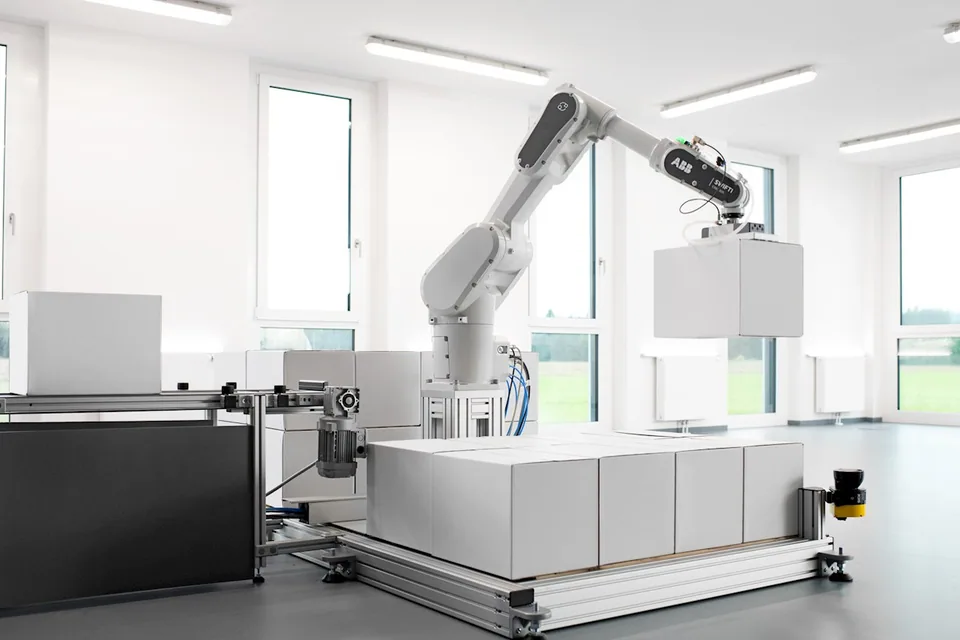
A comparison of the ABB SWIFTI CRB 1300 and the UR7e. The SWIFTI from ABB Robotics is positioned as a bridge between an industrial robot and a cobot. The UR7e from Universal Robots, launched in May 2025 as the successor to the UR5e, represents the versatile, predictable middle of the market. The dilemma is therefore this: pay for speed, or for flexibility and a broad ecosystem. Before deciding, read “Cobot or Industrial Robot”, which explains that boundary, and “How to Buy a Cobot Step by Step”.
ABB Robotics
Universal Robots A/S
| Feature | ABB SWIFTI CRB 1300 | UR7e |
|---|---|---|
| Manufacturer | ABB Robotics | Universal Robots A/S |
| Price (PLN) | no data | no data |
| Weight (kg) | no data | 20.6 |
| Degrees of freedom | 6 | 6 |
| Payload (kg) | 11.0 | 7.5 |
| Speed (m/s) | 6.2 | no data |
| Status | on sale | on sale |
The SWIFTI CRB 1300 reaches a TCP speed of up to 6.2 m/s and has a repeatability of 0.01 mm. It comes in three payload variants, 7, 10 and 11 kg, with a reach of 0.9 to 1.4 m. Torque and position sensors operate in every joint. The source material gives no robot weight, so we do not set it alongside.
The UR7e has six axes, a 7.5 kg payload, a 920 mm reach, a weight of 20.6 kg and a repeatability of ±0.03 mm. The force/torque sensor sits at the tool flange. For the UR7e we have no comparable speed figure, so we do not claim how many times slower it is; we only know that 6.2 m/s is clearly higher than is typical in the cobot segment. On payload, the 11 kg SWIFTI has 3.5 kg more than the UR7e, while the 7 kg variant has 0.5 kg less. The repeatability values (0.01 mm against ±0.03 mm) suggest higher precision for the SWIFTI, but they come from different manufacturers rather than an independent test. The rules for reading such tables are described in “How to Read a Robot Datasheet”.
Neither manufacturer gives a price. The SWIFTI is quoted on request, and the UR7e through distributors, with no public price list. We therefore have no basis for saying which is cheaper. A fast arm may require a more careful risk assessment and costlier safeguards, which add to the price, but we do not know the figure.
In Poland there is no confirmed official distributor for the SWIFTI; ask ABB Polska. Among firms listing the ABB brand is Rob Expert, but we have no confirmation that it offers the SWIFTI. The UR7e is carried by Elmark Automatyka (Universal Robots collaborative robots). The CP Trade page describes only the older UR3, UR5 and UR10, so availability of the UR7e there needs confirming. For both models, ask about delivery time and whether the supplier can provide service in your region.
The SWIFTI is for lines where pieces per minute count: fast assembly, high-frequency pick&place, packing small items and loading components into machines. In a factory it usually replaces a manual station whose operator cannot keep up with the conveyor; in a warehouse it will do for picking light items at a fixed station. Speed does not mean freedom: when working beside people a risk assessment is mandatory, under “Robot Safety Standards”.
The UR7e is for more varied tasks: assembly, machine tending and pick&place in medium runs, often with heavier grippers. Its strength is the ecosystem, that is, a library of grippers, cameras and applications, for example from Robotiq. When 7.5 kg is too little and speed is not the priority, consider the UR12e. If you want to compare ABB with a second ABB cobot first, look at the ABB GoFa CRB 15000.
The SWIFTI CRB 1300 stands out for speed: 6.2 m/s, well above typical values in the cobot segment, which makes it dedicated to fast assembly and high-frequency pick-and-place operations. For the UR7e the manufacturer gives no comparable speed figure. The SWIFTI has a slightly larger payload, 11 kg against 7.5 kg for the UR7e, and comes in three payload variants (7, 10 and 11 kg) with a reach of 0.9 to 1.4 m. Both cobots have six axes and built-in force sensing, though the SWIFTI integrates torque sensing in every joint while the UR7e has it only at the tool flange. The UR7e is available in Poland through elmark.com.pl; for the SWIFTI we have not confirmed a Polish seller (ABB operates in the country through ABB Sp. z o.o.). For lines that need maximum assembly throughput the SWIFTI has the speed advantage; for general assembly and handling applications the UR7e remains the more versatile choice.
If your line is limited by cycle time and the parts fit within 11 kg, the SWIFTI is the arm designed precisely for fast conveyors, and it is worth asking for a quote. If you need a flexible robot for varied tasks, valuing a broad ecosystem and the support of many integrators, choose the UR7e. For beginners without an integrator we advise the UR7e, because a fast robot demands a careful risk assessment. Before deciding, time the cycle of the manual station and check how much of it can be recovered; only then compare quotes, because we know the price on neither side.
Its very high speed for a cobot, 6.2 m/s, meant for fast assembly and pick-and-place operations.
Three: 7, 10 and 11 kg, with an arm reach from 0.9 to 1.4 meters.
The SWIFTI, with torque and position sensors in every joint, against a single sensor at the UR7e's tool flange.
The SWIFTI, with torque and position sensors in every joint. The UR7e has a single force/torque sensor at the tool flange.
No. Neither manufacturer publishes a price, so it is not possible to say which is cheaper.