on sale
Noetix Robotics (Beijing Songyan Power Technology Group)
Noetix Bumi
- 94 cmheight
- 12 kgweight
- 5,400*price (PLN)
Price from
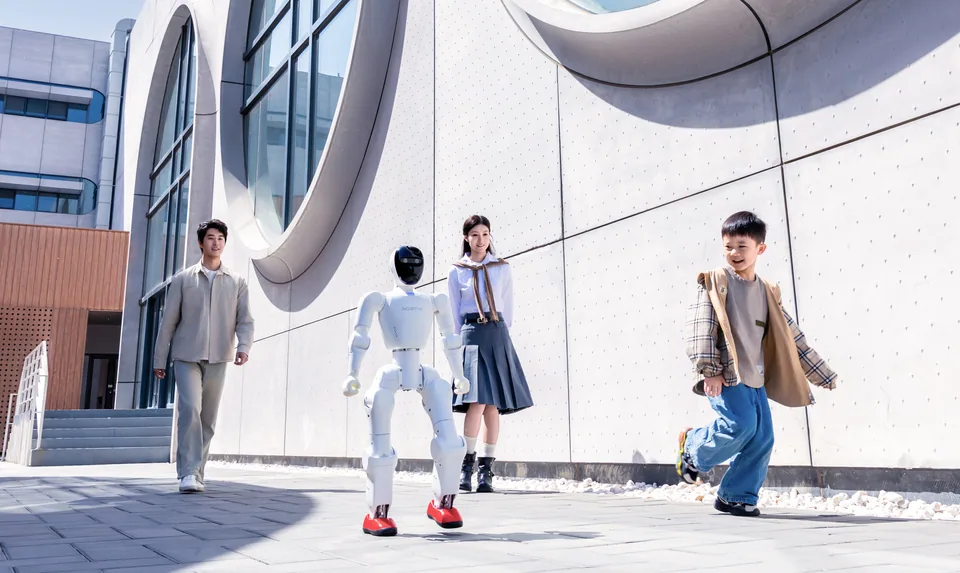
The N2 is the bigger sibling of the Bumi in Noetix Robotics' lineup: a humanoid with 18 degrees of freedom, a top speed of 3.5 m/s (12.6 km/h) and a swappable battery good for roughly 2 hours of work, running an open Linux platform on an RK3588s processor.
The strongest proof of its athletic ability is second place in the world's first humanoid half marathon in Beijing, where the N2 covered 21 km in 3 hours and 37 minutes. The price falls somewhere between $5,500 and $9,000; we use the midpoint of $7,250 (about PLN 28,102 (≈ EUR 6,430)), since the manufacturer has not confirmed a fixed price list. Intended uses include the home, the classroom and senior-care facilities.
Among sporty, athletic humanoids the N2 competes with China's Unitree G1 and the Booster T1 - all three have taken part in similar running events - but the N2 stands out for its open Linux system, which makes it easier to program your own applications.
Its strength is endurance that has been proven in practice; its weakness is a battery life of just 2 hours, which limits continuous use without swapping the pack. Availability in Poland has not been confirmed.
Data checked: · Sources: 5
Data from manufacturer datasheets and product pages; median over the models of this category in the database.
The quoted range is $5,500-9,000; the midpoint is used, as no confirmed fixed list price exists.
Purchase. The price is not fixed: a third-party aggregator gives a range of $5,500-9,000, and we use the midpoint of $7,250, or about PLN 28,102 (≈ EUR 6,430) at a rate of 3.8762. The manufacturer has not confirmed an official price list, so treat the figure as indicative.
Import. Availability in Poland has not been confirmed. As a rough estimate, shipping, customs duty and 23% VAT will add up to PLN 30,000-35,000 (≈ EUR 6,860–8,010) per unit delivered to your door. That is our estimate, not manufacturer data.
Running costs. The swappable battery lasts about 2 hours. For a full-day show you will need spare packs, but we found no prices for them in the sources.
Training. Linux and an open platform mean a team with programming experience will get the robot running faster. We saw no manufacturer courses.
Subsidies and tax relief. Universities can look for funding through research projects. We describe the broader total-cost-of-ownership calculation in “Humanoid Robot TCO: How to Calculate Total Cost”.
No confirmed distributor in Poland
The N2 is a humanoid that showed a relatively cheap robot can actually run. In the world's first humanoid half marathon in Beijing it finished 21 km in 3 hours and 37 minutes, taking second place. That result says more about the endurance of its motion system than any glossy brochure could. The machine has 18 degrees of freedom (DOF), reaches up to 3.5 m/s (12.6 km/h), runs about 2 hours on a swappable battery and is controlled from a Linux platform on an RK3588s processor.
Home. The manufacturer also positions the N2 as a home robot. Real household functions such as cleaning or fetching things have not been publicly documented, so we treat this as potential rather than a finished product. For context, see homes.
Classroom and university. The open Linux system is the main argument for computer-science teachers and lab leaders: you can write your own applications on a familiar operating system instead of learning a closed toolchain. In practice, students can test gait, perception and control algorithms. We cover this in schools and universities.
Senior care. The manufacturer lists care facilities as a field of use. Caution is needed here: two hours of runtime and no confirmed assistive functions mean the N2 is better suited today to conversation and keeping residents entertained than to real help.
Events and sports shows. The half-marathon result makes the N2 an attractive model for shows where spectacle matters - see events and “Renting a Humanoid Robot for an Event”. The swappable battery lets you run a show for longer than designs with a fixed battery.
A good fit: universities and technical schools that want a humanoid with open Linux for tens of thousands of zloty rather than hundreds of thousands. Student teams building their own control software. Event agencies looking for an eye-catching, mobile robot attraction. Enthusiasts who can afford about PLN 26,000 (≈ EUR 5,950) and want something more than a toy.
Not a good choice for: companies expecting manipulation work - the sources give no payload or hand data. Industrial plants: short runtime, no certifications, no distributor in Poland. Care homes hoping for real help for residents - there is no confirmation of that. And anyone who does not want to import hardware and organize service on their own.
If your budget is larger and you need a mature research platform with a broad ecosystem, take a look at Unitree G1.
The availability of the N2 on our market has not been confirmed, and we found no list of customers or installations in schools or care homes in the sources. The only solidly documented "deployment" is the appearance in the Beijing humanoid half marathon and the second-place finish.
Humanoids of this class go to laboratories and universities, for example the Unitree family models described in “Unitree H1, G1, R1 and H2”. In industry, the first pilots include Agility Digit in logistics and Apptronik Apollo in the automotive sector (“Apptronik Apollo in Mercedes-Benz Factories”); for an overview of the situation, read “Humanoid Robots in Factories 2026”. For teams just getting started, a good introduction is “How to Start Learning Robotics in Poland”, and an overview of local players is in “Polish Robotics Companies”.
Unitree G1 - the most obvious comparison. The G1 costs about $13,500 (PLN 52,329 (≈ EUR 11,970)), nearly twice as much as the N2, but it has a longer market history and a wider ecosystem of Unitree tools. For more serious research projects it is often the safer choice.
Booster T1 - a humanoid that has entered similar running events; at about PLN 131,600 (≈ EUR 30,100) in our catalog, it sits in an entirely different price category.
EngineAI PM01 - about PLN 46,514 (≈ EUR 10,640), a compact humanoid for laboratories.
Noetix Bumi - if your budget is a few thousand zloty and all you want is a child-sized robot for play.
Unitree R1 - smaller and cheaper than the G1, about PLN 19,000 (≈ EUR 4,350), for those who prefer a proven ecosystem to open Linux.
For a rundown of the Unitree series, see “Unitree H1, G1, R1 and H2”. Keep in mind that each of these machines has a different specification and a different level of documentation. Before buying, compare the datasheets using the tips in “How to Read a Robot Datasheet”.
Noetix Robotics (Beijing Songyan Power Technology Group)




Noetix Robotics, formally Beijing Songyan Power Technology Group, is a Beijing company known for the N2 humanoid with a Linux platform and 18 degrees of freedom. Its publicity came from the world's first humanoid half marathon in Beijing, where the N2 took second place with a time of 3 hours 37 minutes over 21 km. From a marketing standpoint, an event like this works better than advertising.
The company's next step was the debut of the Bumi in October 2025 - a cheaper, child-sized humanoid at about $1,400 (Noetix Bumi). The N2 therefore remains the "adult", sporty model. We have no information on newer generations or educational versions; we are following the manufacturer's announcements. For a wider picture of the Chinese scene, see “Chinese Humanoid Robots”.
Noetix Robotics launches Bumi, a child-sized consumer humanoid, for $1,400 Noetix Robotics (Beijing Songyan Power Technology Group)
No. The manufacturer Noetix Robotics (China) names no Polish shop or official distributor for the Noetix N2; enquiries go through the manufacturer's website (noetixrobotics.com). Price estimate (midpoint of a range): approx. 28,100 PLN* (≈ EUR 6,430). Confirm service in Poland before buying.
It finished second, covering 21 km in 3 hours and 37 minutes.
About 2 hours, and the battery is swappable.
The price falls between $5,500 and $9,000; the midpoint of $7,250 (about PLN 28,102 (≈ EUR 6,430)) is used here.
Author, source and licence of the photo are given in the caption. Shop links may become affiliate links in future, details: How we make money · How we check