on sale
Humanoid robotson sale
Noetix Bumi
Price from
approx. 5,400 PLN* (≈ EUR 1,240 at NBP rate 4.3641 of 21 October 2026)
converted from 1,402 USD, NBP rate 3.8762, as of 1 October 2026
No confirmed distributor in Poland
Pros
- Price of about CNY 9,988 (around PLN 5,434 (≈ EUR 1,250))
- Child-sized: 94 cm, 12 kg
- Walks, runs and responds to voice
- Opens the humanoid category to households
Cons
- No data on degrees of freedom or payload
- No public specification beyond height and weight
- Not officially sold in Poland
- 94cmHeight
- 12kgWeight
Key facts
- Indicative price (external source)approx. 5,400 PLN* (≈ EUR 1,240) (as of October 2025)
- Specificationsheight 94 cm · weight 12 kg
- Statuson sale
- Availability in Polandnot confirmed
- VerdictA price curiosity and toy-educator for home or school; not a work tool.
Summary
- ManufacturerNoetix Robotics (Beijing Songyan Power Technology Group)
- CategoryHumanoid robots
- Statuson sale
- Availability in PolandNo confirmed distributor in Poland
The Bumi from Beijing startup Noetix Robotics debuted in October 2025 as, according to the maker, the cheapest "high-quality" humanoid in the world: it costs 9,988 yuan, or about USD 1,402 (roughly PLN 5,434 (≈ EUR 1,250)).
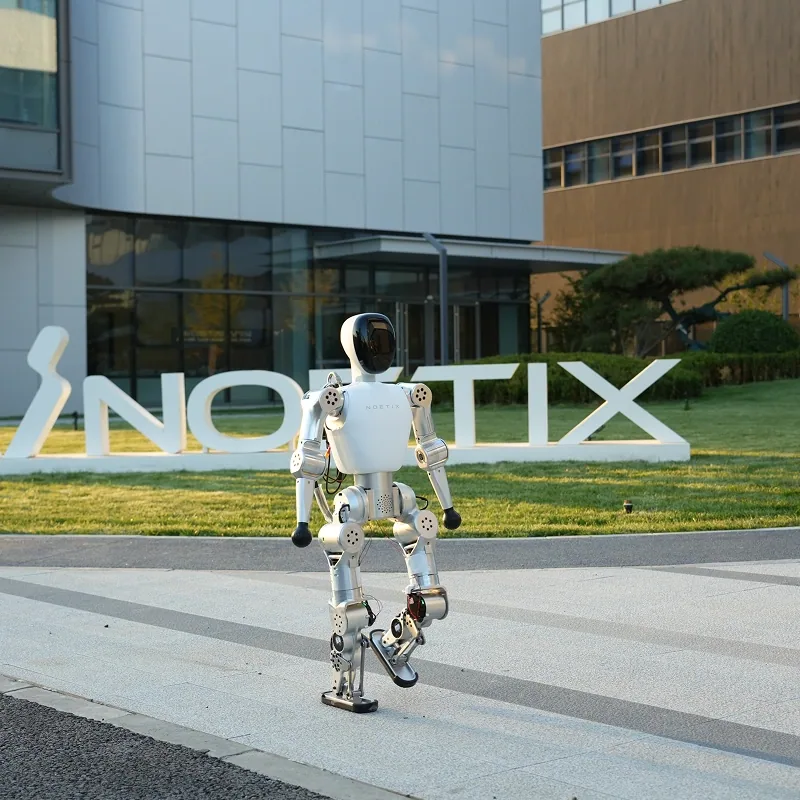
The robot is child-sized, 94 cm (3 ft 1 in) tall and weighing 12 kg (26 lb), built from lightweight composite materials, and it can walk, run and respond to voice commands thanks to its own motion-control system. The manufacturer does not publish degrees of freedom or payload. Battery life is 1-2 hours on a 48 V battery of more than 3.5 Ah (per roboticsandautomationnews.com).
In the segment of cheap consumer humanoids, the Bumi competes mainly with the Unitree R1, although the latter is aimed more at development and programming than at family play. The Bumi's strength is an extremely low price that opens the humanoid category to ordinary households; its weakness is the lack of any public technical specification beyond weight and height, which makes it hard to judge the machine's real capabilities.
The robot is not officially on sale in Poland.
Photo gallery
-
Photo: Noetix Robotics, manufacturer's website (noetixrobotics.com) -
Photo: Noetix Robotics, manufacturer's website (noetixrobotics.com)
Specs
Data checked: · Sources: 2
Data from manufacturer datasheets and product pages; median over the models of this category in the database.
-
Height94 cm−44% vs. the category median (169 cm, n=220)
-
Weight12 kg−81% vs. the category median (63 kg, n=192)
- category medianA higher value doesn't always mean a better robot; it depends on the application.
Dimensions and weight
- Height
- 94 cm
- Weight
- 12 kg
Electronics and AI
- Drive
- electric
- AI stack
- In-house developed motion control system
Price and availability in Poland
approx. 5,400 PLN* (≈ EUR 1,240)
converted from 1,402 USD, NBP rate 3.8762, as of 1 October 2026 · Updated: October 2025 · Source (scmp.com)
CNY 9,988 (about USD 1,402); billed as "the world's cheapest high-quality humanoid robot."
Running and deployment costs
Purchase. The price on the Chinese market is 9,988 yuan, or about USD 1,402, which at PLN 3.8762 per USD comes to about PLN 5,434 (≈ EUR 1,250). The robot is not officially sold in Poland, so the buyer has to reckon with importing it. Expect to add, roughly: international shipping, customs duty and 23% VAT, so the real "delivered" cost could reach PLN 6,000-7,000 (≈ EUR 1,370–1,600); that is our own estimate, not the manufacturer's price.
Operation. Electricity is negligible: a 48 V battery of more than 3.5 Ah is on the order of 170 Wh. The real cost is time: 1-2 hours of runtime means that for longer demos a spare battery will be useful, but we found no price for one in the sources.
Service and warranty. Without a representative in Poland, a repair means shipping to China or tinkering yourself. That risk is worth building into the budget.
Training. We found no official courses; learning is by trial and error.
For comparison with the full costs of large humanoids, see “How Much Does a Humanoid Robot Cost in 2026”.
Dealers in Poland
No confirmed distributor in Poland
Applications
What it's for
The Bumi is a child-scale humanoid: 94 cm tall, 12 kg in mass, with a lightweight composite shell and electric drive. Its maker, Beijing-based Noetix Robotics, did not design it for factories. According to press accounts it is meant to be a "family" machine: it can walk, run and respond to voice commands, and the whole thing is controlled by its own motion-control system. Let's say up front what it isn't suited for: the manufacturer states neither the number of degrees of freedom (DOF) nor the payload, so we can't plan any manipulation work with it.
Home. The manufacturer puts this role first and built its whole "family" message around a humanoid that does not have to cost as much as a car (a price of about USD 1,400). We write more about this role in homes.
Education. In a school robotics lab or a coding club, the Bumi can be an attractive teaching aid: it shows students what bipedal walking looks like, how a robot keeps its balance, and what voice control means. At a price of a few thousand zloty, a single unit can be bought from a lab budget, which can't be said of models costing several hundred thousand. Schools and universities will find context in schools and universities, and the article “Educational Robots for Schools and Universities” organizes the whole category.
Events and stores. A small humanoid draws the eye at a trade-show stand or in a shop window. You have to allow for the short runtime, 1 to 2 hours on a 48 V battery of more than 3.5 Ah (according to Robotics & Automation News), so a demo is best planned in short sessions with charging in between.
Research and hobby. A price under USD 1,500 opens the world of humanoids to students and enthusiasts who until now could only watch them in videos. We have no confirmation that the Bumi offers an open SDK, so we don't promise programming your own behaviors.
Typical applications
Who it's for
Who it's for: families who want a humanoid at home as a toy-educator and accept that it is a product from China with no official distribution in Poland. Teachers and school robotics clubs looking for a cheap entry point into bipedal walking. Enthusiasts and technical content creators who want a first humanoid for a sum comparable to a good smartphone.
Who it's not for: anyone who needs a robot for work. Without a stated payload and disclosed degrees of freedom, we can't judge whether it will grasp an object, open a door or bring a cup. We don't recommend it to companies that expect service in Poland, an SLA, or compliance with the standards described in “Robot Safety Standards”. Nor is it a candidate for researchers who need technical documentation and an API; the manufacturer does not show these publicly.
Parents should remember one thing: a robot with cameras and microphones in the home is a privacy matter; read “Data Security: Robots with Cameras and the GDPR” before you put it in a child's room.
Deployments
The Bumi has no official distributor in Poland, and we found no documented school or commercial installations, abroad included, beyond the market launch itself in China.
In education and research, humanoids are represented by, for example, Unitree models (see Unitree G1), and in industry by Agility Digit in warehouses (“Agility Digit in Warehouses”) or Apollo at Mercedes plants (“Apptronik Apollo in Mercedes-Benz Factories”). That is a completely different price and functionality league from the Bumi. If you are planning a first pilot in a school, start with a small, well-documented platform and check whether the students actually use it; broader guidance is collected in “How to Start Learning Robotics in Poland”. Polish companies from “Polish Robotics Companies” can serve as inspiration.
Comparison
If you want a humanoid priced at a few to a few tens of thousands of zloty, the choice is small, and the Bumi has the lowest price floor here. Here are the real options.
Unitree R1 is the closest competitor, at about PLN 18,993 (≈ EUR 4,350) in our catalog. It costs more, but it targets programming and development rather than family play; behind the maker stands the ecosystem described in “Unitree H1, G1, R1 and H2”.
Noetix N2 is the Bumi's older brother from the same company: 18 degrees of freedom, 3.5 m/s and a swappable battery, but at an estimated PLN 28,100 (≈ EUR 6,440) or so.
Booster K1 is a humanoid at around PLN 48,500 (≈ EUR 11,110), for those who want to enter a more development-oriented platform.
Unitree Go2: if what you really want is a cheap, impressive walking machine (about PLN 6,200 (≈ EUR 1,420)), a quadruped can be a more sensible choice than a humanoid; see “Unitree Go2 Review: Prices and the Air, Pro, X and EDU Versions”.
You can browse the full category in humanoid robots. When choosing, remember that the price gap between the Bumi and the rest of the field is huge: for the price of one Unitree R1 you could buy several Bumis. If a lab needs several robots for group classes, that arithmetic may decide the purchase.
Similar models
- prototype
- on sale
- prototype
 on sale
Noetix Robotics (Beijing Songyan Power Technology Group)
Noetix N2
- 118 cmheight
- 5 kgpayload
- 28,100*price (PLN)
- prototype
History
Noetix Robotics operates in Beijing under the banner of Beijing Songyan Power Technology Group. The Bumi debuted in October 2025 and immediately reached the world's media, because the manufacturer described it as the cheapest "high-quality" humanoid in the world at 9,988 yuan. It was covered by the South China Morning Post and Robotics & Automation News, among others.
Earlier the company had gained attention with another model: the N2 took second place in Beijing's first humanoid half marathon (we describe it at Noetix N2). The Bumi is thus another pillar of the range, a product for the general public rather than a sports showcase. We have no data on later generations or planned updates; if the manufacturer announces them, we will update this description. Context for the whole market is given by “Chinese Humanoid Robots” and “Humanoid Robot Market Forecasts”.
Model unveiled
Sales start
Noetix Robotics launches Bumi, a child-sized consumer humanoid, for $1,400 Noetix Robotics (Beijing Songyan Power Technology Group)
Sources
Frequently asked questions
How much does the Noetix Bumi cost?
9,988 yuan, or about USD 1,402 (about PLN 5,434 (≈ EUR 1,250)).
What technical data does the manufacturer provide?
Only height (94 cm) and weight (12 kg). There is no information on degrees of freedom or payload; battery life is reported at 1-2 hours by a trade outlet.
Is the Bumi available in Poland?
No, the robot is not officially offered on the Polish market.
Author, source and licence of the photo are given in the caption. Shop links may become affiliate links in future, details: How we make money · How we check