on sale
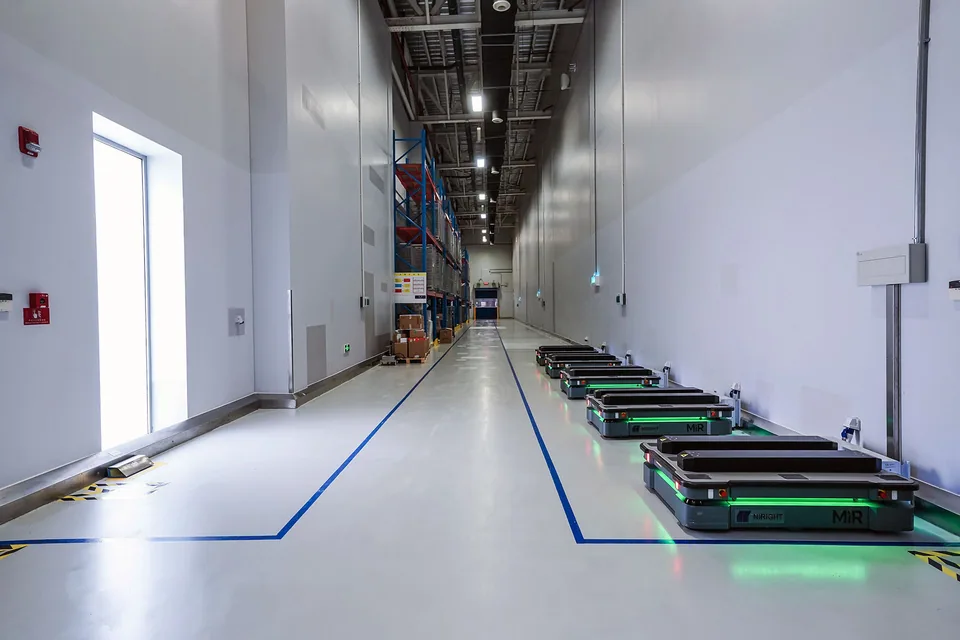
Denmark's MiR (Mobile Industrial Robots, part of the Teradyne Robotics group alongside Universal Robots) places the MiR1350 at the top of its range: it is the highest-capacity model among the seven AMR platforms in the company's portfolio, with a payload of 1,350 kg.
The product sheet states outright a maximum speed of 1.2 m/s and a battery runtime of up to 9 hours 50 minutes; what it lacks are dimensions and price (those sit on a separate specification page). MiR does not publish a price list and points interested buyers to an ROI calculator and its sales network, which is typical for heavy AMR platforms sold as projects rather than from a catalog.
The robot navigates with laser scanners and 3D cameras, with no floor markings, and is designed for transporting pallets and heavy loads in-plant logistics. In the heavy AMR segment, the direct competitor is the Omron LD-450, although that one offers a clearly lower payload; the MiR1350 aims more at the class of forklifts and logistics tugger trains.
A strength is its place in the broad, proven MiR family (from the MiR250 to the MiR1350) with unified MiRFleet fleet software, which makes it easier to scale a mixed fleet. A weakness is the lack of an explicit price and technical specification: a purchasing decision requires direct contact with the manufacturer or an integrator.
Availability in Poland through the MiR dealer network is likely, but has not been independently confirmed by sources.
Data checked: · Sources: 1
Data from manufacturer datasheets and product pages; median over the models of this category in the database.
no data
The manufacturer does not publish a price list for the MiR1350; the price is set individually by the sales network, and only an ROI calculator is available. We therefore give orders of magnitude only, as estimates. General market estimates for the heavy AMR class put it in a range of 85,000 to 150,000 USD (an industry source, not model-specific data). A Polish market overview gives 120,000 to 200,000 PLN (≈ EUR 45,830 at NBP rate 4.3641 of 21 October 2026) for a robot of the MiR250 class; the MiR1350, as the largest model, will by nature sit further up that scale. The robot comes with costs that are easy to forget: fleet management software (80,000 to 300,000 PLN (≈ EUR 68,740) or a subscription, according to the Polish overview), integration with WMS/MES (50,000 to 250,000 PLN (≈ EUR 57,290)) and charging stations (15,000 to 40,000 PLN (≈ EUR 9,170)). Add operator and maintenance training and a safety review of the route. See “Poland's Robotization Tax Relief”: Poland's robotization tax relief (ulga na robotyzację) lets you deduct an extra 50% of costs, but it applies to "industrial robots" in a narrow definition, and its validity after 2026 depends on an announced amendment. Check with an adviser whether an AMR would qualify. The method for calculating total cost is shown in “Humanoid Robot TCO: How to Calculate Total Cost”.
No confirmed distributor in Poland
The MiR1350 is the heaviest of the seven AMRs from Denmark's Mobile Industrial Robots, with a payload of 1,350 kg, a speed of up to 1.2 m/s and a battery runtime of up to 9 hours 50 minutes. It navigates using laser scanners and 3D cameras, so it needs no magnetic tape on the floor. In production it earns its keep in inter-operation transport: it picks up a pallet from a station, carries it to the next stage and returns for another. In internal logistics it can replace the shuttle routes of forklifts: finished-goods warehouse, shipping zone, buffer ahead of assembly. In food and packaging, heavy pallets are an everyday reality, so the payload makes practical sense here, not just marketing sense. The smaller models in the family, the MiR250 and MiR600, take lighter loads, and the MiR1350 handles what they cannot lift. An advantage is the shared fleet software: the MiR1350 can run alongside its lighter siblings, which makes it easier to scale from one robot to a mixed fleet. A general description of the technology is in the article “AMR Robots in the Warehouse”, and the full list of machines in this class is in the category “Mobile robots (AMR)”. Industrial applications are covered in “Factories and manufacturing” and warehouses.
The MiR1350 makes sense where heavy pallets travel the same routes many times a day and forklift drivers are scarce or busy with more important tasks. It is an offering for mid-size and large manufacturing plants, logistics centers and companies that already have an established material flow and want to stabilize it.
It is not a robot for a small company with a single hall and a few pallets a day: integration costs will quickly outweigh the savings. Nor is it suited where the hall layout changes weekly and people and forklifts mix without designated zones, because then the robot will keep slowing down and yielding. If your loads rarely exceed 250 kg, the lighter MiR250 or Omron LD-60/90 will do. Before you ask for a quote, count the number of trips and the distance: those, not payload alone, decide the return on investment.
For the MiR1350 itself there are no confirmed, documented deployments, either in Poland or worldwide. For the MiR family in general, the manufacturer's case studies name plants of Cummins, DENSO and Faurecia, mainly for inter-operation transport. No confirmed deployments of the MiR1350 itself; MiR robots are sold by several authorized integrators, and the lighter MiR100 and MiR250 work in plants and logistics centers. Before deciding, ask the integrator for a visit to a plant where any MiR robot is running: a drive through a hall with real foot traffic tells you more than a product sheet.
The closest family is Mobile Industrial Robots's own range. The MiR600 carries 600 kg at up to 2 m/s; for most European pallets that is enough, and it travels faster than the MiR1350. If the load is lighter, the MiR250 will be a cheaper and more agile choice.
Among competitors, the KUKA KMP 1500P stands out with a 1,500 kg payload, more than the MiR1350, and the KUKA KMP 3000P serves truly heavy loads; both come from Germany's KUKA, which often wins where a plant already has robots of that brand. An interesting alternative is the AGILOX OCF (1,500 kg payload), based on swarm navigation with no central server. At the other extreme stands the OTTO 1500 with a 1,900 kg payload. With heavy pallets, the choice is usually settled by an integrator who can serve your region and by compatibility with robots already working in the plant. The MiR1350's speed (up to 1.2 m/s) is lower than the MiR600's, so with many runs per shift compare transit times on your own route.
MiR was founded in 2013 in Odense, Denmark, and today operates within Teradyne Robotics, together with Universal Robots. The AMR family has grown to seven platforms, from the light MiR100 to the MiR1350, which the manufacturer describes as the strongest model in its portfolio. The exact launch date of the MiR1350 is not given, so we do not state it, and no events are on record for this model. What is visible is the logic of the family's development: successive platforms joined the shared MiRFleet fleet software so that a customer could start with one robot and add heavier machines without changing systems.
No. The manufacturer Mobile Industrial Robots (Denmark) names no Polish shop or official distributor for the MiR1350; enquiries go through the manufacturer's website (mobile-industrial-robots.com). Confirm service in Poland before buying.
The MiR1350 carries up to 1,350 kg, making it the strongest model in MiR's seven-platform range.
The manufacturer does not publish a price list. The price is set individually by the MiR sales network, and only an ROI calculator is available.
Mobile Industrial Robots (MiR), based in Odense, Denmark, part of the Teradyne Robotics group, which also includes Universal Robots.
Author, source and licence of the photo are given in the caption. Shop links may become affiliate links in future, details: How we make money · How we check