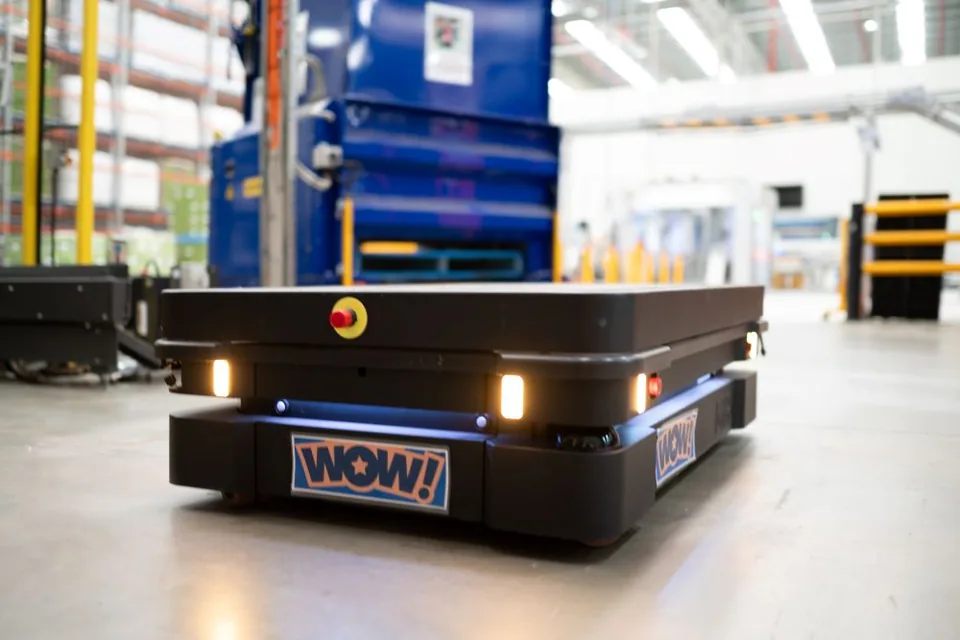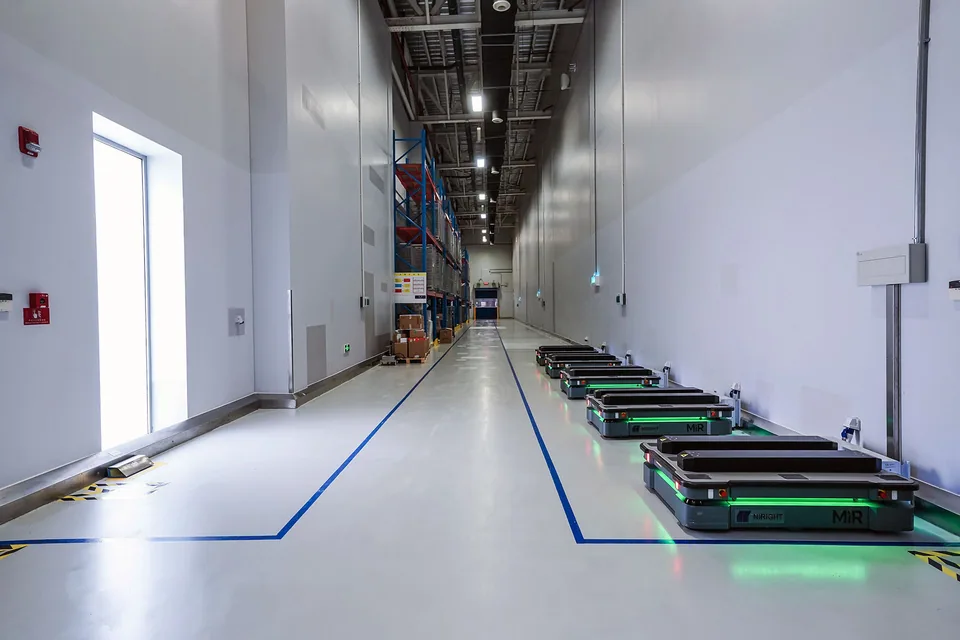
Mobile Industrial Robots (MiR)
Compare
A comparison of the MiR600 and the MiR1350. Both come from Denmark's Mobile Industrial Robots, both drive without magnetic tape, both carry pallets and both are offered “on request”, with no public price list. The question is whether it is worth paying extra for 1,350 kg if most pallets weigh less than 600. Below we set the two robots side by side in numbers and show that this is not a better-or-worse choice, only a matter of matching the tool to the load. The context of the whole category is described in “Mobile robots (AMR)”.
| Feature | MiR600 | MiR1350 |
|---|---|---|
| Manufacturer | Mobile Industrial Robots (MiR) | Mobile Industrial Robots (MiR) |
| Price (PLN) | no data | no data |
| Payload (kg) | 600.0 | 1350.0 |
| Speed (m/s) | 2.0 | no data |
| Status | on sale | on sale |
The most important difference is payload: the MiR600 carries up to 600 kg, the MiR1350 up to 1,350 kg, which is 2.25 times more. The extra payload is paid for in speed. The MiR600 travels at up to 2.0 m/s, the MiR1350 at up to 1.2 m/s, so 40 percent slower. The MiR1350 runs on its battery for up to 9 hours 50 minutes; for the MiR600 the maker gives neither runtime nor battery capacity.
Dimensions and weight are given only for the MiR600: 1350×910×322 mm and 240 kg. For the MiR1350 the product card does not contain them. Both robots use the same set of sensors, laser scanners and 3D cameras, and navigate without floor markers, which sets them apart from older AGVs on magnetic tape. The MiR1350 has the highest payload of the seven AMR models in the maker's range, and both can run under the same MiR fleet software. We describe reading such datasheets and comparing them with hall requirements in “How to Read a Robot Datasheet”. Before deployment it is also worth checking safety requirements (“Robot Safety Standards”).
Prices are not public. MiR publishes no price list for either model; it points to an ROI calculator and to its sales network. For the MiR250 class, Polish sources indicate PLN 120,000–200,000 (≈ EUR 27,500–45,830 at NBP rate 4.3641 of 21 October 2026) for the robot alone, to which come fleet software (PLN 80,000–300,000 (≈ EUR 18,330–68,740) or a subscription), WMS/MES integration (PLN 50,000–250,000 (≈ EUR 11,460–57,290)) and charging stations (PLN 15,000–40,000 (≈ EUR 3,440–9,170)). For the heavier MiR600 and MiR1350 there are no public prices, so we quote no figures; one can assume the robot cost will be no lower than in the MiR250 class, but that is a cautious assumption, not data.
In Poland MiR has several authorised integrators, among them ASTOR, ProCobot and Lintegra, which eases deployment and service; for the MiR1350 availability in Poland is likely but has not been confirmed separately. The text “Humanoid Robot TCO: How to Calculate Total Cost” shows how to calculate total cost, and tax relief for firms is covered in “Poland's Robotization Tax Relief”; whether an AMR qualifies for the robotisation relief is for a tax adviser to decide.
The MiR600 is a universal workhorse for pallets on fixed routes where throughput counts: higher speed and 600 kg of payload suffice for most pallets of finished goods or raw material between the line and the warehouse (factories). The MiR1350 makes sense for the heaviest pallets, containers and tool trolleys, where the alternative would be a forklift. For loads under 250 kg the lighter MiR250 will be the better fit. If you are comparing offers from other firms: the KUKA KMP 600P (600 kg) and the KUKA KMP 1500P (1.5 t) have, according to the maker, a Polish representative, while the OTTO 1500 carries up to 1,900 kg at 2 m/s.
The difference lies purely in payload and the use that follows from it: the MiR600 carries loads of up to 600 kg, the MiR1350 more than twice as much, up to 1,350 kg, which makes it the right choice for the heaviest pallets and warehouse containers. The MiR600 has a documented speed of 2.0 m/s; no comparable value is given for the MiR1350, which may reflect an engineering trade-off between mass and speed at higher loads. Both models use the same set of navigation sensors, 3D cameras and laser scanners, which suggests a shared MiR navigation software platform across the product family. Neither model has a public price. Both target the same sectors, industry and logistics. The choice between them comes down to one question: the maximum weight of the loads to be moved at a given plant.
Pallets up to 600 kg, fixed routes and a need for speed: the MiR600. Loads above 600 kg but below 1,350 kg: the MiR1350, accepting the lower speed. A large plant with heavier pallets and an integration budget should choose the MiR1350; a small firm will not recoup the cost if loads are few. Before ordering a robot, weigh the heaviest pallet, measure the route and ask the integrator for a throughput simulation. Remember that the slower MiR1350 may need more robots on the same route if pallets per hour are what counts and loads stay under 600 kg. The comparison rests on data from the manufacturer, not on our own tests.
The MiR1350 carries 1,350 kg, more than twice the 600 kg declared for the MiR600.
Yes. Both platforms use 3D cameras and laser scanners for navigation.
A speed of 2.0 m/s is given for the MiR600; no comparable value is available for the MiR1350, probably because of its heavier load.
Yes. Both navigate with laser scanners and 3D cameras, without floor markers.
The maker publishes no prices. An offer is prepared through the MiR sales network.