prototype
Manufacturer
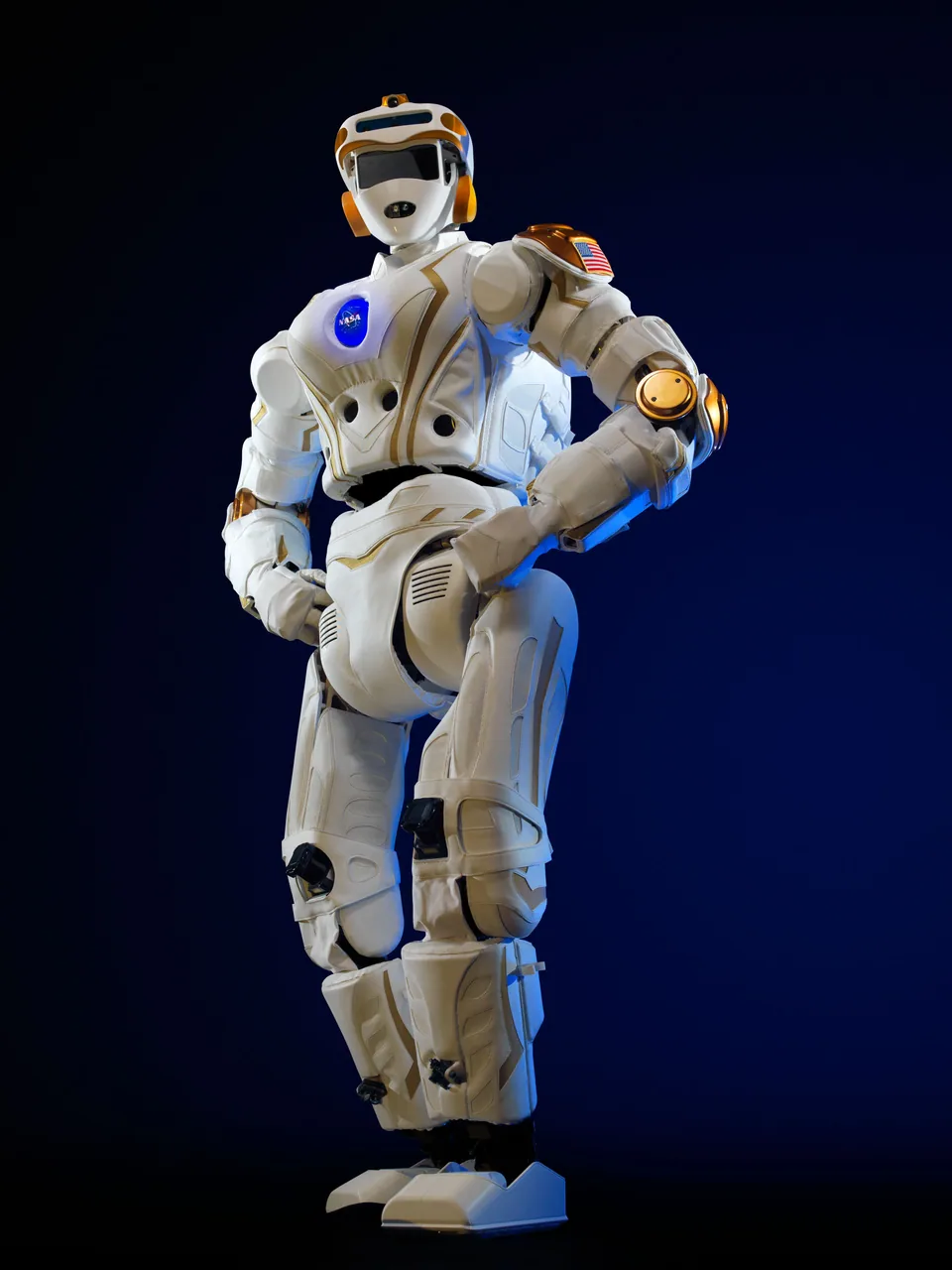
Research humanoid Valkyrie (R5, 2013) from Johnson Space Center: went to MIT and Northeastern with a USD 500,000 grant.
NASA's robotics program at the Johnson Space Center in Houston is behind Valkyrie (R5), a humanoid robot whose prototype was completed in July 2013 for preparatory tasks ahead of crewed planetary missions and as a potential assistant to astronauts.
In 2015 two units went to research teams at MIT and Northeastern University together with a USD 500,000 grant, and the robot was also used in NASA's Space Robotics Challenge. It is a purely research project, not a commercial product, so there is no question of price, availability in Poland or a service network.
Among other research humanoids of that period, such as TALOS from Spain's PAL Robotics, Valkyrie stands out for the scale of its public funding and its direct link to space missions. The organization gives no information on the platform's fate after 2015 or its current status.
NASA's robotics programme at the Johnson Space Center in Houston is behind Valkyrie, also designated R5. The prototype humanoid was completed in July 2013 for preparatory tasks ahead of crewed planetary missions and as a potential assistant to astronauts. An important caveat at the outset: this is not a company but a space agency, so there is no corporate founding year, funding round or valuation here. In 2015 NASA handed two units to research teams at MIT and Northeastern University, together with a grant of USD 500,000. That allowed the universities to develop software for a machine they could not have built themselves. The robot was also used in the NASA Space Robotics Challenge. The manufacturer gives no further fate of the platform after 2015, and we do not know its current status, so we will not guess whether the project continues or has been closed. The history of Valkyrie is therefore short and well documented at only a few points: the prototype's debut, the hand-over to universities and the competition. This is the typical fate of a research humanoid: it is created as a technology demonstrator, goes to laboratories, and its technology spreads through publications and later projects. For the context of today's market, read “Humanoid Robot Market Forecasts”.
In our overview NASA's portfolio contains one robot: the Valkyrie. The machine is 187 cm tall, weighs 136 kg and has 44 degrees of freedom (DOF). Drive is electric, and onboard are two Intel Core i7 processors connected over Ethernet and Wi-Fi. Battery runtime is limited to about an hour, which reflects the experimental rather than production character of the design. The data come from NASA's official R5 page. The robot was built for preparatory work ahead of crewed missions and as an assistant during such missions, for example for initial tasks in difficult or dangerous environments. The manufacturer gives neither payload nor walking speed. Valkyrie is not for sale, so there is no price or offer. To understand what 44 degrees of freedom means, read “Degrees of Freedom (DOF) in Humanoid Robots”, and we write about humanoid drives in “Actuators in Humanoid Robots”. Similar research prototypes are gathered in the category “Humanoid robots”. A configuration with two processors and wired and wireless connectivity suits a research platform on which teams can develop their own control software, which is borne out by the robot's hand-over to universities.
NASA has no market position because it does not sell robots: Valkyrie is a closed research project. Its position can be judged only technically and scientifically. Against other research humanoids of that decade, such as the Atlas from Boston Dynamics or Japanese designs of the HRP series, Valkyrie stood out for its large number of degrees of freedom but lagged behind them in the dynamics of movement. Of the European counterparts, the closest is TALOS from PAL Robotics, the PAL Robotics TALOS. Among other public institutions in our overview, the TORO from Germany's German Aerospace Center, Institute of Robotics and Mechatronics and the HUBO 2 Plus from Korea Advanced Institute of Science and Technology have a similar character. NASA's distinguishing feature is the scale of public funding and the direct link to space missions. There are no market-share data and there should be none, because there is no market. For the reader this means that comparisons with commercial firms make sense only as an illustration of technology, not as an assessment of an offer. A good reference point for the market is the text “How Much Does a Humanoid Robot Cost in 2026”.
Valkyrie is not present in Poland: it is a closed NASA research project, with no plans for commercialisation, no distributor, no service and no price. We also have no information on Polish deployments or cooperation with Polish universities on this robot. For a reader in Poland the value of Valkyrie is educational: it shows what a humanoid designed to work in harsh conditions looks like. Whoever wants to learn robotics will find a starting point in “How to Start Learning Robotics in Poland”, and we describe universities and laboratories interested in such platforms in the section “Laboratories”. Buying or hiring such a robot is therefore out of the question, and the only form of contact with the technology is NASA's publications and materials.
Valkyrie is an important research humanoid from the history of space robotics, but not a product. It cannot be bought, there is no price list or presence in Poland, and after 2015 there is no information on its further development. Recommendation: treat it as a source of knowledge about what a platform designed for planetary missions looks like, not as a commercial offer. For those who like the history of technology, we recommend it as an interesting point of reference.
NASA (Johnson Space Center Robotics)