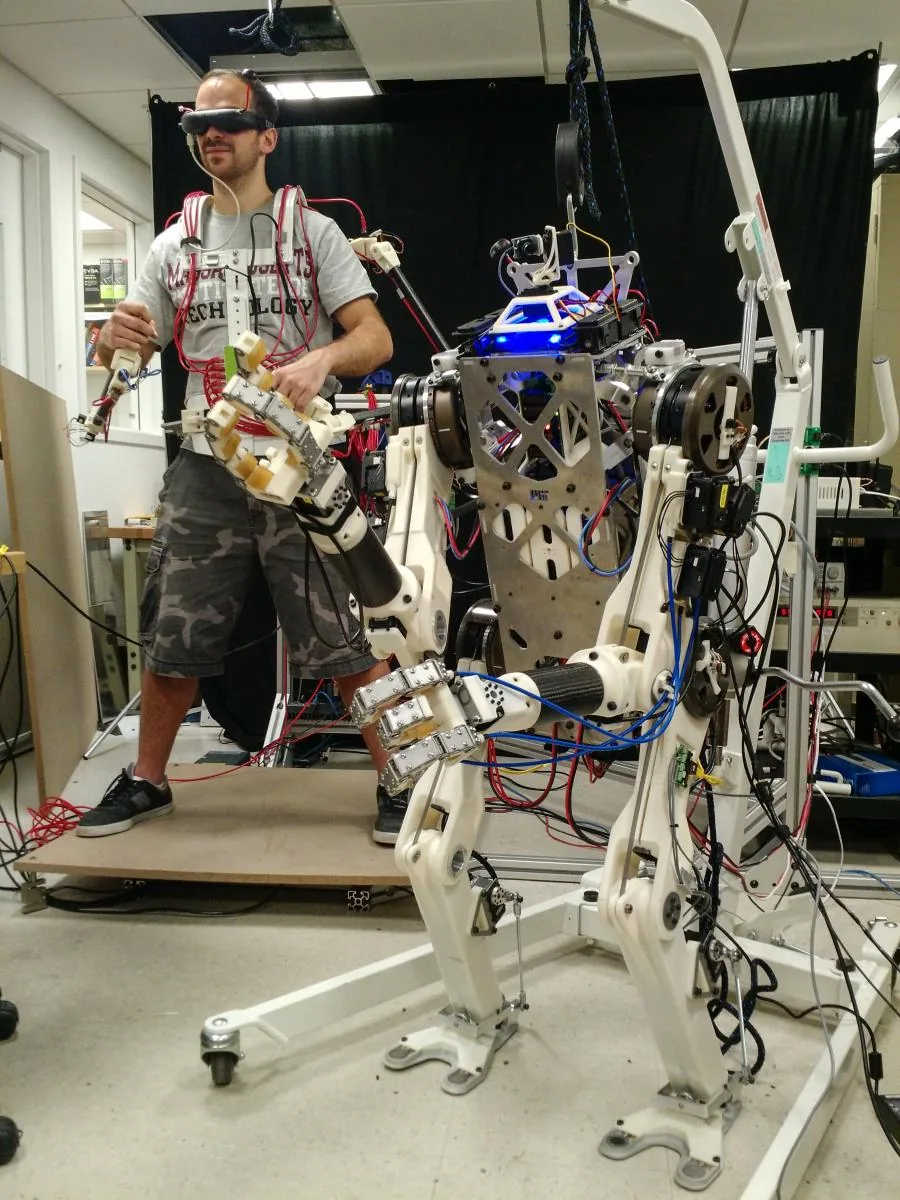
prototype
Massachusetts Institute of Technology (MIT Biomimetic Robotics Lab)Humanoid robots
HERMES
- 45 kgweight
- 24 DOFdegrees of freedom
- —price
Manufacturer
MIT (US): no assigned model, description or specific lab; information limited to the university's name.
The Massachusetts Institute of Technology shows up in general lists of humanoid makers, yet with no assigned model, description, year or any organizational data for a robotics program of its own.
MIT is a research university, not a commercial company, and runs many independent robotics labs, known among other things for quadruped robots and manipulators, but no single project has been confirmed well enough here to describe on its own with technical parameters.
Readers interested in a specific MIT project should go straight to that lab's publications, because the university's name alone carries no informational value without a specific research team.
The institution is recognized worldwide as one of the leading centers for research in robotics, artificial intelligence and automation, and its graduates have founded many of the best-known robotics startups in the world today. Even so, the bare name of the university, without a specific lab or publication, gives a reader looking for a concrete product or technology nothing to work with.
The Massachusetts Institute of Technology in Cambridge was founded in 1861 and has always been a research university, not a manufacturer. That distinction is crucial, because in humanoid roundups the MIT name appears next to companies such as Figure AI or Tesla, although there is no single brand, single team or product line behind it. Many independent laboratories work on robotics there. In our overview we include one of them: the Biomimetic Robotics Lab, author of the HERMES robot. Public sources do not confirm when this lab was established or who is on its team, so we will not state them. We do know that HERMES uses high-torque actuators derived from the Cheetah quadruped project, which means the lab develops the same drive technology across different designs. A description of the robot appeared, among other places, in IEEE Spectrum and in a publication on the lab's own site. What is missing is information on the programme's funding, valuation or staffing, because none of the public sources breaks such data out for a single project. The history of the “manufacturer” MIT is therefore a history of research work, not of a company. If you are interested in how academic research passes into industry, start with “How Does a Humanoid Robot Work” and the overview of humanoid robots. Korea Advanced Institute of Science and Technology is similar in its research character, and we describe its humanoid separately.
MIT's portfolio in our overview is a single model: the HERMES. HERMES is a teleoperated biped built for rescue operations in places too dangerous for people. It weighs 45 kg, has 24 degrees of freedom (DOF), and its drive is electric, based on actuators from the Cheetah project. The build corresponds roughly to 90% of the height of an average person, but we found no exact height in verified materials. The control scheme is unusual: the operator uses a Waldo-type interface, an arm that mimics the movements of the hand, plus a Balance Feedback Interface belt that transfers the pilot's balance movements to the robot. When the person sways, the robot answers with a matching movement of its feet. This sets HERMES apart from autonomous platforms such as the research version of the Atlas and from commercial products like the Unitree H1. The robot is an academic prototype and is not intended for sale. There is no price, because there is no offer. To understand what its parameters mean, read “Degrees of Freedom (DOF) in Humanoid Robots” and “Actuators in Humanoid Robots”. One more point: public materials give neither a declared payload nor a walking speed, so we do not state those values.
MIT has no market position in the commercial sense: it does not sell robots, has no customers and no market share. It does have a scientific position, which has to be judged by other measures. The university is widely recognised as one of the leading centres of robotics research, and the results of its labs influence how commercial robots are built. In HERMES the dependence is visible in the actuators: solutions from the Cheetah project return in a new design. Among the other research units in our overview, MIT is closer to Korea Advanced Institute of Science and Technology with its HUBO 2 Plus and to Germany's German Aerospace Center, Institute of Robotics and Mechatronics with the TORO robot than to companies making humanoids for sale. HERMES stands out for teleoperation based on balance feedback, whereas some rivals bet on autonomy. It is worth adding that no other MIT project has been confirmed here well enough to describe separately with parameters. A reader looking for a specific product should turn to the publications of the particular laboratory, not to the university's name alone.
HERMES is not available in Poland and will not be: it is a research project with no plans for commercialisation, so there is no distributor, no service and no price. We also have no documented Polish deployments or cooperation with Polish institutions concerning this robot. For a reader in Poland, MIT is above all a source of knowledge and inspiration. If you want to start learning robotics, see the guide “How to Start Learning Robotics in Poland” and the text on educational robots “Educational Robots for Schools and Universities”. You will find more on academic uses in the section “Universities and research”. This means a Polish reader can at most draw knowledge from it, not plan a purchase.
In our overview MIT is a scientific curiosity, not a commercial offer. HERMES shows how a biped can be piloted through balance feedback, but it remains a prototype with no price and no availability. There is nothing here to buy or to recommend for deployment. For a reader interested in research it is a good starting point for reading the laboratory's publications. We recommend treating it as reading material, not as an item on a shopping list.
Massachusetts Institute of Technology (MIT Biomimetic Robotics Lab)
Massachusetts Institute of Technology (MIT Biomimetic Robotics Lab)Humanoid robots