prototype
Manufacturer
Toyota's American research center developing the soft humanoid Punyo for whole-body manipulation, so far without a product and without a presence in Poland.
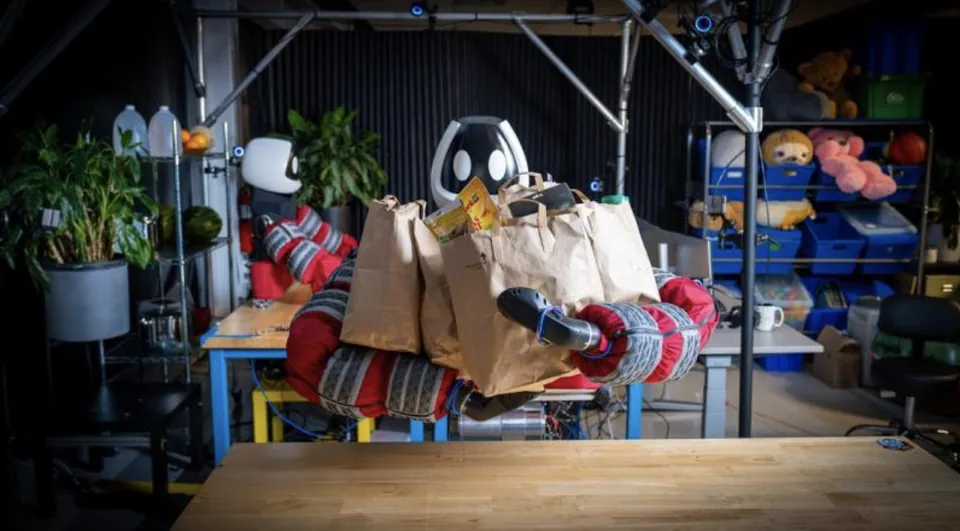
Toyota Research Institute is a California (Los Altos) research unit of the Toyota group, known in robotics above all for the Punyo project, a soft humanoid torso for whole-body manipulation. Instead of rigid grippers, the robot uses 13 air-inflated cushions in each arm, so it can wrap around and lift large, awkward objects such as furniture, grocery bags and cartons, rather than grasping them at single points.
The long-term goal is household help and senior care, but it is still a lab prototype, not a commercial product. Against this background it stands out with a soft-robotics approach versus the rigid arms used, for example, by Boston Dynamics in its manipulators, or the fully humanoid designs of Figure AI.
The strength is safety in physical contact with people and fragile objects; the weakness is the lack of any market date. In Poland the technology is not available, and there is no distribution.
Toyota Research Institute (TRI) is the California research arm of Toyota Motor, based in Los Altos. It is not a robot maker in the usual sense. Its job is to explore technologies that may only later reach products, and in robotics the best-known result of that work is Punyo. It is a legless humanoid torso built for whole-body manipulation. That means a way of working in which the object is embraced by the arms, chest and hands, not just pinched by the fingers of a gripper. The team is led by engineer Alex Alspach. Punyo was conceived with future household help and elder care in mind, where a robot must handle laundry baskets, grocery bags or furniture safely. The institute's own publications and The Robot Report describe the project as a laboratory prototype. They give no market launch date, no price and no planned year of deployment. That leaves no sales history, funding rounds or later product generations that could be described reliably. Public sources do not confirm the year the institute was founded, so we do not state one. We prefer that restraint to inventing a timeline nothing documents. Today TRI is known for one distinctive idea about robotics, not for a commercial track record.
The part of TRI's portfolio that can be described from sources is a single robot: Punyo. It is a humanoid without legs, so it does not travel anywhere, and its point lies in the upper half of the body. Each arm, from shoulder to wrist, is covered with 13 air cushions whose pressure can be adjusted independently. The hands carry inflatable, dot-patterned cushions watched by a camera, and the torso, arms and hands are fitted with tactile sensors. The drive is electric with a pneumatic element. This lets Punyo lift large, heavy or awkward objects, such as furniture or shopping, by wrapping around them the way a person hugs a box. A classic industrial gripper works at a point, whereas here contact is spread across the whole surface of the arms. The approach echoes the thinking behind home robots, where safe contact with people and fragile objects matters more than cycle time. Because the robot is meant to be a household helper one day, the described tasks include carrying food, laundry baskets and furniture. What is missing: the maker gives neither payload nor a count of degrees of freedom, the topic of “Degrees of Freedom (DOF) in Humanoid Robots”, so any comparison with competitors' specifications would be guesswork.
TRI does not appear on the market as a seller, so a market position in terms of share or price cannot be determined. Its place in the technology landscape can be described, though. Most humanoids rely on rigid limbs and grippers. That is how Boston Dynamics works with its electric Atlas, covered in “Boston Dynamics Electric Atlas”, and Figure AI designs its machines along similar lines. Punyo goes the other way: a soft shell and air pressure instead of rigid metal. That is an advantage where contact safety with people and fragile objects counts, and one that is hard to copy for companies built around rigid grippers. The weak side is the purely laboratory status and the lack of legs, because nobody can buy such a robot today or test it in a real home. Compared with commercial designs such as Unitree G1, Punyo plays the role of a demonstration of a research direction, not a product competing on price and availability. For a reader weighing a purchase, the institute is therefore a signal of where the industry may be heading rather than a supplier.
In Poland TRI's technology is unavailable, and there is no distributor or representative. Punyo is a research prototype with no price and no commercial launch date, so there is nothing to import. We also know of no deployments or pilot projects involving the institute on the Polish market. Polish universities and labs that need a humanoid for research can today turn to hardware that is on sale, such as Unitree G1. A general picture of what can be bought is given in “How Much Does a Humanoid Robot Cost in 2026”. The idea of soft manipulation is still worth watching, because household help and elder care are areas where an ageing society, Poland's included, is looking for solutions.
Punyo from Toyota Research Institute is an interesting research direction, but not a product. Soft arms with air cushions give a safe, whole-body grip that rigid humanoids lack. Price, launch date and specifications are missing, and there is no access in Poland. Worth watching, nothing to buy. For the reader it is a signal that humanoids may one day handle people more gently, but only later publications will show whether the idea leaves the laboratory.
Toyota Research Institute (TRI)