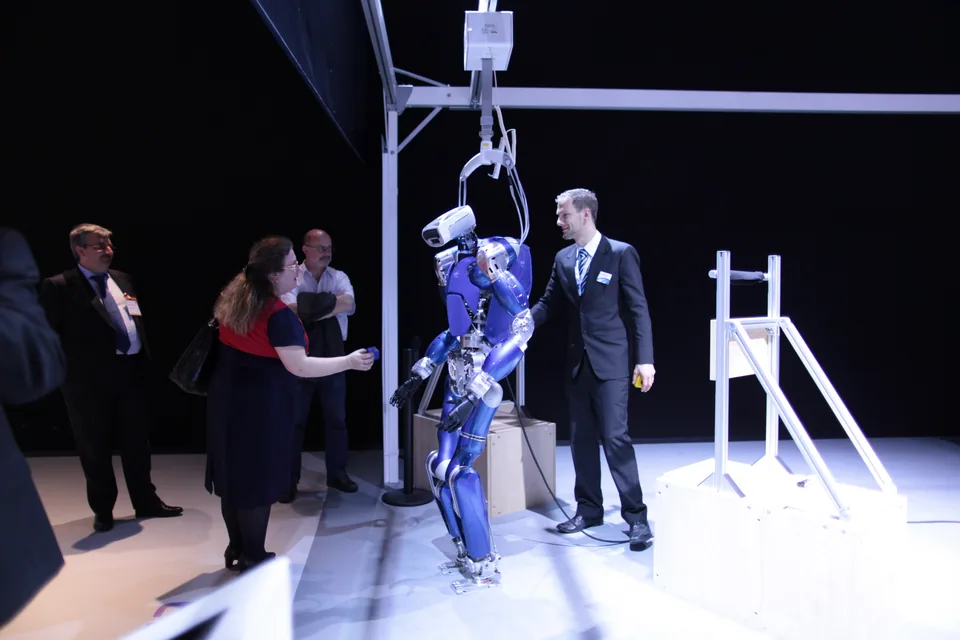
prototype
German Aerospace Center (DLR), Institute of Robotics and MechatronicsHumanoid robots
TORO
- 174 cmheight
- 76 kgweight
- —price
Manufacturer
German research institute DLR: a general entry with no products of its own. The real robotics work happens at the institute in Oberpfaffenhofen.
The German Aerospace Center (DLR), Germany's national research center for aeronautics and space, is the parent body of several robotics projects. There is, however, no overall description of its robotics activity, and no funding figures or complete model list, to go on.
In practice the actual robotics work is carried out by a specialized unit, the Institute of Robotics and Mechatronics in Oberpfaffenhofen, which is responsible for the TORO research robot, among other things. DLR as a whole is a publicly funded research institution, not a maker of robots for sale, so it should not be mistaken for a commercial product line.
More complete technical details are given in the entry for the Institute of Robotics and Mechatronics in Oberpfaffenhofen. Anyone interested in DLR's specific robotics projects should go straight to the institute's own materials, where fuller technical data on the TORO robot is available.
The DLR Institute of Robotics and Mechatronics in Oberpfaffenhofen, Germany, is not a start-up but a research institution with a long track record; our catalog lists it as dating back to 1969. DLR is Germany's national center for aeronautics and space research, and robotics is one of its divisions. Its best-known result is TORO (TOrque-controlled humanoid RObot), shown publicly in 2013 as a development of the earlier DLR-Biped platform. The key idea is torque control in almost all joints, which lets the robot cope better with multi-point contact. Besides TORO, the institute also built a compliant robot called David and a platform named C-Runner. It is worth telling DLR as a whole apart from its robotics institute: the institute does the robotics, while DLR is the parent body. DLR is publicly funded, so there are no investment rounds and no plans to sell; the pace is set by research projects, not quarterly results. That difference has a practical consequence for the reader: you will not find market launches or sales campaigns here, only scientific papers and descriptions of demonstrations. For a look at how research institutions influence commercial humanoids, see “Humanoid Robot Market Forecasts”.
In practice the portfolio is a single robot: TORO. It stands 174 cm tall, weighs 76 kg and has 39 degrees of freedom (DOF), which is a high number even for a laboratory humanoid. Its arms descend from the KUKA-DLR family of lightweight manipulators and lift up to 10 kg. Two IMUs and force/torque sensors in both feet let it keep its balance while climbing stairs or clearing obstacles. There is no price, no distribution and no industrial version. In the humanoid robots category it is a reference entry for researchers, not a product you can buy. The concept of degrees of freedom is explained in “Degrees of Freedom (DOF) in Humanoid Robots”, and how a humanoid works in “How Does a Humanoid Robot Work”. For background on the manipulator family, see KUKA. What matters to practitioners is that TORO shows how much mechanical work hides behind a seemingly simple walk: each of the 39 degrees of freedom needs its own tuning, and the torque control system has to weigh the forces in the feet continuously. That is why the platform remains a benchmark in balance research, even though cheaper designs dominate the market today.
DLR does not compete with commercial manufacturers, which is why you will not find it in price tables. The reference points are the robots now reaching factories: Atlas from Boston Dynamics, Unitree H1 from Unitree Robotics and Agility Digit from Agility Robotics. Their job is to work; TORO's job was to help researchers understand walking and balance. Among European designs with a similar research role, there is PAL Robotics TALOS from PAL Robotics. There is no data on funding or valuation, because this is a public institution. TORO's strength is its research depth and long presence on the scene; its weakness is the lack of a path to commercialization. For an engineer working on biped dynamics, though, it is a reference platform. When comparing, remember the gap of roughly a decade: TORO dates from 2013, so its sensors and computing power do not match the latest commercial designs. The institute's value therefore lies in its knowledge of control, not in its specifications.
DLR has no dealer or official sales representative in Poland, and TORO is not for sale. There is also no documented deployment of the robot at a Polish university. If your university is considering collaboration, the only route is direct contact with the institute, for example through research programs, and its offer is not publicly described. For practical solutions available in Poland, start with “How to Start Learning Robotics in Poland” and “Educational Robots for Schools and Universities”. Alternatives available in Poland, including cheaper ones, are covered in the comparison “Unitree H1, G1, R1 and H2”. For questions about scientific collaboration, a map of the local players will also help: “Polish Robotics Companies”.
TORO is a textbook research robot: solid, well documented and not for sale. For an engineer or student it is an excellent source of knowledge about biped walking; for a company looking for something to deploy, it is the wrong address. If you are looking for a commercial counterpart, turn to humanoid robots. Just remember that this is knowledge from a decade ago, which needs to be supplemented with newer publications and, if possible, contact with the institute itself, because its current projects may go beyond what is described here.
German Aerospace Center (DLR), Institute of Robotics and Mechatronics
German Aerospace Center (DLR), Institute of Robotics and MechatronicsHumanoid robots