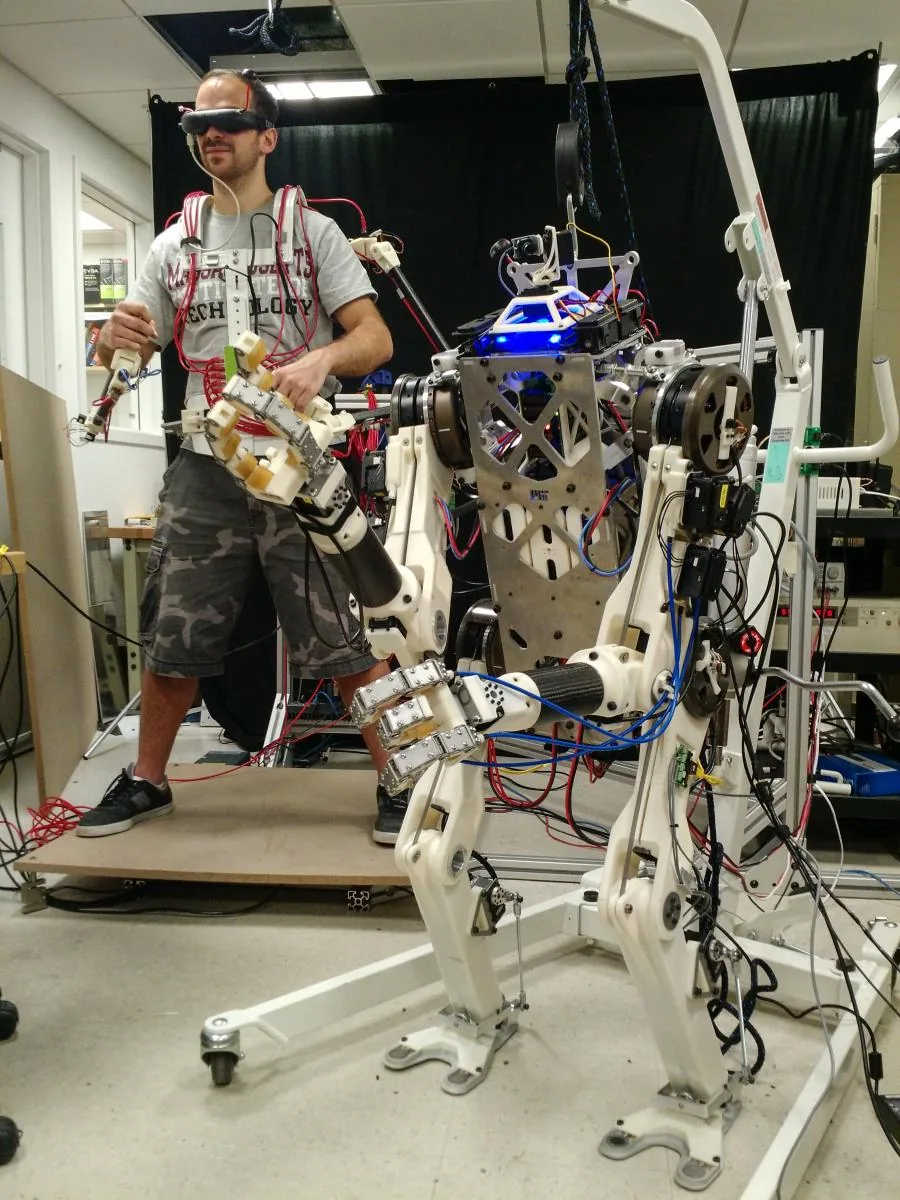
prototype
Massachusetts Institute of Technology (MIT Biomimetic Robotics Lab)
HERMES
- 45 kgweight
- 24 DOFdegrees of freedom
- —price
Data from manufacturer datasheets and product pages; median over the models of this category in the database.
Unveiled in January 2011, the HUBO 2 Plus is the last publicly documented generation of KAIST's HUBO line of research humanoids, preceded by the KHR-3 HUBO (2005), Albert HUBO (2005) and HUBO 2 / Jaemi HUBO (2008-09). The robot stands 130 cm tall, weighs 43 kg and operates autonomously on two legs for about 2.17 hours on a single charge.
Wikipedia (the same source cited here) describes control based on Windows XP with an RTX card for the earlier Albert HUBO (2005); for the HUBO 2 Plus (2011) itself the source gives no control system, so the same specification should not be attributed to it.
It is purely a research platform and is not available in Poland, but it did not remain a one-off prototype with no further fate: KAIST's spin-off Rainbow Robotics, split off in February 2011, produced a small series of 15 units of the HUBO 2 Plus by 2012 and exported 11 of them to research teams in the USA, Japan, Singapore and China (the other 4 went to domestic teams).
So the platform did reach series production and sales or export, though not as a consumer product available to buy. For comparison, among the newer industrial humanoids described here is the much more recent Kawasaki Kaleido 9 (2025), at 190 cm, 99 kg and an 18 kg payload, which shows how far bipedal robot technology has come in fifteen years.
The historical significance of the HUBO 2 Plus is that the platform became the technological base for KAIST's later spin-off, Rainbow Robotics. The model has encyclopedic value for anyone following the history of humanoid robotics and is not available for purchase as a consumer product in Poland.
Data checked: · Sources: 2
no data
We do not know the price of the HUBO 2 Plus and it is not in public sources. The robot is not offered as a product available on the market, so there is no price list, no shopping cart and no distributor in Poland.
What do we know about the scale of the undertaking? By 2012 the KAIST spin-off had produced a series of 15 units, of which 11 went abroad to research teams and 4 stayed in Korea. A small series and institutional orders usually mean individual pricing, estimated at hundreds of thousands of dollars per machine, but that is only an order of magnitude derived from the class of such a design, not a confirmed price.
Operating costs are a separate story. A runtime of about 2.17 hours means the need for facilities to swap and charge batteries, and a research platform needs an experienced team that can start it up and keep it running. Training? For researchers it is part of the team's work, not a separate line item.
It applies to factory-new industrial robots within a specific statutory definition, so a research humanoid bought for research is unlikely to fit in it. You will find a realistic comparison of whole-life costs in “Humanoid Robot TCO: How to Calculate Total Cost”, and indicative market price ranges in “How Much Does a Humanoid Robot Cost in 2026”.
No confirmed distributor in Poland
The HUBO 2 Plus was never meant to stand at an assembly line or in a home. It is a laboratory robot, built so that other scientists could use it to learn to walk, keep their balance and work in an environment made for people. Unveiled in January 2011, it stands 130 cm tall, weighs 43 kg and runs for about 2.17 hours on a single charge, which is as long as a solid experimental session with a break to change the battery.
The platform made it possible to study walking on real, bipedal hardware and not only in a simulator: it was used for research on locomotion, whole-body control and manipulation. According to the data we have, its stated uses are research and the context of the DARPA Robotics Challenge, with the caveat that the latter concerns mainly the earlier generations of the HUBO line and not the HUBO 2 Plus itself.
Industrial use is limited. In a factory this robot will find no work, because it has no documented payload or parameters that would allow a comparison with today's industrial humanoids. In a warehouse, a restaurant or a hospital, no either, because nobody has tested it there in public. Its real "application" today is different: it is a reference point for historians of robotics and for engineers who want to understand where modern designs came from. Anyone studying “How Does a Humanoid Robot Work” will find in the HUBO 2 Plus a textbook example of a complete, electric bipedal robot from before the era of foundation models.
If you are looking for a humanoid robot to work on a shop floor, look at the category “Humanoid robots” or at the article “Humanoid Robots in Factories 2026”. If you are interested in science and teaching, you will find more suggestions in universities and laboratories, which is exactly where this line of designs had its place.
The audience is practically only people who deal with the history and development of humanoid robotics. If you are writing a paper on the evolution of bipedal robots, preparing a lecture or editing a study of Korean robotics, the HUBO 2 Plus is a rewarding starting point: well documented, with a clear lineage and a concrete influence on later companies.
A poor fit: For anyone who is thinking of buying. The model has no price, is not sold as a consumer product and is not available in Poland. Neither a school, nor a company, nor an academic team looking for a robot "off the shelf" will be able to buy it. Nor will you find parameters here such as degrees of freedom, payload or walking speed: the manufacturer does not state them, and we do not fill gaps with guesses.
If your goal is a research platform that can really be ordered, look at Unitree G1 as the cheapest full-size entry point or at LimX Oli. If you want to see what a modern robot of industrial class looks like, go to Kawasaki Kaleido 9. And if you work at a university and wonder what equipment works well in teaching, read “Educational Robots for Schools and Universities”.
Outside Poland the story is more interesting: by 2012, 11 of the 15 units produced went to research teams in the USA, Japan, Singapore and China, and four stayed in Korea. These are strictly research deployments, not commercial ones: nobody bought a HUBO 2 Plus to put it on a production line.
In our catalog we have no documented deployments in services, warehouses or hospitals. If you want to see where humanoids really work today, read “Humanoid Robots in Factories 2026” and “Polish Robotics Companies”, which are a better guide to the market than a single platform from 2011.
Because the HUBO 2 Plus is a historical platform, we choose alternatives by asking: "what would a team that once reached for the HUBO use today?"
Rainbow Robotics HUBO-2: a direct descendant of the same line, developed by the company that grew out of KAIST. If you are interested in where this design led, start here, but remember that there are no public specifications or price.
Unitree G1: a humanoid that is actually available, at about PLN 51,900 (≈ EUR 11,870 at NBP rate 4.3716 of 20 October 2026) (roughly USD 13,400), with an open environment for researchers. Today it is the closest equivalent of a "cheap platform for gait experiments".
HRP-5P: a Japanese research prototype from 2018 (182 cm, 37 degrees of freedom), also not commercially available. Good for comparing approaches: Korea versus Japan.
Kawasaki Kaleido 9: shows what a bipedal robot working at human scale looks like today: 190 cm, 99 kg, 18 kg payload.
LimX Oli: a full-size research humanoid with an open SDK, on which people work today the way they once worked on platforms from the HUBO family.
Massachusetts Institute of Technology (MIT Biomimetic Robotics Lab)
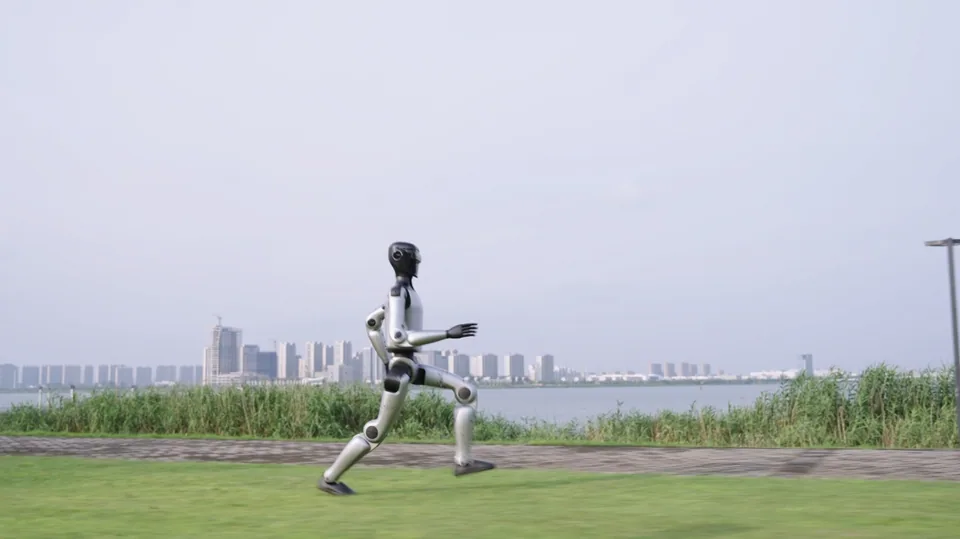
Magiclab (Magic Atom Robotics Technology / Magiclab Robotics Technology Wuxi Co., Ltd.)
The HUBO line began at KAIST in Daejeon with the KHR-3 HUBO and Albert HUBO in 2005. Four years later, in 2008 to 2009, came the HUBO 2, also known as Jaemi HUBO. The HUBO 2 Plus, shown in January 2011, is the last publicly documented generation of this research family.
The most interesting chapter came right after the unveiling. In February 2011 the spin-off Rainbow Robotics separated from KAIST, and by 2012 it had produced a small series of 15 units of the HUBO 2 Plus. Eleven of them went to teams in the USA, Japan, Singapore and China. It is a rare case: an academic platform turning into an export product, although it never reached ordinary retail.
A common error is also worth correcting. Sources that mention control based on Windows XP with an RTX card refer to the earlier Albert HUBO from 2005, not to the HUBO 2 Plus, so we do not attribute that specification to it. Anyone who wants to trace the later fate of the line will find it in Rainbow Robotics HUBO-2 and in the profile Rainbow Robotics, and an introduction to the institution's background in Korea Advanced Institute of Science and Technology.
Model unveiled
The last documented generation of KAIST's research humanoid, unveiled in January 2011.
The manufacturer states about 2.17 hours of operation.
Not as a consumer product in Poland. But it is not an uncommercialized model: KAIST's spin-off Rainbow Robotics produced a small series of 15 units by 2012 and exported 11 of them to research teams abroad.
Shop links may become affiliate links in future, details: How we make money · How we check