on sale
Data from manufacturer datasheets and product pages; median over the models of this category in the database.
The H1-2 is a heavier and stronger variant of the H1 series. At almost the same height (178 cm versus 180 cm) it weighs a full 70 kg, 23 kg more than the base H1, and offers 27 degrees of freedom against the H1's 18. That pays off in payload: the manufacturer quotes a peak value of about 21 kg (continuous capacity of about 7 kg per arm), which the H1 does not declare at all.
The price of the mass is speed: under 2 m/s at most, far less than the H1's record 3.3 m/s. The battery has the same 864 Wh capacity at 67.2 V as in the H1. The compute unit is an Intel Core i5/i7, optionally expandable with up to three NVIDIA Orin NX modules, which suggests it is meant for more advanced perception and manipulation tasks than the basic H1. Sensing includes a 3D LiDAR and a depth camera.
The manufacturer gives neither a price for the H1-2 nor a sales start date, and there is no confirmed availability in Poland and no photo in the source materials. The model is aimed primarily at research centers and integrators who need more payload than the H1 offers, at the expense of walking speed.
no data
The manufacturer does not publish a price for the H1-2, so there is no figure. Reference points from the Unitree family: the G1 in standard version is about PLN 52,300 (≈ EUR 11,980 at NBP rate 4.3641 of 21 October 2026), the H2 about PLN 115,900 (≈ EUR 26,560), and the older H1 about PLN 348,900 (≈ EUR 79,950). The H1-2's price is roughly in the class of several hundred thousand zloty, but that is only an indicative value that must be verified with a seller.
There are costs at purchase that are easy to overlook. The 864 Wh battery does not give all-day operation, so spare cells and chargers go into the budget. The operator must be trained and the work area needs fencing. For a university the real cost also includes the time of doctoral students and engineers. You will find the full costing scheme in “Humanoid Robot TCO: How to Calculate Total Cost” and a price overview in “How Much Does a Humanoid Robot Cost in 2026”.
Qualifying a research humanoid requires an advisor's opinion.
No confirmed distributor in Poland
The H1-2 is a humanoid for those who need strength, not a show of speed. Height 178 cm, mass 70 kg, 27 degrees of freedom (DOF): 6 in each leg and 7 in each arm. Peak payload is about 21 kg, while the source data give a continuous capacity of about 7 kg per arm. The drive stands out for its torque density, about 189 N·m per kilogram according to the manufacturer. In return, walking speed is lower: under 2 m/s, versus 3.3 m/s in the base H1.
Use: above all laboratories. The sensors are a 3D LiDAR and a depth camera, and the brain is an Intel Core i5/i7 processor, optionally with up to three NVIDIA Orin NX modules. It is a configuration on which you can test your own perception, gait and manipulation algorithms, for example in universities or laboratories settings. A research team gets a platform strong enough to carry a load, and so to test grasping heavy objects and holding balance under load.
The second group is companies testing humanoids in logistics. With this payload the robot can move totes and boxes between stations, but remember that the continuous 7 kg per arm is far less than the peak value. The third group is shows and events: a tall, heavy humanoid impresses at trade fairs. Other Unitree models are rented for that purpose, see “Renting a Humanoid Robot for an Event”. For a comparison of the whole series, see the article “Unitree H1, G1, R1 and H2”.
Makes sense for: universities and research centers that want a large platform with enough compute for their own models. R&D departments in companies studying humanoids in logistics or assembly that need a robot with a real payload. Users who want to stay in the Unitree ecosystem with access to Polish sellers.
Less suited to: those who expect a list price, because the manufacturer does not give a price for the H1-2. Companies looking for a fast robot: at under 2 m/s you are better off looking at the H1 (3.3 m/s). Beginners and schools just learning robotics: it is much easier to start with smaller and cheaper models, described in “Educational robots”. We also do not recommend the H1-2 for work near people without a risk assessment: 70 kg in motion requires safety procedures, see “Robot Safety Standards”.
Unitree robots are available in Poland through sellers such as flystore.pl and x-kom.pl, and the company 33bots offers G1 rental with an operator for events and trade fairs.
Globally, Unitree robots appeared on the Vogue World runway in August 2026, and the company showed a humanoid called “Superman” running at 12.66 m/s. There are also controversies: in June 2026 the US Department of Defense added Unitree to a list of companies linked to the Chinese military, and security researchers disclosed vulnerabilities in G1 and Go2/B2 robots in September 2025. For public institutions this is a reason to check the data security policy before purchase, see “Data Security: Robots with Cameras and the GDPR”.
If price and availability matter, check Unitree G1 first. It costs about PLN 52,300 (≈ EUR 11,980), is much smaller, but has Polish sellers and widely documented specs.
For those who need a faster unit from the same company there is the Unitree H1: lighter (47 kg), faster (3.3 m/s), but with fewer degrees of freedom (18) and a lower payload. Its price is about PLN 348,900 (≈ EUR 79,950).
The newer proposal from this family is Unitree H2, at about PLN 115,900 (≈ EUR 26,560). It is a good reference point if you want to avoid overpaying for an older generation.
For a comparison with a Western platform we suggest Atlas: the electric Atlas is by design a product for selected customers, not a research model with a price list (see “Boston Dynamics Electric Atlas”).
If you are looking for another humanoid for gait and manipulation research, you might also consider Fourier GR-2.
Unitree Robotics
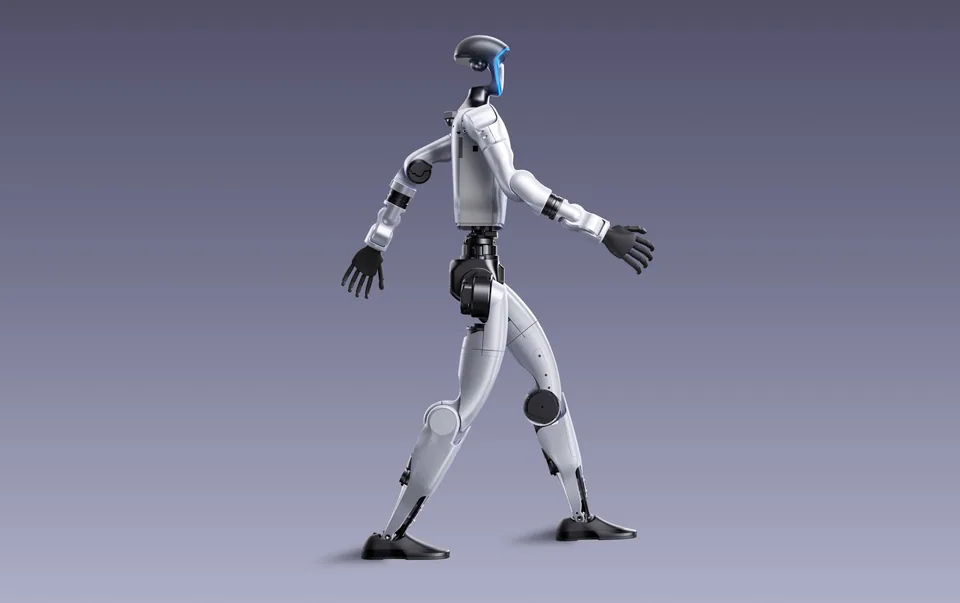

The H1 family began with a video Unitree published in April 2024. In May of that year the company showed the production G1 from about USD 16,000, and in August 2024 the G1 went on sale. In January 2025 Unitree presented the H1 and G1 at CES in Las Vegas, in August 2025 the cheapest R1 went on sale, and in August 2026 the company listed on the STAR Market in Shanghai and raised about USD 905 million. The H1-2 is a development of the base H1: heavier (70 kg versus 47 kg), with more degrees of freedom (27 versus 18) and a higher payload, but slower. The manufacturer's history is covered in the profile Unitree Robotics.
Unitree completes its listing on the Shanghai Stock Exchange; shares rise nearly 500% on the first day Unitree Robotics
Unitree demonstrates its 'Superman' humanoid running at 12.66 m/s, faster than Usain Bolt's world record Unitree Robotics
Unitree Robotics debuts on Shanghai's STAR Market, with shares opening 629% above the offer price; the company raises about $905 million Unitree Robotics
Unitree demonstrates the first fully autonomous humanoid robot fight, powered by the UnifoLM-X2-1.0 model Unitree Robotics
No. The manufacturer Unitree Robotics (China) names no Polish shop or official distributor for the Unitree H1-2; enquiries go through the manufacturer's website (unitree.com). Confirm service in Poland before buying.
The H1-2 is heavier (70 kg versus 47 kg) and has more degrees of freedom (27 versus 18). It offers a higher payload but moves more slowly: under 2 m/s versus the H1's 3.3 m/s.
The manufacturer quotes a peak value of about 21 kg, with a continuous capacity of about 7 kg per arm.
The manufacturer does not give a price for this model.
Shop links may become affiliate links in future, details: How we make money · How we check