research platform
no official photo
Data from manufacturer datasheets and product pages; median over the models of this category in the database.
Pros
- 32 axes of motion and 10-finger hands
- Force feedback: operator feels the robot's resistance
- Force/torque sensors in the joints
- Compact: 154 cm and 75 kg
Cons
- Never offered commercially
- Needs a 170 kg operator rig
- Not autonomous, no price
- 154cmHeight
- 75kgWeight
- 32DOFDegrees of freedom
Key facts
- Specificationsheight 154 cm · weight 75 kg · degrees of freedom 32 DOF
- Statusprototype
- Availability in Polandnot confirmed
- VerdictA teleoperation milestone and today a museum piece; interesting for engineers, useless for businesses.
Summary
- ManufacturerToyota Motor Corporation / Toyota Research Institute (TRI)
- CategoryHumanoid robots
- Statusprototype
- Availability in PolandNo confirmed distributor in Poland
T-HR3 is Toyota's third-generation humanoid, unveiled in November 2017 as a teleoperated platform, not an autonomous one. The operator controls the robot through a body-worn Master Maneuvering System, an external station weighing 170 kg, fitted with VR goggles and force feedback, which lets the operator feel in real time the resistance met by the robot's arms and hands.
The design has 32 axes of motion and 10-fingered hands, with force/torque sensors in the joints providing whole-body coordination and balance. At 154 cm tall and 75 kg, it is relatively small for a demonstration platform. T-HR3 was never offered commercially; it serves to demonstrate remote-assistance applications at home, in medicine, in rescue operations and in space.
Compared with the autonomous Boston Dynamics Atlas or Honda's earlier ASIMO, T-HR3 clearly bets on precise teleoperation at the expense of independence: its strength is force-controlled remote manipulation, its weakness the need for an elaborate external control station. It is not available for purchase in Poland or anywhere else.
Specs
-
Height154 cm−9% vs. the category median (169 cm, n=220)
-
Weight75 kg+19% vs. the category median (63 kg, n=192)
-
Degrees of freedom32+8% vs. the category median (29.5, n=200)
- category medianA higher value doesn't always mean a better robot; it depends on the application.
Dimensions and weight
- Height
- 154 cm
- Weight
- 75 kg
Motion and manipulation
- Degrees of freedom
- 32
- Hand degrees of freedom
- 10
Electronics and AI
- Drive
- electric, teleoperated
- Sensors
- Force/torque sensors at the joints, Head-mounted display feedback
Price and availability in Poland
no data
Running and deployment costs
Purchase. T-HR3 is not for sale and has no price. All that is on record is that it is a research platform with an external Master Maneuvering System weighing 170 kg. So we give no amounts or ranges.
Operation. There is no data on energy or service. Besides the robot you would need an operator station, space, low-latency communications and a trained team. As a rough estimate, the cost of this infrastructure could exceed the cost of the robot itself, but that is a general pattern of teleoperation, not a figure for this model.
Training. The operator has to master whole-body control; there is no training in Poland.
The full method for calculating ownership costs is in “Humanoid Robot TCO: How to Calculate Total Cost”.
Dealers in Poland
No confirmed distributor in Poland
Applications
What it's for
The Toyota T-HR3 is a 154 cm humanoid that repeats the gestures of an operator wearing a 170 kg station with VR goggles (the Master Maneuvering System); the operator feels resistance in the hands when the robot touches an object. It was shown in November 2017, and without that external station the robot is just a set of motors.
Remote work in dangerous places. Toyota points to home assistance, medicine, rescue operations and space as scenarios. This is the potential application of teleoperation: the human stays somewhere safe while the robot goes where it is not worth risking a life. You will meet similar situations in the use-case entries hospitals and construction sites.
Research into force feedback. The robot has 32 axes of motion and hands with ten fingers, with force and torque sensors in the joints. With them the system keeps its balance and coordinates the whole body, and the operator gets feedback. It is a proving ground for engineers who want to know how to transfer "feel" over a distance. How degrees of freedom work is explained in “Degrees of Freedom (DOF) in Humanoid Robots”.
Demonstrations. T-HR3 is a demonstration project; we found no information about it working in a plant or a hospital. It was never sold.
Technical background: the robot is not autonomous. It is no competitor to humanoids with VLA models (which you can read about in “VLA Models: How AI Controls Humanoid Robots in 2026”), but a predecessor of the idea of teleoperated avatars, like the later Honda Avatar Robot.
It is not available in Poland; we discuss similar solutions under “Specialist robots”.
Typical applications
Who it's for
Makes sense for: Engineers and historians of technology who want to learn about the evolution of teleoperated humanoids. R&D teams analyzing force feedback between operator and robot.
Less suited to: Anyone who wants a robot to do work: T-HR3 is not on sale, has a very elaborate operator station and does not act on its own. Not for companies looking for an autonomous humanoid for a shop floor; pick something from the roundup “Humanoid Robots in Factories 2026”.
Not for the home or a hospital either, even though Toyota names them as possible fields of application. Without a technical support team, a low-latency link and an operator who knows the system, the robot remains an exhibit. If you just want to see what the history of humanoids looks like, it is enough to know this design from the manufacturer's descriptions and videos.
Deployments
T-HR3 was a showcase of capabilities and is not offered commercially.
In the category of teleoperated humanoids, prototypes from Japan and the US appear, but most remain in labs. You will not find such robots in Poland; for those interested we suggest the overview “Polish Robotics Companies”, where we have collected domestic companies and integrators.
Comparison
Punyo is Toyota's newer platform, this time an upper half of the body with tactile manipulation; a prototype.
Honda Avatar Robot is a teleoperated hand five times stronger than ASIMO's, controlled by gaze; the same philosophy, a different company. No autonomy and no price.
Valkyrie is NASA's research humanoid from 2013: 187 cm, 136 kg, 44 degrees of freedom. A design built with tasks in harsh environments in mind.
HRP-5P is an AIST prototype from 2018, 182 cm, 37 degrees of freedom; not for sale.
Similar models
- pilot
- on sale
Cyborg Robotics (Shenzhen Cyborg Robotics Co., Ltd. / 深圳赛博格机器人有限公司)
CYBORG R01
- 180 cmheight
- 20 kgpayload
- —price
- prototype
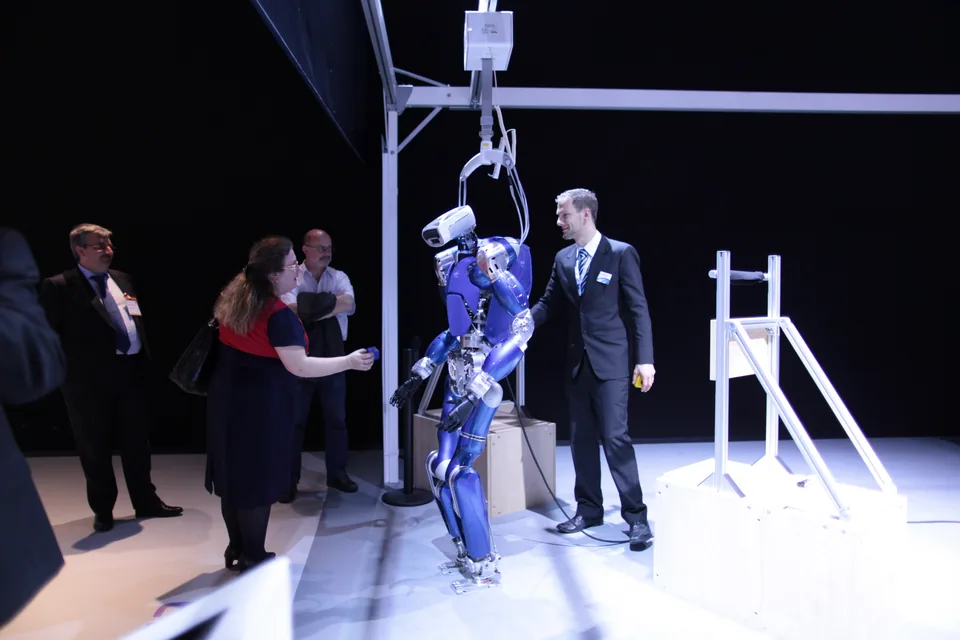 prototype
German Aerospace Center (DLR), Institute of Robotics and Mechatronics
TORO
- 174 cmheight
- 76 kgweight
- —price
 pilot
History
T-HR3 is Toyota's third-generation humanoid, unveiled in November 2017. The design stood 154 cm tall and weighed 75 kg, with 32 axes of motion and hands with ten fingers. From the start it was a teleoperated platform, not an autonomous one: the operator wore the Master Maneuvering System, an external station weighing 170 kg, with VR goggles and force feedback.
Toyota (founded in 1937) works on humanoids as part of a broader robotics strategy. No subsequent events tied to T-HR3 are documented, but seven years later, in 2024, a completely different project was shown: Punyo. The change of direction is telling: from remote control to soft, tactile grasping by a self-operating robot.
Model unveiled
Sources
Frequently asked questions
Is the Toyota T-HR3 available in Poland?
No. The Toyota T-HR3 is a prototype or research platform with no commercial offer in Poland; any sale would be announced by the manufacturer (Japan).
Does T-HR3 work autonomously?
No. The robot is controlled remotely by an operator through an external Master Maneuvering System with force feedback.
How many axes of motion does T-HR3 have?
The design has 32 axes and ten-fingered hands.
When was T-HR3 unveiled?
The robot was shown in November 2017.
Shop links may become affiliate links in future, details: How we make money · How we check