on sale
Data from manufacturer datasheets and product pages; median over the models of this category in the database.
Price from
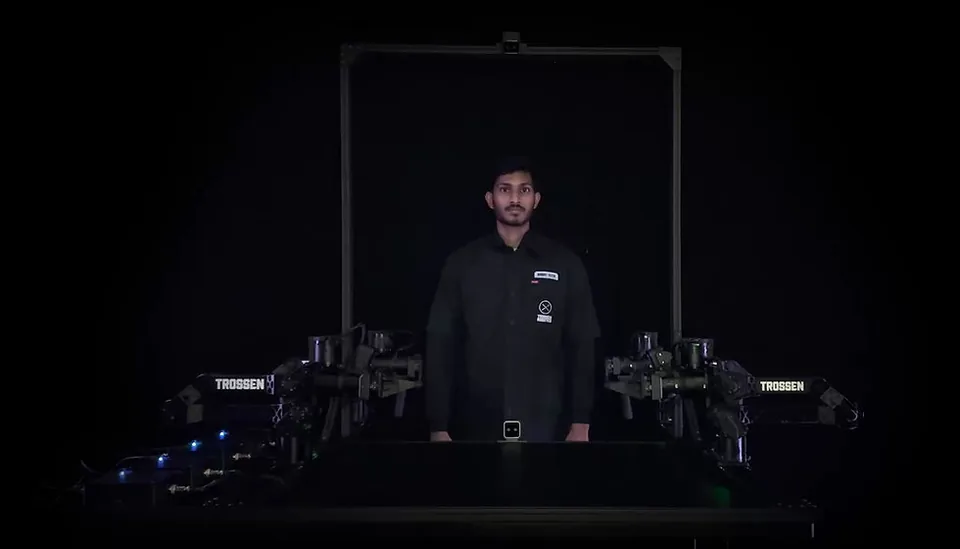
ToddlerBot, developed in Stanford's Hybrid Robotics lab, is a fully 3D-printed, open-source desktop humanoid weighing 3.7 kg with 30 degrees of freedom (7 per arm, 6 per leg, a 2-axis neck and a 2-axis waist), designed as a research platform for machine learning of locomotion and manipulation.
It is powered by an NVIDIA Jetson Orin NX 16 GB, moves at up to 0.25 m/s and carries a payload of 1.484 kg, but battery endurance is only about 19 minutes of active walking, a significant limit for longer experiments.
Unlike commercial research humanoids such as the Unitree G1, which is used in similar educational settings, ToddlerBot has no sale price: only a parts list and open-source assembly instructions are available, so the cost depends on buying the components yourself. Its status is a research prototype, not a commercial product.
It cannot be bought in Poland in the traditional sense, but the documentation is freely available online. Suited to universities and robotics labs building their own test platforms, not to end users.
no data
There is no finished price: ToddlerBot is an open-source project, so the cost is the sum of parts and printing. As a rough estimate, based on the component list alone: servos, the Jetson Orin NX computer, cameras, battery and filament; the total rises mainly with the choice of onboard computer. No exact figure appears, so none is given here. Labor adds to this: assembly, calibration and replacing worn-out servos. The cost of training is team time, not an invoice. Universities usually look for grants and support programs. For a comparison of the costs of ready-made humanoids, see “How Much Does a Humanoid Robot Cost in 2026”.
No confirmed distributor in Poland
ToddlerBot from the Hybrid Robotics lab at Stanford University is a child-sized humanoid with a 3D-printed body that can push a cart, do push-ups and pull-ups. It is an open-source desktop humanoid weighing 3.7 kg with 30 degrees of freedom (7 per arm, 6 per leg, a two-axis neck and a two-axis waist). Its job is not to work for customers but to support research into machine learning of locomotion and manipulation, including two-handed manipulation. It is powered by an NVIDIA Jetson Orin NX 16 GB computer, sees through two fisheye cameras, hears through two microphones and has an IMU sensor. It walks at up to 0.25 m/s and its payload is 1.484 kg. An important limitation: the battery lasts only about 19 minutes of active walking, which means frequent swaps during long experiments. At a university it works well for reinforcement-learning courses and the models described in “VLA Models: How AI Controls Humanoid Robots in 2026”; in a lab it serves as a cheap platform for prototyping algorithms before they move to a larger robot, see laboratories and universities. In a school it can inspire a team project, see schools.
Makes sense for: universities, student science clubs and robotics labs that want to build their own test platform and have a 3D printer, the ability to order components and the patience to assemble them. Doctoral students studying gait on ordinary, inexpensive servos. Teachers who want to show students what a humanoid is really made of; “How Does a Humanoid Robot Work” is a good starting point. Who it does not suit: a company looking for a finished product. ToddlerBot has no commercial price, is not sold, and its status is a research prototype. The documentation and parts list are freely available online, but the cost depends on buying the components yourself. You cannot buy it in a Polish shop and you will not get a warranty. Nor is it a robot for working around people: a 1.5 kg payload and 0.25 m/s speed are the parameters of a research machine, not a service one.
We have no data on ToddlerBot use in Poland. The sources describe research demonstrations: walking, push-ups and pull-ups, pushing a cart, two-handed manipulation. These are laboratory applications, not production ones. In the educational category, ready-made platforms play a similar role, as described in “Educational Robots for Schools and Universities”. Teams that want to start learning robotics in Poland will find guidance in “How to Start Learning Robotics in Poland”. Universities and student clubs looking for ready-made teaching kits can start with the category “Educational robots” and treat ToddlerBot as a project for advanced users.
If you need a ready-made, open educational humanoid, the ROBOTIS OP3 has been sold since 2018, stands 51 cm tall, weighs about 3.5 kg and has 20 degrees of freedom; in Poland it is available through generationrobots.com. With a larger budget, and when a modern research humanoid matters, the Unitree R1 Air costs about 4,900 USD (about 18,993 PLN (≈ EUR 4,340 at NBP rate 4.3716 of 20 October 2026)), stands 123 cm tall and has 20 DOF; it is the cheapest humanoid from Unitree Robotics and is available from a Polish seller. For a team that needs a full SDK and hands with tactile sensors, that leaves the Unitree G1 EDU, though reseller prices run to tens of thousands of dollars. The difference is fundamental: you assemble ToddlerBot yourself, while the others you buy finished. If you want a cheap experiment without a soldering iron, ToddlerBot is still the cheapest route, provided you have the time. For a cost comparison of several ready-made humanoids, see also “Unitree H1, G1, R1 and H2”.
Aldebaran / SoftBank Robotics / United Robotics Group (now Maxtronics)
ToddlerBot was presented in February 2025 in an arXiv paper (2502.00893) by the Hybrid Robotics team at Stanford. The project was open from the start: the design, parts list and assembly instructions were published online, and no finished units are sold. Its status is a research prototype. Beyond this publication there are no dated milestones, so no further generations are listed. A similar spirit, an open platform for researchers, accompanied earlier educational humanoids such as the ROBOTIS OP3, sold since 2018. ToddlerBot belongs to that tradition but goes a step further: instead of buying a finished body, anyone can print one.
Model unveiled
No. The ToddlerBot is a prototype or research platform with no commercial offer in Poland; any sale would be announced by the manufacturer (USA).
Not as a finished product; only open-source documentation and a parts list for 3D-printing it yourself are available.
3.7 kg with 30 degrees of freedom.
About 19 minutes of active walking (0.32 h).
Shop links may become affiliate links in future, details: How we make money · How we check