
pilot
Price from
Swiss start-up RIVR, formerly known as Swiss-Mile and a spin-off of ETH Zurich, built Milo on the hardware of the Unitree B2 quadruped and added a wheeled-legged drive that lets it handle curbs and stairs, the classic obstacle for conventional wheeled delivery robots. The robot is being tested on "last hundred yards" deliveries with the British courier Evri in Barnsley.
In March 2026 RIVR was acquired by Amazon, which means Milo is no longer a product that outside companies can buy, but an internal logistics tool of the giant. Compared with typical wheeled delivery robots, such as the Starship Technologies units that only roll along flat sidewalks, Milo's advantage is that it can climb the stairs up to the customer's door.
Its weakness is the status of the project: it has not moved from pilot to commercial sales, and after the acquisition a market offering is unlikely any time soon. There is no data at all on price, weight or range. It is not available in Poland and is likely to stay that way, given its internal role at Amazon.
The model shows where quadruped-based delivery robotics is heading rather than a real commercial offer.
no data
Milo has no price: it is a non-commercial product for internal use at RIVR/Amazon, with no sales to third parties. So there are no purchase costs that could be discussed reliably. As a rough estimate, looking at the hardware base, Unitree B2, priced at about PLN 387,620 (≈ EUR 88,820 at NBP rate 4.3641 of 21 October 2026) (estimated at USD 76.9-296 thousand depending on the source), the base hardware alone runs to hundreds of thousands of zlotys, and that is before adding the wheeled drive, software and operations. The real cost of such a delivery is not the robot but the whole infrastructure: charging, remote supervision, insurance, integration with the courier's system. Training for operators is limited to fleet supervision. For a Polish business this is a theoretical exercise; if you want to work out the costs of a real delivery or mobile robot, see “Poland's Robotization Tax Relief” (Poland's robotization tax relief, ulga na robotyzację) and “Humanoid Robot TCO: How to Calculate Total Cost”.
No confirmed distributor in Poland
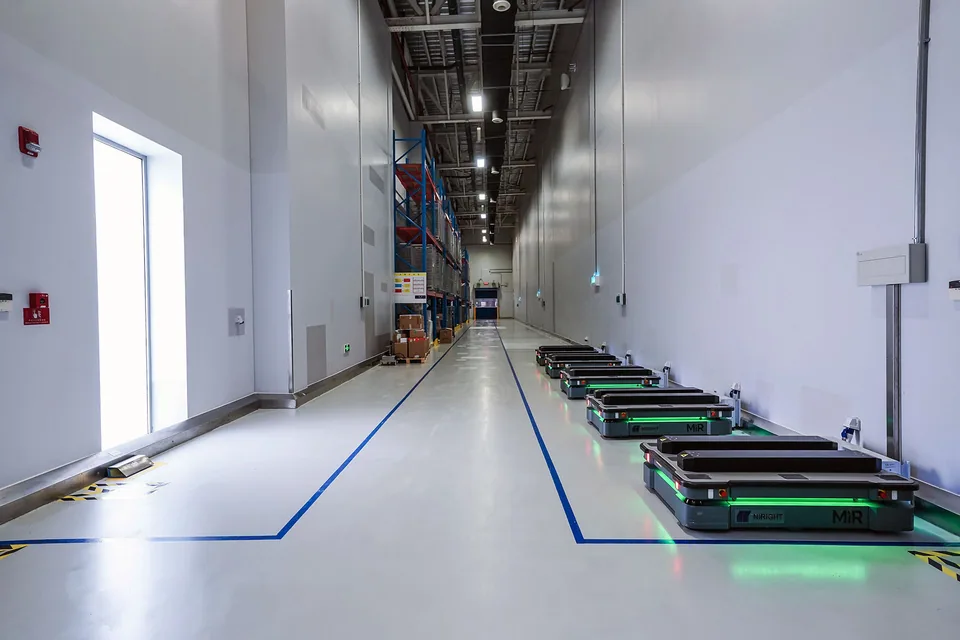
Milo is a delivery robot from Swiss company RIVR (formerly Swiss-Mile, an ETH Zurich spin-off), built on the hardware base of the Unitree B2 quadruped with a wheeled-legged drive added. The wheels provide speed on flat ground; the legs handle stairs and curbs. The key scenario is the pilot with British courier Evri in Barnsley: parcels delivered right to the door. Classic wheeled robots such as Starship Delivery Robot roam sidewalks but stop at the first step. Milo is meant to get past it. What the robot does not do: it will not replace a warehouse robot, since pallets are moved by AMRs such as MiR250. And it is not a product you can buy: after Amazon acquired RIVR in March 2026, Milo is an internal logistics tool. There is no data on price, weight, payload or range. One note on control: it relies on proprietary neural networks trained with reinforcement learning (RL) to coordinate wheels and legs.
Yes: logistics and urban-delivery watchers, courier companies and innovation teams tracking how quadrupeds will change the last mile. Yes: researchers interested in wheeled-legged drives.
No: anyone who wants to buy a robot, because Milo is an internal Amazon project with no sales to third parties. No: Polish courier firms expecting an offer; the robot is not available in Poland and probably never will be. No: warehouse halls, where wheeled AMRs do the job well; read “AMR Robots in the Warehouse”. If you are looking for a quadruped you can actually buy, see “Quadruped Robots: Uses in Inspection, Security and Industry”.
Milo has no recorded deployments in Poland. Abroad, Milo was tested in a pilot with Evri in Barnsley (UK), and the sister robot RIVR ONE with Swiss Post in Regensdorf. These are pilots, not mass production deployments. In the delivery-robot category, the one proven at scale is Starship Delivery Robot, with more than 10 million deliveries. In Poland, more is happening in internal logistics; see warehouses and mobile robots.
RIVR ONE is RIVR's sister robot, tested with Swiss Post in Regensdorf; 30 kg payload, LiDAR and GPS. Same story and same fate: Amazon.
Starship Delivery Robot has made more than 10 million deliveries in 300+ cities and runs up to 18 hours on a battery; it is thoroughly proven, but cannot climb stairs. It is not yet available in Poland.
Unitree B2-W is a commercial wheel-leg hybrid (15 km/h on wheels, payload up to 120 kg) available from resellers; a good pick if you want a similar design you can actually buy.
Pudu T300 is an industrial AMR (300 kg, ISO 3691-4) for transport inside a facility, not for door-to-door delivery.

RIVR grew out of Swiss-Mile, an ETH Zurich spin-off founded in Zurich in 2023. The company raised roughly USD 22 million and built Milo on the Unitree B2 platform. Milo went into a "last hundred yards" delivery pilot with British courier Evri in Barnsley; the demonstration took place in 2025. The key event on the timeline: in March 2026 RIVR was acquired by Amazon. From that moment Milo stopped being a market product. Other events on the timeline do not relate directly to this model. Manufacturer profile: RIVR; Amazon itself is Amazon.com.
Model unveiled
Not off the shelf. The RIVR Milo (delivery quadruped based on the Unitree B2) runs in pilot programmes with selected customers, and there is no official seller in Poland.
No. Since Amazon acquired RIVR in March 2026, it is an internal logistics tool that is not sold to outside companies.
On the hardware platform of the Unitree B2 quadruped, with a wheeled-legged drive added for climbing stairs and curbs.
In a "last hundred yards" delivery pilot with the British courier Evri in Barnsley.
Shop links may become affiliate links in future, details: How we make money · How we check