on sale
Price from
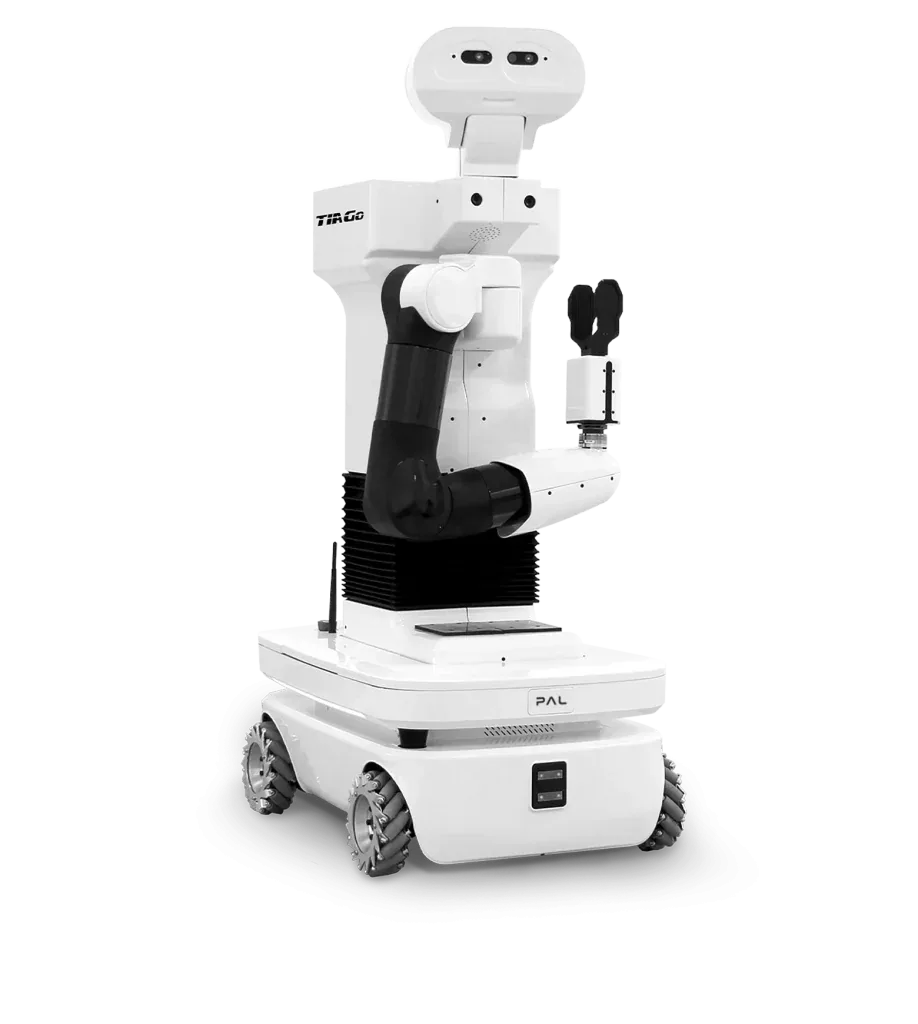
TIAGo Pro is an upgraded version of the TIAGo platform, redesigned around a ROS 2 architecture with gravity compensation in the ros2_controller controller. The robot has 23 degrees of freedom in total, spread across two 7-DOF arms, a single-DOF torso lift with a 35 cm stroke, a 2-DOF head and a 4-DOF drive base on mecanum wheels that allow omnidirectional movement.
The payload remains at the level of the classic TIAGo, 3 kg per arm without a gripper, but the reach is clearly greater: 92 cm vertically and 236 cm horizontally, supported by six safety brakes on the arms and one on the torso.
Navigation and perception are provided by two 360° laser rangefinders (10 m range), an RGB-D head camera, a 10-inch touchscreen and a four-microphone array, while computing is handled by an Intel i5 computer with 16 GB of RAM running Ubuntu with PREEMPT-RT. Unlike its predecessor, the manufacturer has not disclosed the weight, height or battery capacity; this data is not published on the product page.
TIAGo Pro targets the same research labs as the classic TIAGo, offering a newer software stack and wider arm reach at the cost of less transparent physical specifications. The price is not published.
Data from manufacturer datasheets and product pages; median over the models of this category in the database.
no data
The price of TIAGo Pro is not public, so treat any figure as a question for the manufacturer, not a fact. As a rough estimate, based on how dual-arm research mobile manipulators are priced, for example the Reachy 2 mentioned above at about 70,000 USD, expect an amount in the hundreds of thousands of zloty for a complete setup. Beyond the purchase there are costs that are usually forgotten: grippers or hands (the 3 kg payload is given without a gripper), software and licenses, service, battery replacement and engineer time. For a research platform, team time is the biggest item: the first months go to integrating with your own code, not to driving down the corridor. ROS 2 training is not an extra cost only if the team already knows it. Universities usually fund such purchases from grants; an overview of programs is in the funding section.
No confirmed distributor in Poland
The TIAGo Pro is a mobile manipulator designed for research: two arms with 7 degrees of freedom (DOF) each, a torso with one degree of freedom and a 35 cm stroke, a head with two degrees, and an omnidirectional base on mecanum wheels that lets the robot drive sideways without turning. Together that adds up to 23 degrees of freedom, and the arms' reach extends 92 cm vertically and 236 cm horizontally, so they can reach both a countertop and a high shelf. The typical area of use is research on indoor mobile manipulation: learning to grasp, opening doors and drawers, carrying light objects, teleoperation. The manufacturer names the research community and industry as target groups. In industry, the place for such a robot is prototype stations and pilots, where a team checks whether a task can be automated before buying a dedicated cell. In higher education, TIAGo Pro suits universities running serious ROS 2 programs: the entire control architecture is based on ros2_controller with gravity compensation, which makes it easier to work with your own algorithms. Limits: the payload is 3 kg per arm without a gripper, so this is not a machine for moving cartons in a warehouse. Nor is it a product for a restaurant or hotel, since it lacks certified guest-service functions. Keep in mind, too, that the manufacturer does not give the weight, height or battery capacity, so if you are planning to use it on a floor without an elevator or in a narrow corridor, the dimensions have to be confirmed directly with PAL Robotics.
Yes: research teams at technical universities and institutes that build their own algorithms for grasping, motion planning and learning from demonstration and want to work in the ROS 2 ecosystem. Yes: R&D departments in companies that need a platform for prototyping manipulation tasks in a real environment, not just in simulation. Yes: labs with a grant budget for which hardware flexibility matters more than unit price.
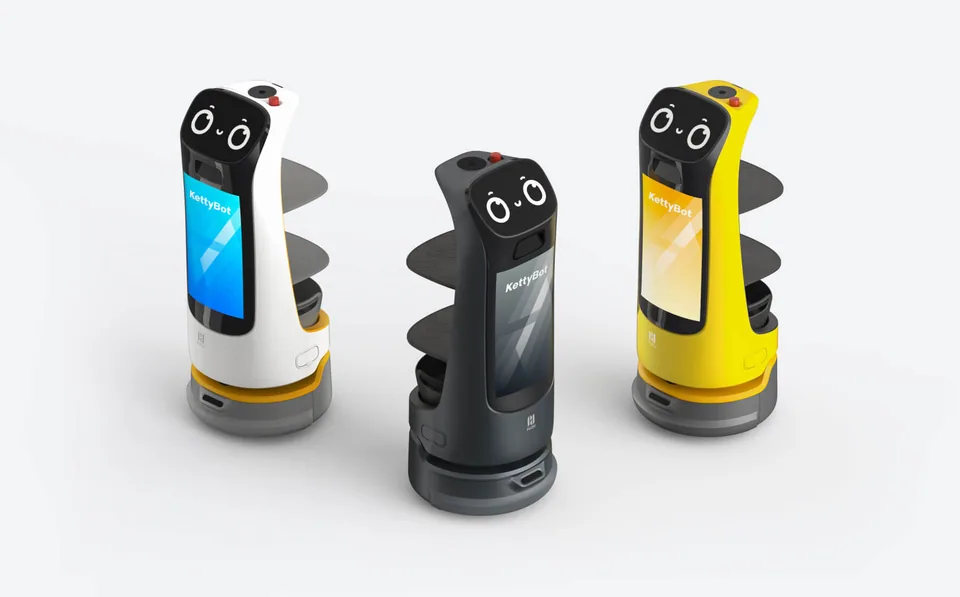
No: small companies looking for a "plug and play" ready-made solution. TIAGo Pro is a platform for people who write code, not a product for a shop-floor operator. No: restaurants, hotels and shops; for guest service there are service robots such as Pudu BellaBot. No: high schools and robotics clubs with a budget of a few thousand zloty; educational robots, which we cover in the category “Educational robots”, make more sense for them. No: anyone who needs a price for a budget today, since the manufacturer does not publish one and the robot has no confirmed distributor in Poland. Beforehand it is worth reading how to make sense of a datasheet: “How to Read a Robot Datasheet”.
TIAGo Pro has no institutions or companies assigned to it, and the model has no official distributor in Poland. We also have no documented deployments abroad for it, so we will not invent any. Mobile manipulators and service robots work in labs and at pilot stations across Europe, and PAL Robotics is one of the suppliers most often associated with such hardware for research communities. Polish universities and companies looking for a similar solution can compare several options from service robots and take a look at laboratories.
The classic PAL Robotics TIAGo is the same manufacturer and the same idea, but an older generation: a 7-DOF arm and a 3 kg payload. Choose it when you do not need the latest ROS 2 architecture and care about a fuller physical specification.
Reachy 2 is a mobile research torso with two 7-DOF arms, ROS 2 and LeRobot integration; it has a price of about 70,000 USD, a concrete figure that TIAGo Pro lacks. A good choice for teams working with imitation learning.
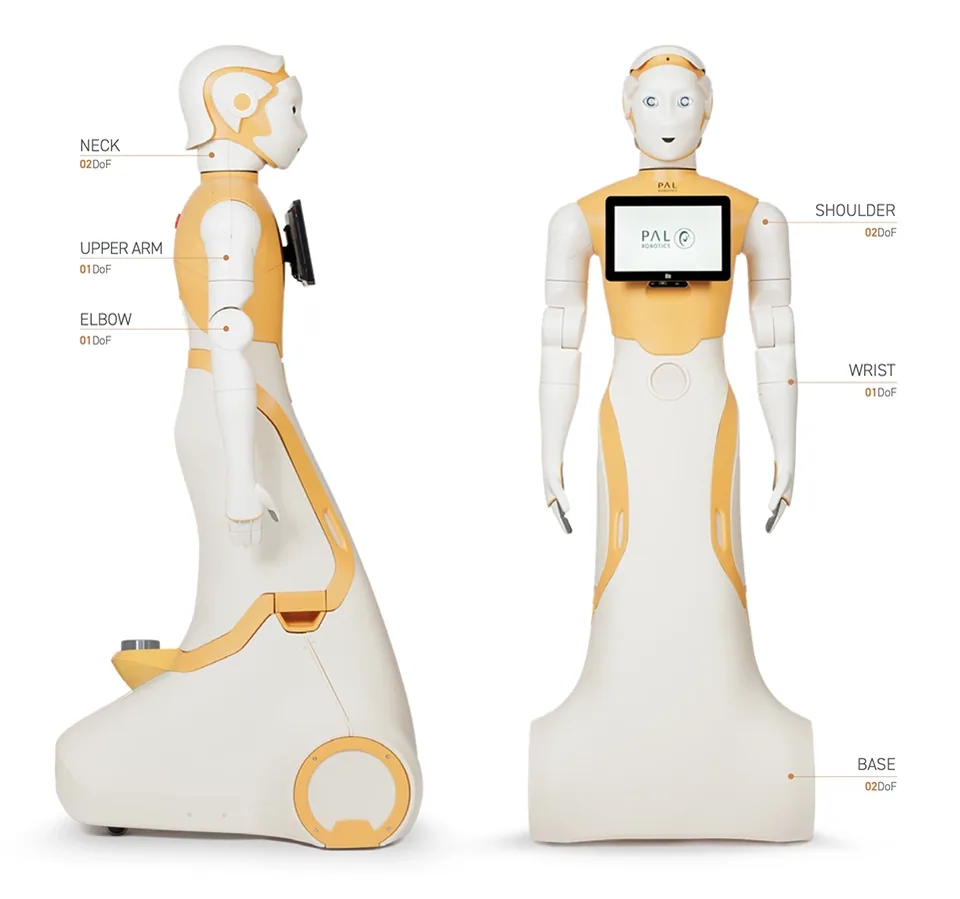
PAL Robotics ARI comes from the same stable, but it is an entirely different role: a social service robot for reception and human-robot interaction research, with speech in more than 20 languages.
Boston Dynamics Stretch is a single-purpose machine, unloading trucks, with a 22.7 kg payload. If your problem is logistics rather than research, it is in another league.
Pudu Robotics (Shenzhen Pudu Technology Co., Ltd.)
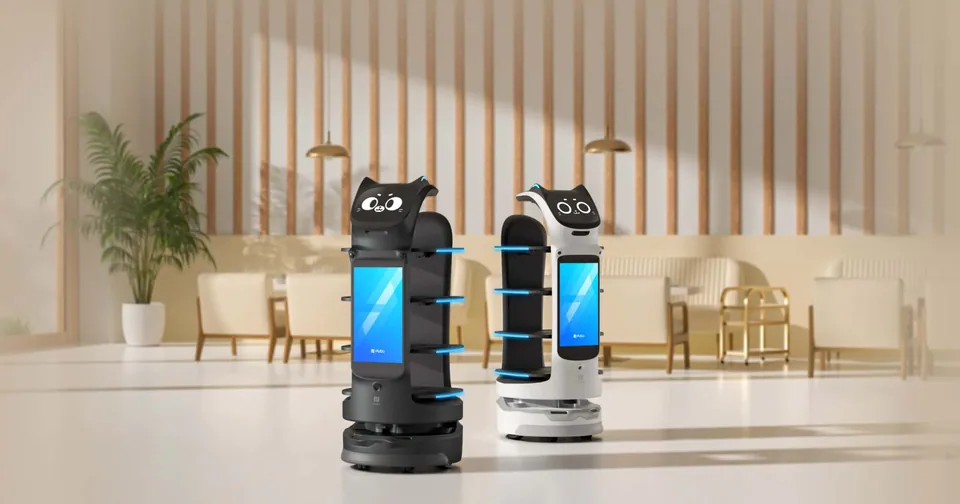
Pudu Robotics (Shenzhen Pudu Technology Co., Ltd.)
TIAGo Pro is a newer take on the TIAGo platform from Spain's PAL Robotics of Barcelona, a company founded in 2004 and known for ROS-based research robots: TIAGo, the humanoid PAL Robotics TALOS and the modular PAL Robotics Kangaroo. We have no launch date for the Pro and no timeline events, so we do not give one from memory. What we know from the product sheet concerns the differences from the predecessor: redesign around ROS 2, gravity compensation in the controller, two 7-DOF arms and greater reach. The datasheet available on the manufacturer's website carries the year 2026 in the file address, which suggests the model is part of the current lineup. More about the company itself: PAL Robotics.
No. The manufacturer PAL Robotics (Spain) names no Polish shop or official distributor for the PAL Robotics TIAGo Pro; enquiries go through the manufacturer's website (pal-robotics.com). Confirm service in Poland before buying.
23 in total: two arms with 7 DOF each, 1 DOF in the torso, 2 DOF in the head and 4 DOF in the drive base.
Up to 92 cm vertically and 236 cm horizontally.
No. Both models have a 3 kg payload per arm; the difference lies in the number of degrees of freedom, the ROS 2 architecture and the reach, not in grip strength.
Author, source and licence of the photo are given in the caption. Shop links may become affiliate links in future, details: How we make money · How we check