on sale
Manufacturer
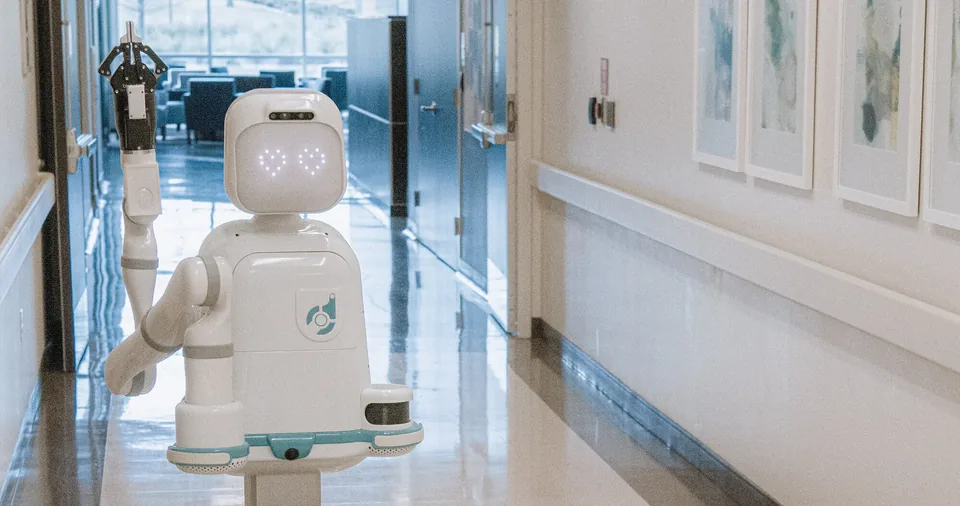
Moxi, a hospital logistics robot with more than a million deliveries, a rare example of documented deployment at scale.
Diligent Robotics, an American company founded in 2017 and led by women, does not build humanoids in the classic sense. Its flagship product, Moxi, is a mobile hospital manipulator with an arm, a gripper, a wheeled base and an expressive “face”, which delivers supplies, lab samples, personal protective equipment and medications between wards.
A single task takes 20 to 26 minutes on average, and the robot fleet has passed one million deliveries, which is rare proof in this industry of real, repeatable operation rather than mere demonstrations. The newer Moxi 2.0 uses NVIDIA computing power that is 10 to 15 times faster than the previous generation.
Competition comes from other hospital logistics robots, though few of them publish operating data as concrete. Presence in Poland is not confirmed.
Diligent Robotics was founded in 2017 and from the start bet on something rare in the humanoid industry: a concrete problem in a concrete place. Instead of building a robot in human form, the US company, led by women, took on hospital logistics. Moxi is a mobile manipulator: a wheeled base, an arm with a gripper and an expressive “face” that eases cooperation with staff. The robot delivers supplies, lab samples, personal protective equipment and medications between wards, and a single task takes 20 to 26 minutes on average. The greatest proof of maturity is a number: the Moxi fleet has passed one million deliveries, as reported by, among others, The Robot Report. The next step is Moxi 2.0, with computing on an NVIDIA Thor module, which according to the manufacturer has about ten times the power of the first generation. Diligent is thus building what industry calls a reference story: documented, repeatable tasks instead of showpiece videos. Such a pedigree sets this company apart from many firms that live mainly on presentations. For the Polish reader there is one more interesting point: this is a company that does not sell a vision but nurses' time. Every task on the list, a sample, a drug, protective equipment, is concrete, countable and easy to verify in hospital records. The context of what robotics looks like outside factories is described in “Service Robots in Restaurants and Hotels”.
The portfolio is compact: Diligent Moxi 2.0 and its previous generation as described by the manufacturer. Moxi 2.0 is an electric, wheeled robot with cameras and a navigation system, whose brain is NVIDIA Jetson in the Thor version. The application is narrow and therefore effective: the duty nurse, instead of running a test tube to the lab, assigns it to the robot and returns to the patient; that is how the company itself presents a scene on the ward. It is not a humanoid but a service robot from the category “Service robots”, and its domain is hospitals. The manufacturer does not publish a unit price: Moxi is offered under fleet contracts, Robots-as-a-Service, with no disclosed amount. What such agreements mean in practice is shown by the calculation in the article “Humanoid Robot TCO: How to Calculate Total Cost”, and the differences between mobile platforms are described in “AMR Robots in the Warehouse”. The name Moxi 2.0 suggests evolution, not revolution: the same idea, but with a newer computing core. The manufacturer says the new module has about ten times the power, which is supposed to translate into faster recognition of the surroundings. We found no weight, arm reach or payload in verified sources, so we don't state them; this is a typical case where a description of the service replaces the spec sheet. For that reason, a comparison with other models has to rest on application, not on a table of parameters.
In hospital logistics, Diligent is compared with platforms such as the Aethon TUG, though there is no data to compare parameters. From the perspective of our lineup, the comparison with service robots from other companies matters more: Pudu BellaBot from Pudu Robotics or Keenon DinerBot T8 from Keenon Robotics work in food service, not in hospitals. Social robots, such as Mirokaï from Enchanted Tools, stand apart. The scale of a fleet with more than a million deliveries is its greatest asset, together with the social acceptance that comes from the robot's “face”. Funding, valuation and headcount are not published, so we don't state them. The weakness is narrow specialization: Moxi will not replace a general-purpose robot, and pricing available only in fleet agreements makes comparison harder for smaller hospitals. It is worth remembering that this is one of the few companies we cover that can point to a number of tasks performed, not just a number of pre-sale orders. That is precisely what sets it apart from some humanoid makers, described for example in the roundup “Humanoid Robot Market Forecasts”.
Moxi 2.0 is not available in Poland and does not appear in our catalog as tested locally. We found no Polish distributor or hospital that has deployed it. For Polish facilities the problem is twofold: no official sales and the need to sign a fleet contract for a model built around American hospital procedures. If you are interested in how Polish hospitals enter robotics at all, see “da Vinci Robots in Polish Hospitals”, and we write about financial support for robotization in “Poland's Robotization Tax Relief” (Poland's robotization tax relief, ulga na robotyzację). Until an official offer appears in Europe, a sensible step for a Polish hospital is to choose from local integrators, listed in the integrators section, and to analyze whether any logistics tasks can be automated with simpler mobile platforms.
Diligent Robotics is one of the better-documented examples of service robotics: a million deliveries is data, not a slogan. For Polish hospitals, however, it is still a model to watch, because without availability and without a public price there is nothing to order. For the director of a Polish hospital it is a signal of where ward logistics is heading, not yet a shopping list. When the company shows a price list and a European partner, we will return to this entry with an assessment of cost-effectiveness.
Diligent Robotics