on sale
Manufacturer
Nasdaq-listed Serve Robotics: 2,000+ courier robots, Jetson Orin, Level 4 autonomy, 99.8% delivery success.
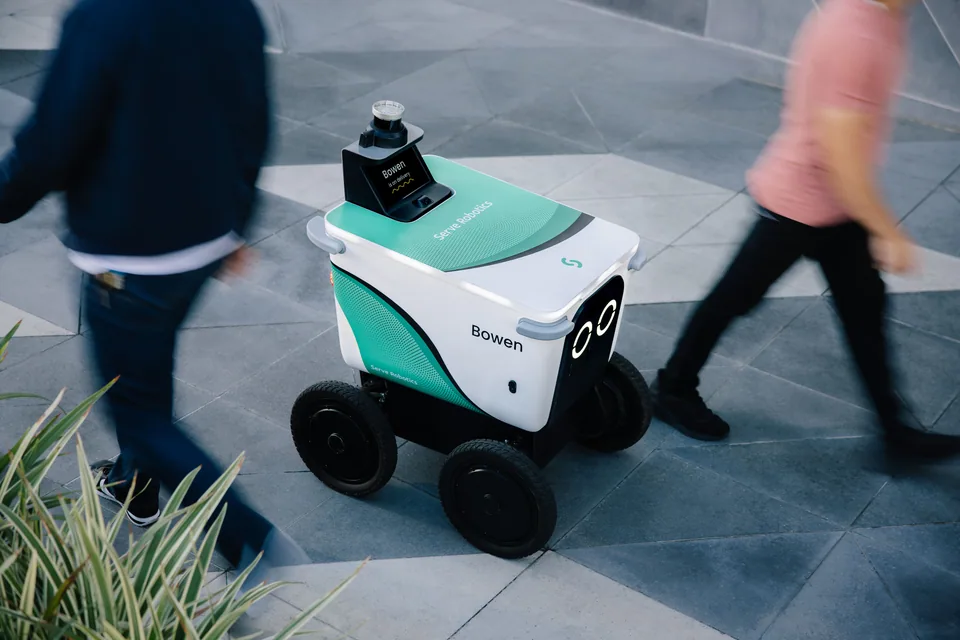
Serve Robotics, a Nasdaq-listed company (SERV) that spun out of Postmates/Uber, runs the largest fleet of sidewalk delivery robots in the US, with more than 2,000 units built. The third-generation robot uses the NVIDIA Jetson Orin computing platform and an Ouster REV7 lidar, and reaches Level 4 autonomy with a claimed delivery success rate of 99.8%.
Compared with Europe's Starship Technologies (more than 10 million completed deliveries, present in over 300 cities), Serve is a younger player focused almost entirely on the American market, but it has the advantage of being publicly listed and having a well-documented third-generation specification.
The manufacturer does not disclose funding beyond its stock market listing, nor any plans to expand to Europe or Poland. For last-mile delivery operators, this is currently a purely American proposition.
Serve Robotics is a company listed on Nasdaq under the symbol SERV, with roots in Postmates and, indirectly, Uber. The founding year and headquarters are not clear-cut in available sources: we know the firm has American roots, but we do not settle dates. It runs the largest fleet of sidewalk delivery robots in the US — more than 2,000 units have been built. The third-generation robot uses the NVIDIA Jetson Orin compute platform and an Ouster REV7 lidar, reaching level 4 autonomy and a claimed 99.8% delivery success rate. The manufacturer does not state this as an SAE level, so it is its own classification. There is no data on funding beyond the stock listing itself, or on expansion plans for Europe. The business model rests on food delivery in cities, not on general-purpose robots. The context is given by the service robots category, and the autonomy components are covered in the NVIDIA Jetson and Ouster profiles. We stress that all figures come from the company's press releases and technical-data sites rather than independent audits, so the claimed 99.8% delivery success rate is a manufacturer value.
Serve offers one robot: the Serve Robotics Gen 3, a third-generation sidewalk delivery robot. The manufacturer says it is about twice as fast and has twice the range of the Gen2, but hard specifications such as dimensions, weight and load capacity have not been confirmed. The robot travels on sidewalks and delivers meals; its brain is an NVIDIA Jetson in the Orin version, and its eyes an Ouster lidar. The claimed autonomy level is 4, with no indication of the SAE scale. No price is given, because the company provides a delivery service rather than selling robots. How to judge such claims is explained in “How to Read a Robot Datasheet”. This robot is not a classic warehouse machine, though the logic resembles that in “AMR Robots in the Warehouse”, and its usefulness comes from operating in urban space, not in a plant. The lack of hard data on dimensions and load capacity makes comparison with other delivery robots difficult, and for an operator what counts is how many orders fit in one trip. For that reason we treat the claim of “twice as fast and twice as far” as a direction, not a measurement.
Serve's closest rival is the European Starship Technologies with its Starship Delivery Robot: according to available data more than 10 million completed deliveries and a presence in over 300 cities. Serve is a younger player focused almost exclusively on the American market, but with the advantage of listed-company status and a well-documented third-generation specification. A third player is Coco Robotics with the Coco 2. Serve's strength is fleet scale, its weakness dependence on a single market and the absence of profitability information. For last-mile delivery operators it is currently a purely American proposition. The general backdrop for service robots is given in the overview “Service Robots in Restaurants and Hotels”, although sidewalk delivery is a separate segment. Serve's advantage is that its partners and components are publicly known, which makes the technology easier to assess; that is rare among robotics startups. On the other hand a scale of 2,000 units speaks of production, not of the number of deliveries, which is not stated.
Serve Robotics has no plans to expand to Europe or Poland, and available sources contain no information on any Polish deployment or distributor. Sidewalk robots in Poland would also have to meet national pedestrian-traffic rules, a separate challenge. For Polish catering and retail, indoor robots are more realistic today, described in the restaurant section and in “Service Robots in Restaurants and Hotels”. If you run a catering venue in Poland and are thinking about deliveries, couriers or in-house systems are for now more realistic; sidewalk robots remain a topic to watch, not to deploy.
Serve Robotics is the largest American operator of sidewalk delivery robots, with a solid fleet but only in the US market. For a Polish reader it is a look at a foreign trend, not an offer. If you are thinking about deliveries in Poland, follow Starship and in-venue robots instead. For firms in the delivery market it is a good case study, and for everyone else rather a curiosity. The Polish market has nothing to offer here yet.
Serve Robotics