on sale
Pros
- Fully autonomous instead of teleoperated
- Up to 5.8 m/s on sidewalks, bike lanes and streets
- Up to six compartments, several orders per trip
- About three times the uptime and better weather resistance (per manufacturer)
Cons
- Cannot be bought, only used as a service by restaurants and platforms
- Price is not published
- No information on availability in Poland or Europe
- Runs only as an urban service in the USA
- 5.8m/sSpeed
Key facts
- Specificationsspeed 5.8 m/s
- Statuson sale
- Availability in Polandnot confirmed
- VerdictFor urban delivery operators in the USA; for Polish readers more an observation than an offer.
Summary
- ManufacturerCoco Robotics
- CategoryService robots
- Statuson sale
- Availability in PolandNo confirmed distributor in Poland
Coco 2 is the next generation of the Los Angeles delivery robot, built together with Segway and moving from a human-teleoperated model to full autonomy. It travels on sidewalks, bike lanes and streets at up to 5.8 m/s (about 13 mph), and with up to six separate compartments it can handle several orders at once in a single trip.
The manufacturer claims roughly three times the operational uptime of the previous generation and better weather resistance. Perception is handled by cameras, LiDAR and GPS, with computing by an NVIDIA Jetson Orin NX. The price is not published: Coco Robotics operates a delivery-as-a-service model for restaurants and delivery platforms and does not sell robots directly.
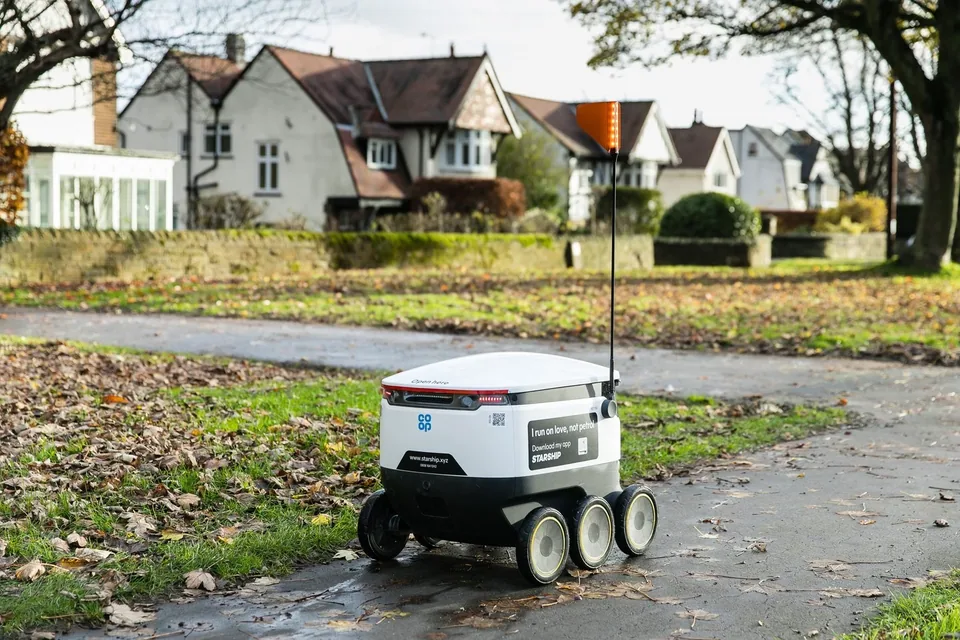
Compared with Starship Technologies, which focuses on slower sidewalk robots, Coco 2 aims higher on the speed ladder thanks to its approval to drive on streets and bike lanes, which brings it closer to the light-vehicle category than to classic sidewalk robots. There is no information on availability in Poland or Europe.
A solution of interest to urban delivery operators in the US looking for higher throughput than slower sidewalk robots offer, not for retail customers.
Photo gallery
-
Photo: Coco Robotics, product page (cocodelivery.com) -
Photo: Coco Robotics, product page (cocodelivery.com) -
Photo: Coco Robotics, product page (cocodelivery.com) -
Photo: Coco Robotics, product page (cocodelivery.com) -
Photo: Phillip Pessar, Wikimedia Commons, CC BY 4.0; resized and converted to WebP -
Photo: Alexis Doine, Wikimedia Commons, CC0; resized and converted to WebP -
Photo: Mx. Granger, Wikimedia Commons, CC0; resized and converted to WebP
Specs
Data checked: · Sources: 2
Data from manufacturer datasheets and product pages; median over the models of this category in the database.
-
Speed5.8 m/s+383% vs. the category median (1.2 m/s, n=25)
- category medianA higher value doesn't always mean a better robot; it depends on the application.
Motion and manipulation
- Speed
- 5.8 m/s
Electronics and AI
- Drive
- electric
- Sensors
- Cameras, LiDAR, GPS
- Computing unit
- NVIDIA Jetson Orin NX
Price and availability in Poland
no data
Running and deployment costs
The price of Coco 2 is not published, and the manufacturer does not sell robots directly; Coco Robotics acts as a service provider for restaurants and platforms. The cost to a partner is therefore a fee for deliveries, not the purchase of a machine; we do not know its amount and will not guess it. Staff training on the client side is minimal, since the operator manages the robot; the hidden cost lies in integrating orders with the platform's app. General orders of magnitude for robot prices are in “How Much Does a Humanoid Robot Cost in 2026”, though it concerns a different class of machines.
Dealers in Poland
No confirmed distributor in Poland
Applications
What it's for
The Coco 2 is the next generation of the Coco Robotics delivery robot, built together with Segway: a low wheeled robot that brings orders from restaurants to people's homes. The robot drives on sidewalks, bike lanes and streets at up to 5.8 m/s, and the manufacturer describes a move from a human-teleoperated model to full autonomy. Six separate compartments let it take several orders at once, so a single trip can serve neighbors on the same street. In practice it is a tool for restaurants: the venue hands over a package, the robot sets off, and the customer picks up the food from the compartment. The same logic suits retail. Perception comes from cameras, LiDAR and GPS, and computing is handled by an NVIDIA Jetson Orin NX; similar computing platforms power many of the robots described in “How Does a Humanoid Robot Work” (see also NVIDIA Jetson). The manufacturer claims roughly three times the operational uptime of the previous generation and better weather resistance, which for an operator means fewer hours when the robot sits in service. Keep in mind, though: this is an urban service in the US, not a product you set up in your own warehouse. For a Polish reader, Coco 2 is above all a reference point, showing where last-mile logistics is heading.
Typical applications
Who it's for
Best suited to: urban delivery operators, restaurants and delivery platforms in the US that want to raise throughput beyond what slower sidewalk robots offer. Coco 2 works in a service model (delivery-as-a-service), so the partner does not buy a machine but orders deliveries. Who it is not for: the retail customer who would like to own a robot, and Polish companies; the manufacturer does not publish a price, and there is no confirmation of availability in Poland or Europe. If you run a venue in Krakow or Gdansk and are looking for automation, it makes more sense to look at the robots that work inside the premises in the service robots section. For editorial teams, researchers and city governments, Coco 2 is instead good material for discussion: who is responsible for a robot on the sidewalk, how to share space with pedestrians, and what “Data Security: Robots with Cameras and the GDPR” looks like with cameras filming the street.
Deployments
Coco 2 is offered as a service in the US, and we have no information on availability in Europe. The delivery robot category does have its veterans, though: Starship Delivery Robot and Serve Robotics Gen 3 are models present in the same niche, covered in our catalog. For last-mile delivery in Poland, a more realistic example today is InPost Robomat, InPost's compact parcel locker with a Cartesian robot mechanism, intended for space-limited Żabka convenience stores. It is not a robot that drives on the street, but it shows how automated parcel pickup is entering Polish retail (see the section “Specialist robots”).
Comparison
The closest rival is Starship Delivery Robot, a slower sidewalk robot with, according to the catalog, more than 10 million deliveries in more than 300 cities; choose it if scale and steady, calm sidewalk driving matter. Serve Robotics Gen 3 is the third generation of the Serve robot, also a delivery robot, worth attention as a second American operator in a comparable class. If someone is looking to automate service on the floor rather than on the street, a good direction is Pudu BellaBot, a waiter robot that carries trays between the kitchen and the tables. Coco 2 wins on speed and the ability to drive on the street, and loses on availability: none of these alternatives is cheap, but at least the Pudu can be priced with a distributor. When choosing, always ask the same thing: where does the robot actually drive, who supervises it remotely, and who is liable for damage on the sidewalk.
Similar models
 on sale
 on sale
 on sale
 on sale
 discontinued
History
Coco 2 was presented in February 2026 as the successor to the first-generation Coco robot, created in Los Angeles. The key milestone is a change of philosophy: the first robots were largely teleoperated by a human, while the second generation is meant to drive fully autonomously. The robot was built in cooperation with Segway, hence the phrase “Built with Segway” in the manufacturer's descriptions. The manufacturer also states that the new version is more resistant to weather conditions and has about three times the operational uptime. Coco Robotics does not disclose a founding date or funding data, so we cannot reconstruct the company's full timeline.
Model unveiled
Sources
Frequently asked questions
Is the Coco 2 available in Poland?
No. The manufacturer Coco Robotics (USA) names no Polish shop or official distributor for the Coco 2; enquiries go through the manufacturer's website (cocodelivery.com). Confirm service in Poland before buying.
Can you buy a Coco 2?
No. The manufacturer offers it only as a service (delivery-as-a-service) for restaurants and delivery platforms, and the price is not published.
How fast does the robot travel?
Up to 5.8 m/s, or about 13 mph, on sidewalks, bike lanes and streets.
How many orders can it handle at once?
Up to six separate compartments, allowing a single trip with multiple orders for different customers.
Author, source and licence of the photo are given in the caption. Shop links may become affiliate links in future, details: How we make money · How we check