prototype
Technical University of Munich (TUM), Chair of Applied MechanicsHumanoid robots
LOLA
- 176 cmheight
- 68 kgweight
- —price
Manufacturer
The Munich university (founded 1868) builds the bipedal LOLA (26 degrees of freedom, 176 cm, 68 kg) for research on fast, human-like walking.
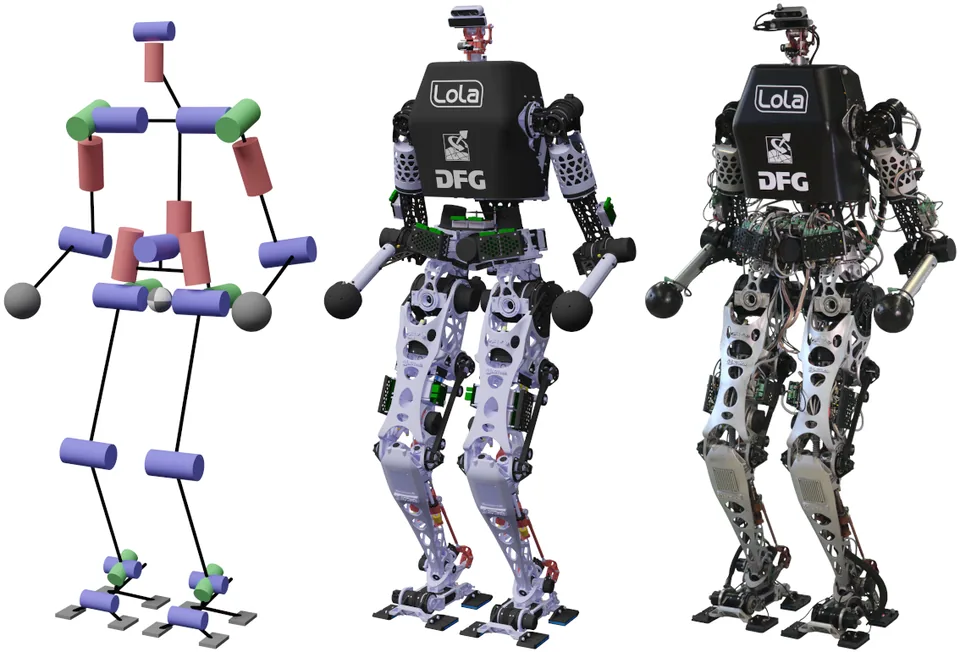
The Technical University of Munich, specifically its Chair of Applied Mechanics, has for years been developing the bipedal robot LOLA: 176 cm tall, 68 kg and a full 26 degrees of freedom (DOF), giving it movement flexibility close to human. The robot was built within a DFG research cluster on the dynamics of fast, autonomous, human-like walking, including over uneven terrain, not for commercial production.
The electric drive, based on brushless motors and modular joint design, allows new real-time motion-planning algorithms to be tested. It is an academic project, comparable more to Honda's historic ASIMO or Japanese university platforms than to commercial humanoids from Boston Dynamics or Unitree; what counts here is the scientific publication, not sales.
The strength is the precision of dynamic walking, the weakness a complete lack of any path to market. The robot is not and will not be available in Poland, because it is not a product.
The Technical University of Munich (TUM) is a university in Munich founded in 1868. Its humanoid robotics work is carried out by the Chair of Applied Mechanics, known in German as the Lehrstuhl für Angewandte Mechanik. Its most important creation in the field is LOLA, a bipedal research robot built within a DFG research cluster devoted to the dynamics of fast, autonomous, human-like walking, including on uneven terrain. This is an important distinction: LOLA is neither a product nor a prototype of a future product, but a tool for studying motion. It is used to test new real-time motion-planning and gait-control algorithms, and the aim is scientific publications, not sales. On this basis the story of a company in the usual sense cannot be told, because there were no funding rounds, launches or ownership changes. The founding date of the university is known, and the robot's background shows the project has been developed for years, but the exact chronology of successive versions is not publicly confirmed, so we do not invent one. That gap is itself information: in academia what counts is continuity of research and results, not a launch date. How robots of this kind work is explained further in “How Does a Humanoid Robot Work”.
TUM's portfolio in this overview is one robot: LOLA. LOLA stands 176 cm tall, weighs 68 kg and has 26 degrees of freedom (DOF), which “Degrees of Freedom (DOF) in Humanoid Robots” explains. The legs have redundant, seven-degree kinematics that allow smooth movement over uneven terrain. The drive is brushless electric motors in a modular, lightweight joint design, and related topics are discussed in “Actuators in Humanoid Robots”. The uses given by the source are fast, autonomous, human-like walking and moving over uneven ground, in other words classic laboratories work. The robot is purely a scientific platform, so there are no commercial versions, price list or customer variants. Unlike commercial humanoids such as Unitree G1 or Unitree H2, there is no software package for outside users and no sales support. The whole point of the machine lies in what it shows about walking itself. It is worth noting that the redundant leg kinematics is a deliberate design choice. It gives the algorithms more freedom to place the feet on uncertain ground, and that is exactly the area that interests gait researchers most. The modular joints also make it easier to replace and modify parts during successive series of experiments.
TUM has no market position because it sells nothing, so an assessment can only concern its place in the research world. The closest counterpart is the Japanese WABIAN-2 from Waseda University: WABIAN-2 has far more degrees of freedom but a less modern, heavier drive, while LOLA favours a lighter structure and walking on difficult ground, at the cost of fewer degrees of freedom in the hands. In the background there is also the historic benchmark, Honda's ASIMO, from Honda Motor Co.. Commercial machines, like those from Unitree Robotics or Boston Dynamics, play in a different league, because they have to sell, not merely demonstrate principles. LOLA's strength is gait stability on difficult terrain, and its weakness is the absence of any path to commercialisation. For an industrial reader this means the results from Munich may influence future algorithms but will not become a product you can buy.
LOLA is not and will not be on sale, in Poland or elsewhere, because it is not a product. We know of no distributor or deployments on the Polish market. Polish universities that need a humanoid for research use designs that are on sale, one example being the educational Unitree G1 that appears in labs, including at AGH. Results from Munich reach the scientific world in the form of publications that Polish researchers can read as well. More on choosing a robot for a university can be found in “Educational Robots for Schools and Universities”.
LOLA is a model research robot for fast walking over uneven terrain, but only as a scientific platform. The stability of its motion is impressive, yet the project has no path to market, no price and no distribution, in Poland included. Worth following in publications, not worth looking for as an offer. The project is valuable for researchers and engineers who want to understand how to build a stable biped, not for buyers. For them knowledge counts, not an offer.
Technical University of Munich (TUM), Chair of Applied Mechanics
Technical University of Munich (TUM), Chair of Applied MechanicsHumanoid robots