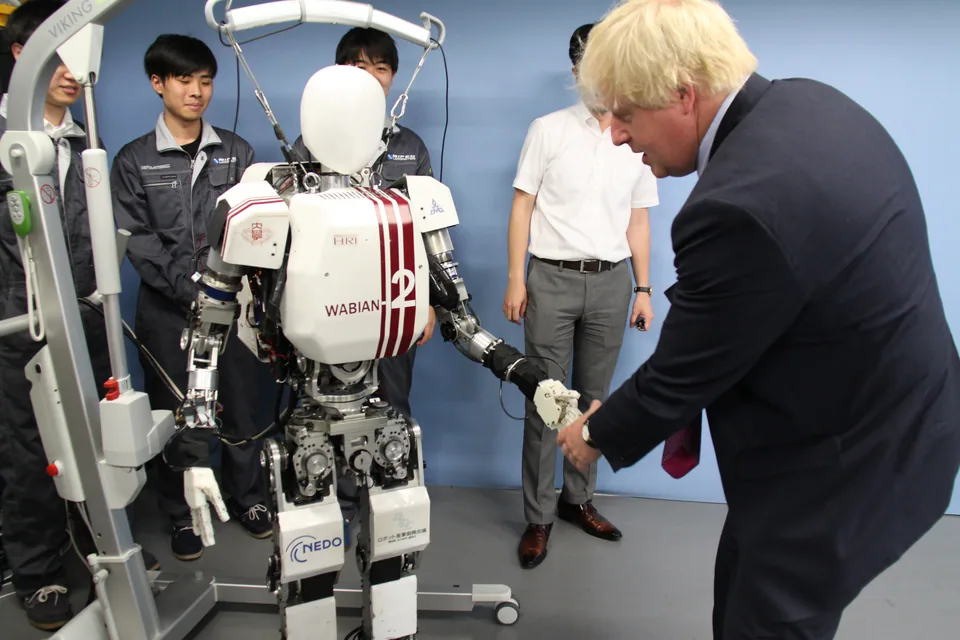
prototype
Manufacturer
Waseda: no confirmed sources of its own and no models, only a general cross-reference in lists of humanoid robots.
Like other universities mentioned in general, encyclopedic lists of robots, Waseda University appears only as a cross-reference from a general article on humanoid robots, with no description of its own, no industry sources and no robot model attached.
The university is widely known for a long tradition of humanoid robotics research in Japan, including the historic WABOT series, and in contemporary materials it is also sometimes named as a research partner on Tokyo Robotics' Torobo platform, but none of this is confirmed in this specific context, so it is not cited here as established fact.
There is no current data on funding, team or commercial products of the university. No connection to the Polish market appears. The university nevertheless remains an important historical center of Japanese humanoid robotics, worth the attention of enthusiasts.
Waseda University in Tokyo, founded in 1882, has a long tradition in humanoid robotics, tied to the Takanishi Laboratory. That is where WABIAN-2 was built, a bipedal research robot that continues the long-running WABOT series reaching back to the 1970s. It is worth saying at once what this story rests on. The source is a scientific publication describing the robot's design, not manufacturer material, because Waseda is not a manufacturer. There is no funding, valuation, headcount or product on sale. The university sometimes appears in general roundups of humanoid robots as a cross-reference, and then guesses come easily, for example about a role as research partner on other people's platforms. No source confirms such ties, so we do not repeat them. What is certain is that the university is an important historical centre of Japanese humanoid robotics, and its designs were used to study human-like walking. For comparison it is worth looking at the newer German platform from Munich, discussed in “How Does a Humanoid Robot Work” in the context of how biped robots work. Further facts about when later versions appeared would need a separate, confirmed publication.
The only Waseda robot described here is WABIAN-2. It stands 148 cm tall and weighs 64 kg. The design has as many as 41 mechanical degrees of freedom (DOF), which “Degrees of Freedom (DOF) in Humanoid Robots” explains. They are distributed as follows: six in each leg, two in the hips, two in the trunk, seven in each arm, three in each hand (six across both hands), three in the neck and one in each foot, with a passive toe joint. The drive is electric. The key achievement is a gait close to a human one: with straightened knees, heel contact and toe push-off. It was achieved thanks to a hip mechanism that imitates the movement of a human pelvis. Many other research bipeds walk with bent knees because that makes stability easier, but at the cost of natural movement. The robot is purely a scientific platform used in research, that is in laboratories and universities. There are no commercial variants and no official price. This division of joints shows how far the designers went in copying the human body: even the neck and each foot have their own degrees of freedom. In practice this yields more natural movement, but also a complex structure that is hard to simplify into a product.
Waseda has no market position because it does not sell robots. It can only be assessed as a research centre. The closest comparison is LOLA from the Technical University of Munich, described under Technical University of Munich, Chair of Applied Mechanics: WABIAN-2 has far more degrees of freedom but a less modern, heavier drive, whereas LOLA wins on lightness of construction. Commercial humanoids, such as Unitree H1 or models from Boston Dynamics, have an entirely different aim, because they must be manufactured and sold. WABIAN-2's strength is the naturalness of its gait, and its weaknesses are the age of the design and the lack of a commercial successor. For someone who wants to buy a humanoid, Waseda is neither supplier nor competitor, but a source of knowledge about how far imitating human movement can go. The general market background is given in “Humanoid Robot Market Forecasts”. WABIAN-2's value therefore lies in having set a reference point for natural walking that later designs refer to. Anyone comparing bipedal robots today should know this tradition, even if the hardware itself is no longer being built.
WABIAN-2 has no connection with the Polish market that sources mention. It is not sold, has no price or distributor, and we know of no deployments or joint projects with Polish institutions. Polish universities that want to study humanoid gait or manipulation tend to buy commercial hardware available on the market. The example of AGH shows that the educational Unitree G1 is appearing here. Choosing hardware for a university is covered in “Educational Robots for Schools and Universities”. Any cooperation with Polish centres would require separate arrangements with the university, and we know of no such initiative. For the Polish reader WABIAN-2 therefore remains an example from the scientific literature.
WABIAN-2 is a historically important research robot that refined a human-like gait with straightened knees. As a scientific platform it has no price, no successor on sale and no distributor in Poland. For the reader it is a lesson about movement, not an offer. It is worth knowing as a reference point for natural bipedal walking, but not as hardware you can buy. Its value is mainly historical and scientific, and the humanoid robot market is developing today in entirely different places.
Waseda University (Takanishi Laboratory)