on sale
Manufacturer
British maker of Ameca, an expressive, non-mobile humanoid; data on funding and presence in Poland unconfirmed.
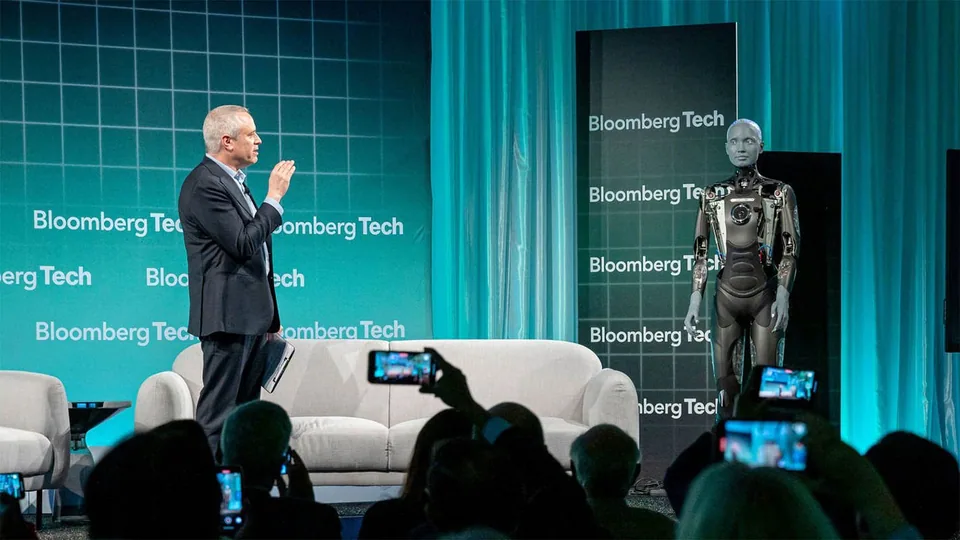
Ameca, the best-known robot from Falmouth, Cornwall-based Engineered Arts in the UK, represents a different philosophy from the industrial humanoids of Figure or Fourier: it is a stationary robot that does not move on its own, but has exceptionally expressive facial mimicry, and it is used mainly in exhibitions, research on human-robot interaction and shows.
Data on the company's founding year, funding and headcount are not confirmed, and the Falmouth headquarters comes from earlier scouting and has not been independently re-verified. The model covered here is Ameca (extended-specification version). There is no information on unit price or commercial availability beyond event rental. In Poland no distributor or show featuring the robot has been recorded.
Falmouth in Cornwall is associated with sailors, not robots, and yet that is where, according to earlier scouting we have not independently confirmed, Engineered Arts Ltd comes from. The founding year, funding and headcount are not confirmed, so we will not tell a heroic garage story here. What is known is that the company works on social robots, and its face is Ameca, unveiled in December 2021. The version covered here is the extended-specification model: 187 cm tall, 61 actuated movements, mains-powered. Ameca does not walk: it stands and reacts with expressive facial mimicry. That design decision is the core of the company's philosophy: instead of pushing a humanoid into a factory, the British team invests in what people perceive as life in a face. That is why, compared with the humanoids in the text “Humanoid Robots in Factories 2026” (humanoid robots in factories), Ameca has a different job: drawing attention at trade fairs and serving as an object of research on the human-robot relationship. A description of how a humanoid works mechanically is in the text “How Does a Humanoid Robot Work”.
In our coverage the company is represented by one model: Engineered Arts Ameca. It is a non-walking, mains-powered social humanoid, 187 cm tall with 61 actuated movements, intended for trade fairs, shows and research on human-robot interaction. There is no unit price in the sources, and commercial availability beyond event rental is not confirmed. So it makes sense to compare roles, not parameters. Alongside Ameca stands Sophia, another social robot built around image and conversation, and Mirokaï, which heads toward services. At the other end of the spectrum are working humanoids such as Unitree H2 or Figure 03, from which Ameca differs the way an actor differs from a laborer. The wider background of the category is in humanoid robots and service robots. If you are thinking of renting, see the text “Renting a Humanoid Robot for an Event”. An important tip for a buyer: since Ameca is mains-powered and does not walk, its place is a stand, an exhibition hall or a laboratory, not a production floor. What robot parameters look like and what the number of actuated movements means is explained in “Degrees of Freedom (DOF) in Humanoid Robots”. In the guide “How to Read a Robot Datasheet” we explain what to look at in the data when a manufacturer gives only selected parameters.
Engineered Arts appears in our catalog without numbers: we have no confirmed funding rounds, valuation, stock listing or headcount, and no customer names either. Its position can therefore be described only through its role. It is a maker of showcase robots, so its competition is other companies with social robots: Hanson Robotics with its Sophia, Realbotix with its line of companion robots and PAL Robotics, who build robots for interaction with people, though in a different style. Engineered Arts does not appear in the same line as giants like Tesla or Boston Dynamics, and that is probably more comfortable, because the market for shows and research demands neither payload nor shift-level reliability. Its advantage here is a recognizable face, and its limitation is the lack of mobility. Should you want to set Ameca against robots meant for work, the answer is in the text “How Much Does a Humanoid Robot Cost in 2026”, where the economics of the applications become visible.
In Poland no distributor or show featuring Ameca has been recorded, and we know of no Polish branch of the company. The only realistic way to see such a robot live is an event rental or a guest show, and there is no information about any of those. For organizers of conferences and trade fairs this means: an inquiry abroad, no local service and the need to sort out logistics. An alternative can be renting other humanoids, described in the text “Renting a Humanoid Robot for an Event”. Places where such a robot could work are described in the event (events) and universities (university) sections. We know neither the costs nor the terms of such a show.
Ameca is an actor, not a worker: excellent on stage and in a laboratory studying human-robot interaction, useless on a factory floor. With no price and no presence in Poland, it is not a product you can buy off the shelf. Treat it as a model of what a robot you talk to could look like. For an event organizer it can be an inspiration, for an engineer a curiosity, and for a purchasing department more of a question without an answer.
Engineered Arts Ltd