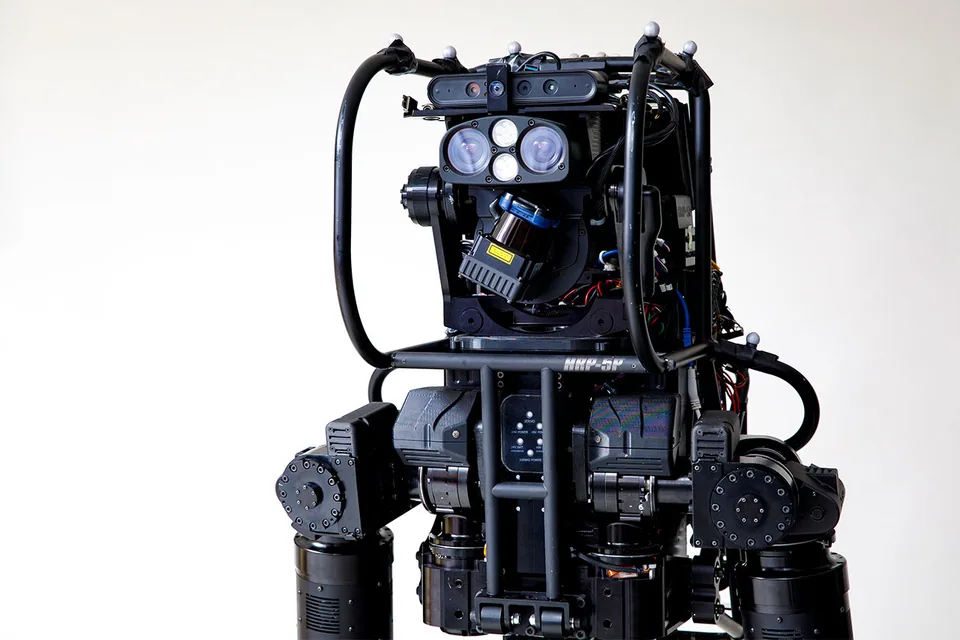
prototype
National Institute of Advanced Industrial Science and Technology (AIST)Humanoid robots
HRP-5P
- 182 cmheight
- 13 kgpayload
- —price
Manufacturer
Japanese research institute AIST, creator of the HRP series; the latest public model is the HRP-5P prototype from 2018.
AIST, the National Institute of Advanced Industrial Science and Technology in Tsukuba, is a Japanese public research institution that has operated since 2001. It is not a commercial company, so its work looks nothing like the offering of a startup or a robotics group. For years the institute has developed the HRP series of research humanoids, built in hardware partnership with Kawada Robotics.
The last publicly documented generation is the HRP-5P from 2018, designed for autonomous heavy work and hazardous environments, such as construction or demolition of structures. That single prototype is the only one we know of. It has no price and no sales status, and it never went into commercial production.
By comparison, commercial rivals from Boston (Boston Dynamics) and China have gone much further in commercializing similar platforms. The institute has no market significance for Poland.
It is not a commercial company, so its story differs from those of startups: it is measured in generations of prototypes, not funding rounds. The line began with the HRP-2 in the early 2000s, and one of its best-known editions was the HRP-4C from 2009, a humanoid with the appearance of a woman, shown as a demonstration of motion and looks. The last publicly documented generation remains the HRP-5P from 2018, a robot designed for autonomous heavy work and for hazardous environments, for example building or dismantling structures. The picture of a humanoid handling construction elements on its own became part of the debate over what humanoids might be for, long before the fashion for factory pilots. What matters is that AIST never announced a sale: for the institute, the robot is a tool for research into gait, perception and manipulation, not a product. To see what the commercial version of this idea looks like today, read “Humanoid Robots in Factories 2026”; for how humanoids are built, see “How Does a Humanoid Robot Work”.
AIST's portfolio in our catalog is a single model: HRP-5P. It is a Japanese research humanoid prototype from 2018, 182 cm tall, weighing 101 kg, with 37 degrees of freedom and a payload of 13 kg. It is intended for autonomous heavy work and for dangerous environments such as a construction site. It has no price and no sales status; the model never entered commercial production. For comparison, the robot weighs nearly twice as much as typical lightweight research platforms like the Unitree G1 and is heavy even next to today's designs such as the Atlas or the Apptronik Apollo. If you want to see how big the gap is between a research prototype and something you can actually buy, compare the HRP-5P with the UBTech Walker S2. The significance of the number of degrees of freedom is covered in “Degrees of Freedom (DOF) in Humanoid Robots”. Construction uses are described on the construction site page, and research uses on laboratories. You will find the whole category under “Humanoid robots”. Keep in mind that this is a 2018 design, not a series product: the parameters are values from a research prototype and have no counterpart in a price list.
AIST does not compete in the market because it is not present in it. It is, however, a reference point for the history of humanoids: institutions like this one, together with Honda Motor Co. (represented in our catalog by the avatar robot Honda Avatar Robot), built the foundations of Japanese knowledge about bipedal walking. Commercial rivals from Boston, Boston Dynamics, and from China, Unitree Robotics and UBTECH Robotics, have gone much further in commercializing similar platforms. Data on AIST's funding, customers and valuation is not published, because the institute is publicly funded and does not operate like a company. The last documented generation is the HRP-5P from 2018; we cannot confirm any later public editions. For a current picture of the market, see “Humanoid Robot Market Forecasts”. The takeaway for readers is simple: AIST is worth knowing as a source of ideas and reference designs in humanoid research, but not as a supplier you could sign a robot purchase agreement with.
The institute has no market significance for Poland: it does not sell robots and has no distributors or deployments at Polish companies. Scientific cooperation between universities is possible, but we have no confirmed projects with Polish research centers. If you are looking for a way to start learning robotics, see “How to Start Learning Robotics in Poland”. Students and researchers can follow the institute's publications and the robotics conferences where the HRP is sometimes presented. For companies, what matters more is that the knowledge from such projects flows into commercial humanoids, whose offers are worth following separately. Worth a look.
The HRP-5P is excellent material for learning the history of humanoids, but it is not an offer you can buy. Read it as a milestone of Japanese research, not as a product. For practical uses, look for commercial models under “Humanoid robots”. If you want to understand where today's humanoids came from, spend a moment on this line; if you need a robot to do work, start with the commercial models. In short: this entry is about history and inspiration, so base purchasing decisions on models that have a price and a supplier.
National Institute of Advanced Industrial Science and Technology (AIST)
National Institute of Advanced Industrial Science and Technology (AIST)Humanoid robots