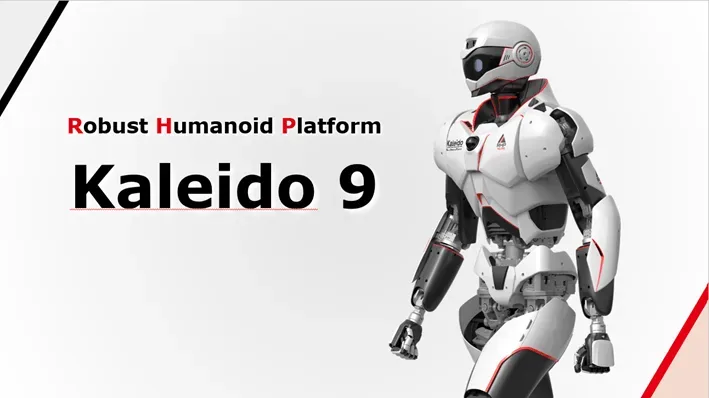
prototype
Kawasaki Heavy Industries (Robot Division)Humanoid robots
Kawasaki Kaleido 9
- 190 cmheight
- 18 kgpayload
- —price
Manufacturer
Kawasaki (Akashi, since 1968, first industrial robot in 1969): represented in Poland by ASTOR (Kraków) since 2007, co-producer of the Astorino.
Kawasaki Heavy Industries built the world's first commercial industrial robot in 1969, and the robotics division of the Japanese group, headquartered in Akashi (listed as TYO:7012), has operated continuously since 1968.
In Poland the brand is represented by Kraków-based ASTOR, an authorized distributor since 2007 covering 12 markets in Central and Eastern Europe, with Polish-language documentation, 24-hour service and a spare-parts warehouse in Kraków.
ASTOR and Kawasaki jointly produce the educational Astorino under the Kawasaki brand, a rare example of local production cooperation rather than mere distribution in this segment. The only model covered here is the humanoid Kaleido 9 arm, aimed more at service applications than a typical assembly line.
That sets Kawasaki apart from purely industrial players like Fanuc or ABB, although the core of its business remains classic welding and assembly robots. A local distributor with a full service backup makes Kawasaki one of the more accessible Japanese manufacturers on the Polish market.
The robotics division of the Japanese conglomerate Kawasaki Heavy Industries has operated without interruption since 1968, and its home is Akashi. As early as 1969 the group built the world's first commercial industrial robot, which gives Kawasaki a place in the earliest chapter of the whole industry. The company is listed on the Tokyo stock exchange under the symbol 7012. For decades the core of the business was classic welding and assembly robots, like those working on production lines in factories. The humanoid programme grew out of that industrial root only in recent years: Kawasaki has been developing its own two-legged designs since 2015, and in December 2025 it showed the ninth generation, Kaleido 9. It is worth noting that in the catalogue this is a division of a larger group, not a standalone company. Data on the robotics division's exact revenue, headcount and development funding does not appear, so we do not state it. The difference between an industrial robot and a collaborative one is explained in “Cobot or Industrial Robot”, and the place of such machines on the shop floor is described in “Factories and manufacturing”.
In our catalogue Kawasaki is represented by one model: Kawasaki Kaleido 9. It is a humanoid 190 cm tall and weighing 99 kg, with a payload of 18 kg, presented in December 2025. The robot uses LiDAR and stereo cameras for three-dimensional mapping of its surroundings and walks on its own while avoiding obstacles, and besides the autonomous mode it can be controlled remotely through VR goggles. Its near-human scale is meant to let it use standard tools and personal protective equipment and move through spaces designed for people. The strong side is the leap in stability and payload over generations 7 and 8; the weakness is the lack of commercial deployment, an unknown price and an unstated number of degrees of freedom, whose meaning we discuss in “Degrees of Freedom (DOF) in Humanoid Robots”. Kaleido 9 is a prototype in the category “Humanoid robots”, and its applications, such as cleaning, meaning sweeping, and moving objects, fit well with the topic of “Humanoid Robots in Factories 2026”. Beyond the humanoid the company has a broad range of classic industrial robots, which we do not describe because their parameters have not been verified. This entry is therefore more about the company's direction of development than about a ready product to order.
In industrial robotics Kawasaki is one of the large Japanese makers, alongside FANUC, Yaskawa Electric and DENSO Robotics, and among European brands it is usually set against ABB Robotics and KUKA. What sets Kawasaki apart is that its first robot appeared at the very beginning of the industry, and in recent years it has added an ambitious, though still prototype, humanoid programme. The core of the business is still welding and assembly robots, so next to purely industrial players Kaleido 9 is more a signal of direction than a source of revenue. We have no reliable data on the market shares of individual manufacturers, so we give no percentages. If we want to compare the total cost of owning such machines, “Humanoid Robot TCO: How to Calculate Total Cost” helps. For comparison with an academic centre that developed two-legged designs fifteen years earlier, see the entry on Korea Advanced Institute of Science and Technology. It shows how far the frontier of humanoid capability has moved.
In Poland the brand is represented by ASTOR of Kraków, an authorised distributor since 2007. The company serves 12 markets of Central and Eastern Europe in total, and provides Polish-language documentation, round-the-clock service and a spare-parts warehouse in Kraków. ASTOR and Kawasaki jointly produce the educational robot Astorino, a rare example of production cooperation rather than distribution alone. ASTOR also distributes other brands, among them AGILOX Automation. For schools and universities considering a robot for teaching, “Educational Robots for Schools and Universities” provides a starting point. As a prototype, Kaleido 9 is not offered on any market, including the Polish one. We found no documented deployments of classic Kawasaki robots at specific Polish plants, so we do not name any.
Kawasaki is a solid, experienced player and one of the more accessible Japanese manufacturers in Poland, because a local distributor handles sales and service. Kaleido 9 is fascinating, but it is still a prototype without a price, so a reader looking for a ready deployment should look at the company's classic robots and talk to ASTOR. The strongest side is the local support base; the weakest is the lack of public data on the humanoid.
Kawasaki Heavy Industries (Robot Division)
Kawasaki Heavy Industries (Robot Division)Humanoid robots