on sale
Elephant Robotics
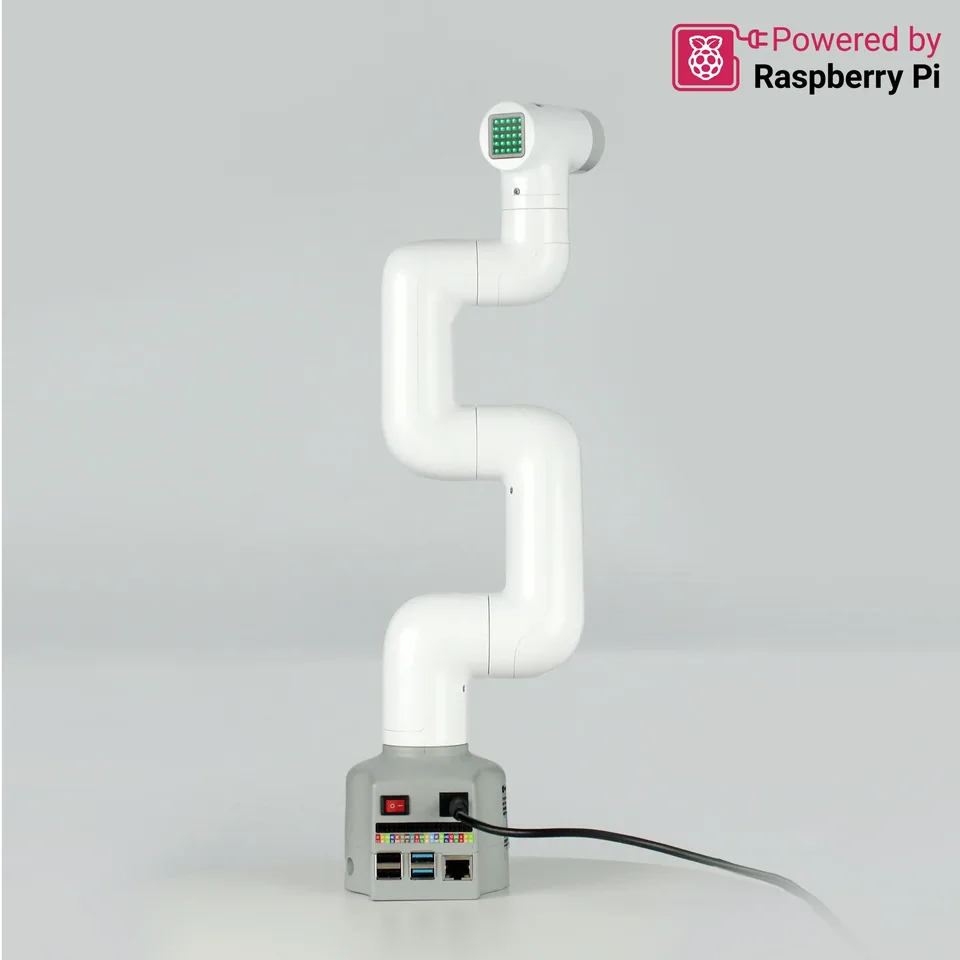
myCobot 280
- 6 DOFdegrees of freedom
- 0.25 kgpayload
- 3,990price (PLN)
Price from
The bigger sibling of the myCobot 280 in Elephant Robotics' lineup, the myCobot 320 raises the payload to 1 kg while keeping six axes of motion and a Raspberry Pi-based controller. The indicative price is about 4,000 USD, or 15,500 PLN (≈ EUR 3,550) at the 3.8762 rate of 1 October 2026.
It comes from a 2022 all-in-one bundle configuration and has not been verified against the current 2026 offer, a caveat both the manufacturer's listing and our own editors flag clearly. The arm has been on sale since 2022, though no exact launch date is given. Within the myCobot family it competes directly with the cheaper myCobot 280.
The difference is mainly a fourfold higher payload (1 kg versus 250 g) at a considerably higher price, so the choice comes down to whether your project needs to lift heavier items than the typical classroom demonstration.
Across the wider cobot market, the myCobot 320's position is unclear: at around 4,000 USD it starts to compete with entry-level industrial models such as the Universal Robots UR3e, which offer a much higher payload and industrial safety certification. Its strengths are compactness and compatibility with the myCobot ecosystem (Python, ROS).
Its weaknesses are the unverified current price and the lack of a clear rationale for a segment sitting between education and industry. Availability in Poland has not been confirmed by any source.
Data from manufacturer datasheets and product pages; median over the models of this category in the database.
The price comes from a 2022 all-in-one bundle configuration; the current 2026 price has not been verified.
The indicative price is about 4,000 USD (15,500 PLN (≈ EUR 3,550) at the 3.8762 rate of 1 October 2026), but it comes from a 2022 all-in-one configuration and has not been verified for the 2026 offer. Treat it as a reference point, not a price list. Before buying, ask the seller for a current quote and check what is included in the kit. Running costs are estimated to be low: power and small accessories. The biggest item is often the time a teacher or engineer spends setting up the station. Training is estimated at a few hours when programming in Python.
No confirmed distributor in Poland
The myCobot 320 is a small arm for learning and prototyping: six axes, a 1 kg payload, 350 mm reach, a weight of 3.36 kg and control via a Raspberry Pi module. Compared with its younger sibling, the myCobot 280, the payload is four times higher (1 kg versus 250 g). That changes what the arm can do. Instead of building blocks, it can handle light items such as small containers, samples and 3D-printed parts. Typical scenarios include learning Python and ROS programming, trade-show demo stations, prototypes of simple pick-and-place lines and thesis projects. Its compact size and compatibility with the myCobot ecosystem make it easy to carry code between variants. The limits: the price in our catalog dates from 2022 and has not been verified for the 2026 offer. The arm has no confirmed industrial safety certification, so do not put it next to workers on a shop floor. It sensibly rounds out education in educational robots and cobots; also read “Cobot or Industrial Robot” to understand where a toy ends and a tool begins. Use cases: universities and laboratories.
Worth considering for: labs where the 250 g payload of the myCobot 280 turned out to be too little but the budget rules out industrial class. Student teams building projects with a simple gripper and a camera. Training companies that want stations for robot-programming courses and do not need a certified device.
Who it does not suit: production plants looking for a cobot for permanent duty. At around 4,000 USD the model starts to compete with entry-level robots of the UR3e class, which offer a higher payload and industrial certification. Schools on a tight budget, since the cheaper 280 or the open SO-101 are enough for many lessons. And anyone who needs a firm price, because the current value is not verified.
None, and we have no offer from a Polish distributor on record. The model has no documented use cases in our catalog, so we do not list any. Teaching arms and cobots are an area where Polish universities and technical schools already have experience with other brands. See “Educational Robots for Schools and Universities” and “Doosan Robotics: Cobots from the Korean Maker in Poland” to see what the transition from learning to production looks like.
The natural alternative within the family is the myCobot 280: a 250 g payload, but 649 USD in the manufacturer's store and 3,990 PLN (≈ EUR 915) in a Polish shop. Buy it if you do not need a full kilogram.
If you want to stay in education but need more reach, consider the Kinova Gen3 Lite, a six-axis arm with 760 mm reach and a 0.5 kg payload, with an unconfirmed price. It has a lower payload but a longer reach.
The step toward industry is the UR3e from Universal Robots: much more expensive, but designed for production environments; the brand is covered in “Universal Robots UR5e, UR10e and UR20 Compared”. The next level up in the same family is the myCobot Pro 600 (2 kg, 600 mm reach, 34,107 PLN (≈ EUR 7,820) according to our catalog).
Elephant Robotics
Clearpath Robotics (Rockwell Automation)
Dobot (Shenzhen Yuejiang Technology)
According to the sources, the myCobot 320 has been on sale since 2022, but the manufacturer does not give an exact launch date. Elephant Robotics, a Shenzhen company founded in 2016, placed this model between the cheapest myCobot 280 and the higher-end myCobot Pro 600. In our assessment that position is unclear: at around 4,000 USD the model enters territory where entry-level industrial robots compete with each other. Background: “What Is a Cobot and How Does It Differ from an Industrial Robot”.
Sales start
No. The manufacturer Elephant Robotics (China) names no Polish shop or official distributor for the myCobot 320; enquiries go through the manufacturer's website (shop.elephantrobotics.com). Price estimate (midpoint of a range): approx. 15,500 PLN* (≈ EUR 3,550). Confirm service in Poland before buying.
It has a higher payload, 1 kg versus 250 g for the 280, while keeping six axes of motion, but at a clearly higher price.
Not fully. The quoted price of about 4,000 USD (15,500 PLN (≈ EUR 3,550)) comes from a 2022 all-in-one configuration and has not been verified against the 2026 offer.
The model is controlled by a Raspberry Pi module.
Author, source and licence of the photo are given in the caption. Shop links may become affiliate links in future, details: How we make money · How we check