on sale
Hugging Face / LeRobot (TheRobotStudio SO-ARM)Educational robots
SO-101
- 6 DOFdegrees of freedom
- 890*price (PLN)
Manufacturer
Hugging Face LeRobot (USA): open SO-101 arm, 3D-printed, Feetech servos. For machine-learning researchers.
The LeRobot project, run by Hugging Face from New York, maintains open-source, low-cost robot arm designs for teleoperation and imitation learning: the SO-100/SO-101 and the older Koch. They were designed by TheRobotStudio and are built from 3D-printed parts and Feetech STS3215 servos.
That puts LeRobot in direct competition with the Poppy Ergo Jr from Generation Robots among the companies covered here, although LeRobot is aimed more squarely at machine-learning researchers and the open-source community than at classic school education. Its key advantage is integration with the Hugging Face libraries for training robot policies. The model covered here is the SO-101, currently on sale.
The year 2016 given as a founding date refers to Hugging Face itself, not to the LeRobot project, which came later; that distinction is worth preserving in any publication. There is no data on funding or on sales volumes of the robot kits themselves. Presence in Poland: kits can be ordered online, with no local distributor.
LeRobot is an open-source project developed by Hugging Face, which is based in New York. Hugging Face itself was founded in 2016, but that date refers to the company, not to the robotics project, which appeared much later — the distinction matters so that LeRobot is not credited with a longer history than it has. The project maintains low-cost arm designs for teleoperation and imitation learning: SO-100 and SO-101 plus the older Koch model. The arms were designed by TheRobotStudio, and their construction rests on 3D-printed parts and Feetech STS3215 servo motors. The whole idea is that a researcher or hobbyist does not need to buy an expensive industrial robot to collect data and train control models. The hardware is meant to be cheap and open enough for anyone to build and modify. We have no data on funding for the project itself, the number of kits sold or headcount. Hugging Face does not report them separately for robotics, so we do not guess. For now the story of LeRobot is one of a community and open files, not of a classic hardware manufacturer.
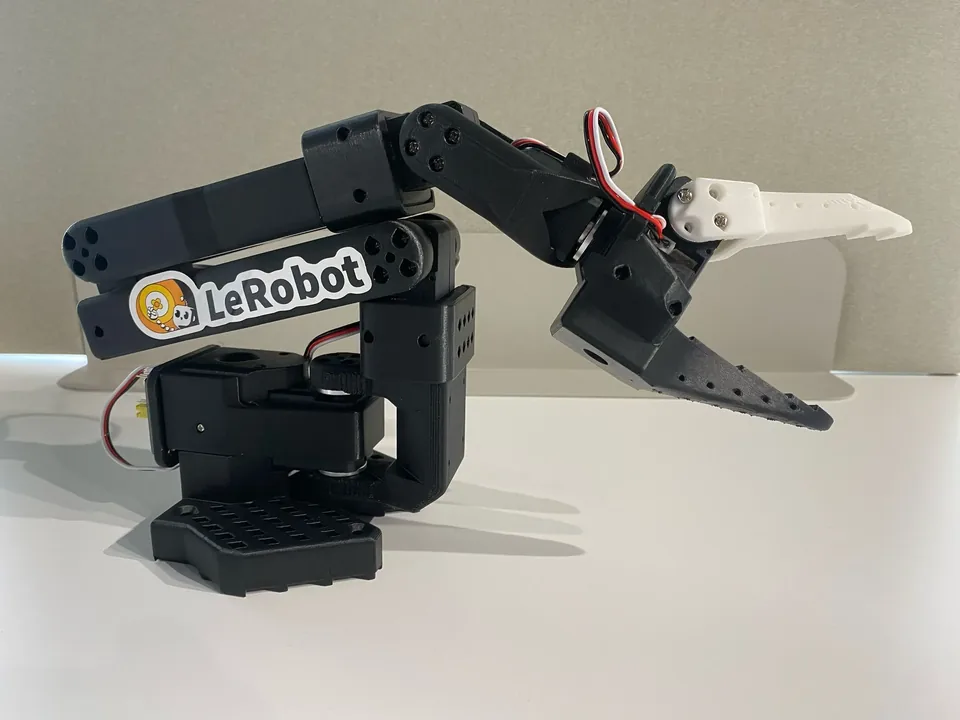
The only model in our coverage is SO-101, a six-axis educational arm in the educational robots category, available as a kit to assemble yourself. It has six degrees of freedom, and its parts are made by 3D printing. The intended use is teleoperation and imitation learning, that is, collecting examples of movements performed by a person on which a model learns; we describe this direction in “VLA Models: How AI Controls Humanoid Robots in 2026”. The official bill of materials on GitHub, in the TheRobotStudio/SO-ARM100 repository, puts the cost of the Follower arm alone at 121.94 USD and of a Follower and Leader pair at 229.88 USD, roughly 891 zlotys after conversion. There is no single fixed price or single seller, because the kit is assembled from parts bought separately. That is why the price depends on the source and the country. Tips on how to read such data are in “How to Read a Robot Datasheet”. The kit consists of two arms: the Follower, which performs the movements, and the Leader, which a person holds. The operator moves the Leader and the Follower repeats the motion, which makes it possible to record data for learning. In practice the buyer must order the servos, print the parts and assemble the structure alone, so the cost depends on printing, shipping and any extra parts such as power supplies or mounts. It is not a device you take out of the box and run at once, which is worth bearing in mind when planning classes.
LeRobot competes directly with Poppy Ergo Jr from Poppy Project, likewise an open, inexpensive educational arm. The difference lies in the audience: LeRobot aims more clearly at machine-learning researchers and the open-source community than at classic school education. Its key advantage is integration with Hugging Face libraries for training robot policies, which means a quick path from hardware to a model experiment. For schools seeking a ready, supported kit with teaching materials it is still not an obvious choice. A wider overview of this niche is in “Educational Robots for Schools and Universities”. At fundamentally different prices it is no rival to cobots such as the ReBeL from igus, which offer better repeatability and are built for work. We give no market shares, because there is no reliable sales data.
In Poland the kits can be ordered online, but there is no local distributor. A buyer therefore orders parts or finished kits abroad and is responsible for import, customs and any warranty. We know of no Polish schools or universities that have officially deployed the SO-101, so we cite no examples. The project may interest student clubs and laboratories — we describe such uses in the university and laboratories sections. For teachers, the overview in “How to Start Learning Robotics in Poland” may be more useful.
The SO-101 is the cheapest way to touch real machine-learning-driven robotics, but it demands your own work: printing, assembly and configuration. It suits researchers and enthusiasts best. If you need ready hardware for a classroom, choose a kit with local support. The bill-of-materials price, under 1,000 zlotys for a pair of arms, is unmatched among arms controlled through machine learning. You must, however, expect your own labour and no warranty in the classic sense, because this is open hardware, not a finished commercial product.
Hugging Face / LeRobot (TheRobotStudio SO-ARM)
Hugging Face / LeRobot (TheRobotStudio SO-ARM)Educational robots