Xiaomi Corporation
Compare
Xiaomi CyberOne vs Unitree H1: A 2022 Prototype Against a Research Model You Can Buy
Key facts
- Price in PolandXiaomi CyberOne: — · Unitree H1: 439,000 PLN (≈ EUR 100,590 at NBP rate 4.3641 of 21 October 2026)
- PayloadXiaomi CyberOne: 1.5 kg · Unitree H1: —
- WeightXiaomi CyberOne: 52 kg · Unitree H1: 47 kg
- StatusXiaomi CyberOne: prototype · Unitree H1: on sale
- In PolandXiaomi CyberOne: no · Unitree H1: yes
Two Chinese humanoids of almost the same height, one from an electronics group, the other from a robotics specialist. This pairing appears when someone has seen the high-profile presentations of Xiaomi CyberOne and, looking for a robot to buy, lands on the Unitree H1. The answer fits in one sentence: CyberOne is a prototype that never went on sale, the H1 is a product you can order. In this text we check what else separates them and what can be compared at all. The two brands are profiled at Xiaomi and Unitree Robotics, and the wider context of Chinese builds is in “Chinese Humanoid Robots”.
| Feature | Xiaomi CyberOne | Unitree H1 |
|---|---|---|
| Manufacturer | Xiaomi Corporation | Unitree Robotics |
| Price (PLN) | no data | 439,000 PLN (≈ EUR 100,590) |
| Height (cm) | 177.0 | 180.0 |
| Weight (kg) | 52.0 | 47.0 |
| Degrees of freedom | 21 | 18 |
| Payload (kg) | 1.5 | no data |
| Speed (m/s) | 1.0 | 3.3 |
| Status | prototype | on sale |
Design and specifications
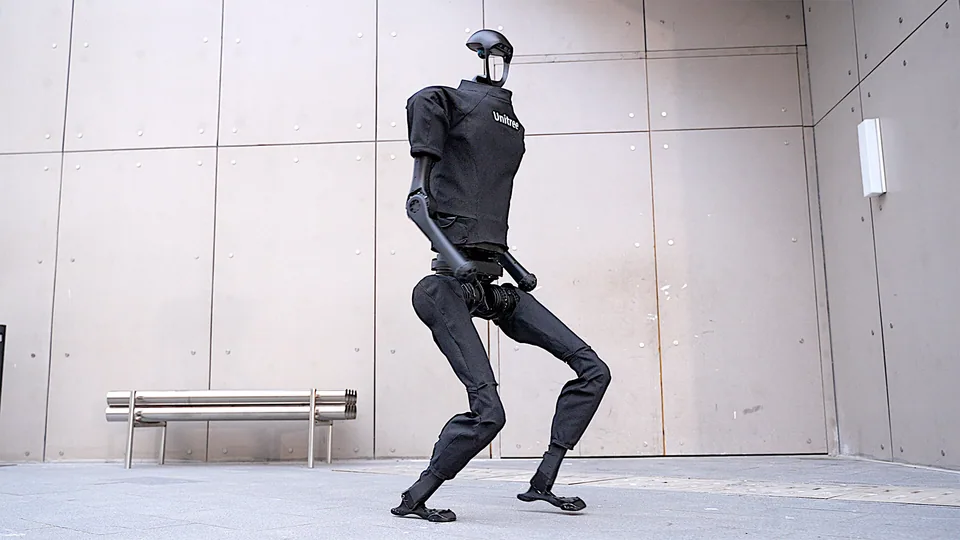
CyberOne is 177 cm tall, weighs 52 kg and has 21 degrees of freedom (DOF). The H1 is 180 cm, 47 kg and has 18 degrees of freedom (“Degrees of Freedom (DOF) in Humanoid Robots”). In joint count CyberOne is thus slightly richer, but the rest of the data favours the H1. CyberOne’s walking speed is up to 1 m/s, while the H1 has a measured 3.3 m/s, theoretically up to 5 m/s according to the manufacturer, and a peak torque of 189 N·m/kg. CyberOne’s payload is only 1.5 kg, so it cannot even carry a toolbox; for the H1 the manufacturer gives no payload.
Senses and heart differ too. CyberOne has the Mi-Sense system for recognising a speaker’s emotions, which is not documented for the H1. The H1 has a 3D LiDAR, a depth camera, an 864 Wh battery and an Intel Core i5 or i7 computer. CyberOne’s data lacks battery capacity and runtime, and the H1’s lacks runtime. There are gaps on both sides, so runtime cannot be compared honestly.
Price and availability in Poland
CyberOne has no price because it was never offered on the market, either at retail or to companies. A figure of USD 89,000–104,000 circulates online, but it is a 2022 production-cost estimate given by Xiaomi’s chief Lei Jun (CNY 600,000–700,000), not a selling price. It is a common mistake, which is why we leave the price field empty. Were such a prototype ever to go on sale, it would cost more than its production cost, but quoting a specific amount would be guesswork.
Unitree lists the H1 at USD 90,000, about PLN 348,900 (≈ EUR 79,950) at the 3.8762 rate of 1 October 2026. In Polish shops on 28 September 2026 we saw higher offers: PLN 439,000 (≈ EUR 100,590) at Botland. The manufacturer does not explain the spread, so ask for a quote with a specific configuration before ordering. On top of the price come spare batteries, service and a protective zone around a running machine. Alternatives available in Poland are in the overview “How Much Does a Humanoid Robot Cost in 2026”. The robotisation tax relief applies to industrial robots, so a research humanoid is unlikely to qualify (“Poland's Robotization Tax Relief”).
Which model for which job
CyberOne is useful today mainly as a demonstration: on a conference stage, at trade fairs, in a company showroom (events). A second field is research into human–robot interaction, where recognising mood matters. A third is the pilot in Xiaomi’s own factory: according to 2026 reports the robot works pilot shifts in the electric-vehicle plant, and in July 2026 a success rate of 98% was reported. We do not know the scale, the number of robots or the tasks, so we do not treat this as a reference for outside customers. In April 2026 Xiaomi showed a second generation of the robot.
The H1 serves research into gait dynamics, balance and reinforcement learning in the laboratory and at universities, as well as Unitree’s record-setting demonstrations. It is not suited to factory work: 18 degrees of freedom is little, and the manufacturer documents no payload. If you want a cheaper humanoid available in Poland, look at the Unitree G1, about PLN 52,300 (≈ EUR 11,980) at the manufacturer’s price, or the newer Unitree H2. For beginners there are also educational robots.
Conclusion
CyberOne, presented in August 2022, never went on sale and remains a prototype tested inside Xiaomi's EV factory. The H1 has been genuinely available for purchase by research and industrial institutions since 2023. The robots are close in height (177 cm versus 180 cm), but the H1 is lighter (47 kg versus 52 kg) and clearly faster: a 3.3 m/s walking speed against the 1.0 m/s stated for CyberOne. The USD 89,000 to 104,000 valuation of CyberOne that circulates online is in fact a production cost estimate given by Xiaomi's CEO in 2022, not a sale price, so the price field is left empty. CyberOne stands out with its Mi-Sense emotion recognition system, which the H1 has no documented equivalent of. For anyone looking for a robot to actually buy, the H1 is the only real option of the pair.
If you want to buy a humanoid, the choice is clear: the H1. CyberOne is not a product, and anyone asking about its price has usually mistaken production cost for a market price. Read about it as a milestone in Xiaomi’s development and as a prototype that after four years has earned a factory pilot and a second generation.
Even the H1 is worth buying only if you need its particular motion characteristics: since October 2025 Unitree’s flagship humanoid has been the H2, and the H1 remains on sale as an older model. For a team with no experience of large machines, 47 kg of running robot is a real risk. How to read manufacturers’ claims is explained in “How to Read a Robot Datasheet”.
Frequently asked questions
Can CyberOne be bought?
No. It remains a prototype tested in Xiaomi's factory and never went on commercial sale.
Where does the rumor of a USD 89,000 to 104,000 price for CyberOne come from?
It is a 2022 production cost estimate given by Xiaomi CEO Lei Jun, not an official sale price, and it is therefore not treated as a confirmed figure.
Which robot is faster?
The H1, with a walking speed of 3.3 m/s, is more than three times faster than the 1.0 m/s stated for CyberOne.
Can the Xiaomi CyberOne be bought?
No. The robot never went on sale, either at retail or to companies, and its pilot takes place inside Xiaomi’s factory.
How much does CyberOne cost?
It has no price. The figure of USD 89,000–104,000 is a 2022 production-cost estimate (CNY 600,000–700,000) given by Xiaomi’s chief, not a selling price.
Is the H1 suitable for factory work?
No. With 18 degrees of freedom and no documented payload it is a machine for motion research and demonstrations.
Sources
- Xiaomi CyberOne · technode.com
- Xiaomi CyberOne · interestingengineering.com
- Unitree H1 · shop.unitree.com
- Unitree H1 · unitree.com
- Unitree H1 · github.com