Boston Dynamics
Compare
A comparison of the Atlas and the Unitree H1. Both stand over 180 cm tall, both are electric, and both are sometimes called “the best humanoid in the world”. That makes it easy to miss that they are two different kinds of product: one you can buy, the other you cannot. We set Atlas against Unitree H1 to separate what looks impressive on video from what fits a university or company budget. For the wider picture, see the humanoid robots category and the explainer “How Does a Humanoid Robot Work”.
Boston Dynamics
| Feature | Atlas | Unitree H1 |
|---|---|---|
| Manufacturer | Boston Dynamics | Unitree Robotics |
| Price (PLN) | no data | 439,000 PLN (≈ EUR 100,590) |
| Height (cm) | 190.0 | 180.0 |
| Weight (kg) | 90.0 | 47.0 |
| Degrees of freedom | 56 | 18 |
| Payload (kg) | 50.0 | no data |
| Speed (m/s) | no data | 3.3 |
| Runtime (h) | 4.0 | no data |
| Status | prototype | on sale |
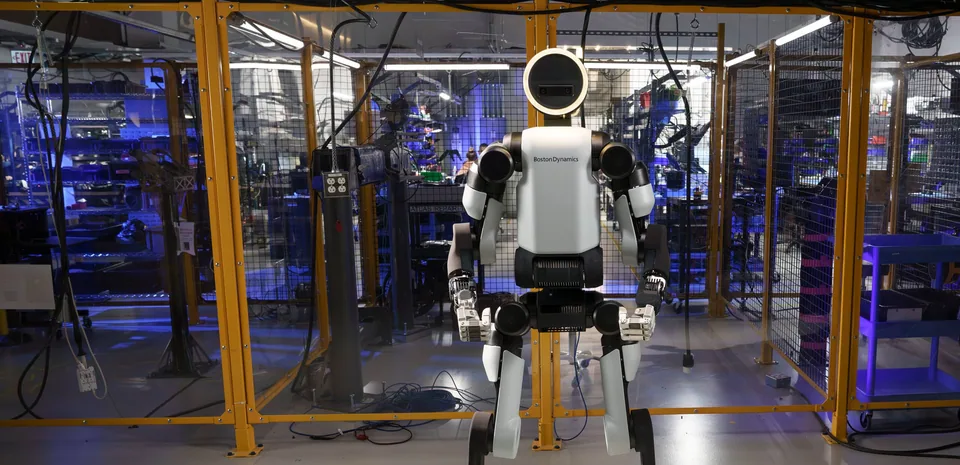
Atlas stands 190 cm tall, weighs 90 kg and has 56 degrees of freedom (DOF). The H1 is 180 cm, 47 kg and has 18 degrees of freedom: five per leg and four per arm. The gap in complexity is more than threefold, which explains why the two machines play such different roles (“Degrees of Freedom (DOF) in Humanoid Robots”). Atlas lifts 50 kg briefly and 30 kg continuously, has an IP67 enclosure, works from −20 to 40 °C and swaps its own battery in under 3 minutes. Runtime is 4 hours. Computing is handled by an NVIDIA Jetson Thor T5000 (NVIDIA Jetson), with foundation models supplied by Google DeepMind.
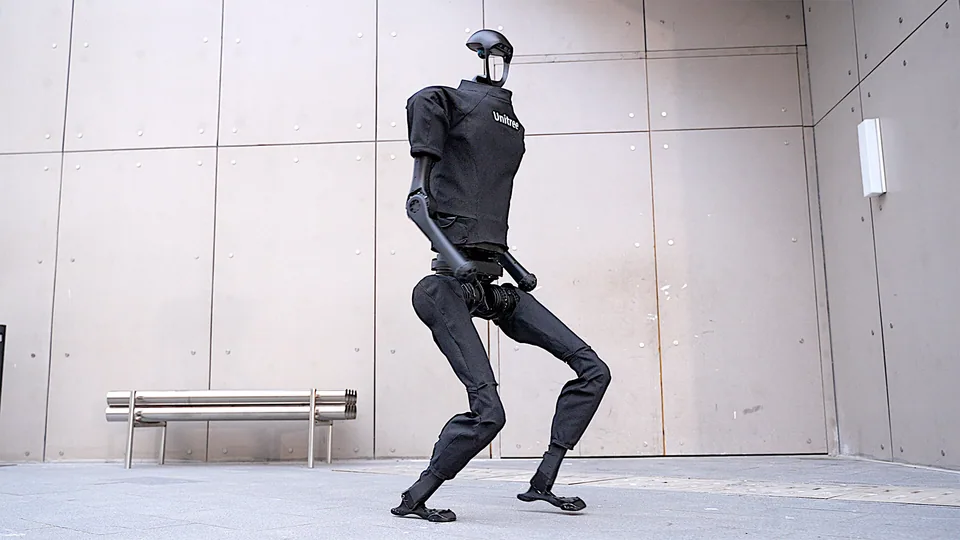
The H1 wins where dynamics matter. Unitree quotes a measured speed of 3.3 m/s, theoretically up to 5 m/s, and a peak torque density of 189 N·m/kg. The battery is 864 Wh at 67.2 V, the computer is an Intel Core i5 (standard) or i7 (developer version), and the senses are a 3D LiDAR and a depth camera. The manufacturer does not state payload or battery runtime, so those two key figures cannot be set against Atlas. Atlas, in turn, has no published walking speed or battery capacity in Wh.
We cannot price Atlas. Boston Dynamics publishes no figure, and all production capacity for 2026 is assigned to the Hyundai Robotics Metaplant Application Center and Google DeepMind labs. Hyundai has announced output of 30,000 units a year in the US by 2028, but that is a statement about scale, not an offer to outside customers. For a Polish university or company there is simply no purchase route (Hyundai Motor Group).
Unitree lists the H1 at USD 90,000, about PLN 348,900 (≈ EUR 79,950) at the 3.8762 rate of 1 October 2026. That conversion is indicative only: on 28 September 2026 we saw higher prices in Polish shops, PLN 439,000 (≈ EUR 100,590) at Botland. Ask for a quote with a specific configuration before ordering. On top of the price come spare batteries, repairs after falls and a protective zone around a 47 kg machine that runs. The method for calculating the whole cost is in “Humanoid Robot TCO: How to Calculate Total Cost”, and market price context in “How Much Does a Humanoid Robot Cost in 2026”. The Polish robotisation tax relief applies to new industrial robots; whether a research humanoid qualifies is a question for an adviser (“Poland's Robotization Tax Relief”).
The H1 is a machine for studying motion: locomotion, balance, whole-body control and reinforcement learning. Its natural homes are the laboratory and the university. It also works as a showpiece at events, because 180 cm makes a bigger impression than smaller builds. It is not suited to the factory: 18 degrees of freedom is little for manipulation, and the manufacturer documents no payload.
Atlas points to where industry is heading. Its confirmed workplaces are Hyundai plants and DeepMind research. The CES 2026 demo, in which it sorted car parts, was by reports run under remote control, so full autonomy remains a goal. A broader view of deployments is in “Humanoid Robots in Factories 2026”, and the design history in “Boston Dynamics Electric Atlas”. If you want a humanoid you can actually buy and that has more degrees of freedom than the H1, look at Unitree H2 and the series overview in “Unitree H1, G1, R1 and H2”.
The H1 has been on sale since 2023 and genuinely reaches research labs, although no publicly confirmed price has been found below the USD 90,000 given in the data. The electric Atlas remains at the pilot stage, reserved solely for Hyundai and Google DeepMind; you simply can't order one. The scale differs considerably: Atlas is 190 cm and 90 kg with a 50 kg payload, while the H1 is 180 cm and 47 kg with no payload figure on record, but with a documented walking speed of 3.3 m/s that Unitree has used in public running demonstrations. The H1 is a much simpler design, with 18 degrees of freedom against Atlas's 56, which translates into a lower entry cost for a research team. For an institution planning its own research program, the H1 is a realistic, if pricey, purchase option; Atlas remains out of commercial reach.
For a research team with a budget of a few hundred thousand zlotys the answer is simple: the H1, because it is the only one of the pair you can realistically order. Buy it if your subject is gait dynamics and you need a large, powerful platform. Remember, though, that since October 2025 Unitree’s flagship humanoid has been the H2, and the H1 stays on sale as an older model, so compare the two before deciding.
For an industrial group, an integrator or an analyst who wants to understand where hall automation is going, Atlas is the reference point: 56 degrees of freedom, IP67, a battery swap in minutes and an AI partner in DeepMind’s class. Treat it as a compass, not an offer.
In short: the H1 is a product, Atlas is a preview. Before putting either into a plan, ask for the datasheet and delivery terms; how to read one is explained in “How to Read a Robot Datasheet”.
No. All of its capacity is reserved for Hyundai and Google DeepMind, and outside that circle the robot isn't sold.
Atlas has 56 and the H1 has 18, which makes Atlas mechanically far more complex.
Yes. Unitree has used the H1 in public demonstrations and running records, drawing on its 3.3 m/s walking speed.
No. All production capacity for 2026 is assigned to the Hyundai Robotics Metaplant Application Center and Google DeepMind, and the manufacturer offers neither single-unit sales nor a price.
Atlas has 56 degrees of freedom, the H1 has 18. The difference shows up in mechanical complexity and range of motion, not in availability.
The manufacturer’s price is USD 90,000, about PLN 348,900 (≈ EUR 79,950). In Polish shops on 28 September 2026 we saw PLN 439,000 (≈ EUR 100,590) (Botland); the final figure is set individually.
No. With 18 degrees of freedom and no documented payload it is a machine for motion research and demonstrations, not for moving loads.