Compare
Unitree H1 vs Unitree H2: Two Flagships, Two Years of Development Apart
Key facts
- Price in PolandUnitree H1: 439,000 PLN (≈ EUR 100,420 at NBP rate 4.3716 of 20 October 2026) · Unitree H2: 219,900 PLN (≈ EUR 50,300)
- WeightUnitree H1: 47 kg · Unitree H2: 70 kg
- StatusUnitree H1: on sale · Unitree H2: on sale
- In PolandUnitree H1: yes · Unitree H2: yes
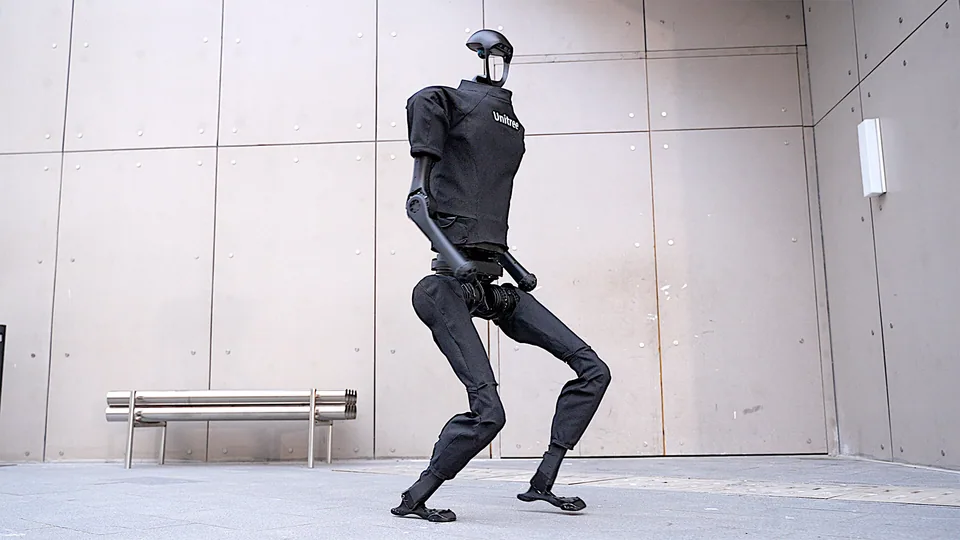
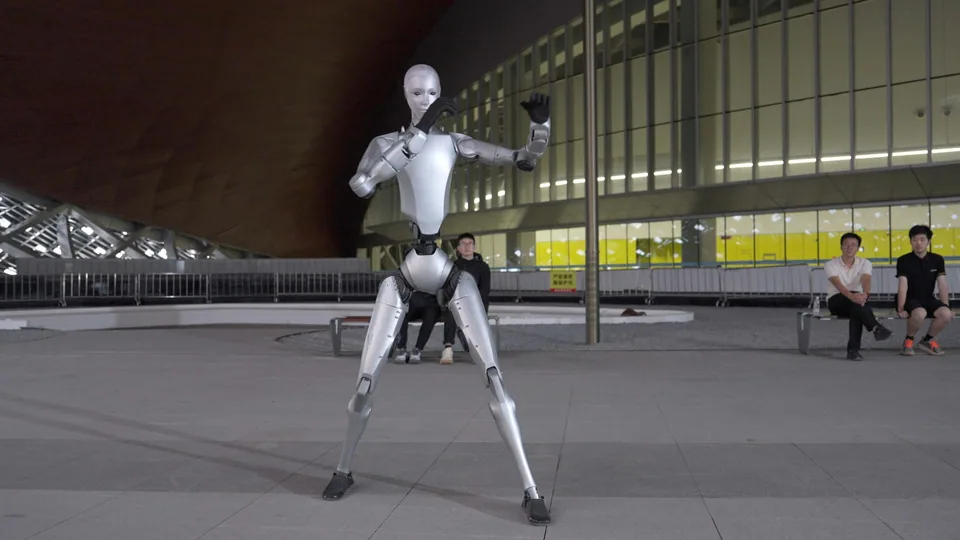
A comparison of the Unitree H1 and the Unitree H2. Intuition says newer means better, but here the successor is heavier and described in less detail than its predecessor. At the same time Unitree Robotics prices it much lower in dollars. We check what that means in practice, including for a buyer in Poland, where prices look different from the manufacturer’s shop.
| Feature | Unitree H1 | Unitree H2 |
|---|---|---|
| Manufacturer | Unitree Robotics | Unitree Robotics |
| Price (PLN) | 439,000 PLN (≈ EUR 100,420) | 219,900 PLN (≈ EUR 50,300) |
| Height (cm) | 180.0 | 180.0 |
| Weight (kg) | 47.0 | 70.0 |
| Degrees of freedom | 18 | 31 |
| Speed (m/s) | 3.3 | no data |
| Status | on sale | on sale |
Design and specifications
Both robots are 180 cm tall, and the similarity ends there. The H1 weighs 47 kg and has 18 degrees of freedom (DOF), of which according to the detailed data 5 are in each leg and 4 in each arm. The H2 weighs 70 kg, almost half as much again, and has 31 DOF. That is a leap towards range of motion and expressiveness: the H2 is the first Unitree humanoid with a bionic face, and its compute unit delivers 2070 TOPS. The H1 relies on a different strength, speed. The manufacturer quotes a measured 3.3 m/s for it (theoretically up to 5 m/s, not independently confirmed), a peak torque density of 189 N·m/kg, an 864 Wh battery at 67.2 V and an Intel Core i5 or i7 processor. For the H2 the sources we gathered give no confirmed speed, payload or battery capacity, so those values can be neither compared nor guessed. For the H1, in turn, payload and runtime are missing. How to read such incomplete sheets is explained in “How to Read a Robot Datasheet”, and what DOF figures hide is covered in “Degrees of Freedom (DOF) in Humanoid Robots”.
Price and availability in Poland
According to the manufacturer’s shop the H2 costs USD 29,900, or about PLN 115,900 (≈ EUR 26,510) at 3.8762 zloty to the dollar, and the H1 USD 90,000, or about PLN 348,900 (≈ EUR 79,810). The newer robot is therefore three times cheaper in dollars. A variant called “H2 Plus” is said by an outside source to cost USD 100,000, but the manufacturer has not confirmed it. One caveat matters: only the EDU version supports further programming (secondary development), so the base price does not describe the robot you would use for research. Polish listings from late September 2026 paint a different picture: Botland listed the H1 at PLN 439,000 (≈ EUR 100,420), while the H2 cost PLN 219,900 (≈ EUR 50,300) at Delta Robots and PLN 240,000 (≈ EUR 54,900) at x-kom (EDU Smart A configuration). Older x-kom entries ran from PLN 269,000 (≈ EUR 61,530) (EDU Smart F) through PLN 432,000–497,500 (≈ EUR 98,820–113,800) (PLUS Flagship) to PLN 1,000,000 (≈ EUR 228,750) for the top configuration. Listing prices do not always describe the same equipment. Total cost of ownership is discussed in “Humanoid Robot TCO: How to Calculate Total Cost”.
Which model for which job
The H2 in its EDU version is the natural choice for a university or laboratories that develops its own software and needs plenty of compute, for instance for the models described in “VLA Models: How AI Controls Humanoid Robots in 2026”. The H1 remains a reference point for research on fast walking and for record demonstrations. Neither is suited to a factory, since neither has a documented payload; real deployments are described in “Humanoid Robots in Factories 2026”. If the robot is to appear only at events, renting is often more sensible than a purchase worth hundreds of thousands of zloty; see “Renting a Humanoid Robot for an Event”.
Conclusion
The H2, unveiled in October 2025, is a noticeably heavier and more complex machine than the 2023 H1: 70 kg versus 47 kg, and 31 degrees of freedom versus the H1's 18. That leap shows up in the price too, but in the opposite direction from what you might expect. The H2 is priced at USD 29,900 (about PLN 115,898 (≈ EUR 26,510)), far below the H1 (USD 90,000, about PLN 348,900 (≈ EUR 79,810), according to available data), even though it is technically more elaborate. The H1, for its part, has a documented walking speed of 3.3 m/s and was used in Unitree's public running records; for the H2 the manufacturer gives no such figure. The H2 uses a compute platform rated at 2,070 TOPS, which suggests a focus on more demanding perception tasks rather than motion showcases. The choice depends on the goal: the H1 remains the benchmark for gait dynamics, while the H2 looks like a successor aimed at industry and research with a larger compute budget.
A lab buying a research platform today to last for years should choose the H2 in its EDU version: more degrees of freedom, more compute and a lower price than the H1 at a comparable height. Before ordering, though, get the full spec sheet from the supplier, because key parameters are unconfirmed for the H2. The H1 makes sense only if you specifically need its documented running speed or already have a team working with it; at PLN 439,000 (≈ EUR 100,420) and up it is hard to justify for a new project. An organiser of shows should not buy either without checking the rental offer.
Frequently asked questions
Has the H2 replaced the H1 in Unitree's lineup?
Both models are listed as available for sale. The H2 is not formally a successor that retires the H1 but a separate, heavier platform.
Which model has more degrees of freedom?
The H2 has 31 degrees of freedom against 18 for the H1, which makes it mechanically more complex.
Is the H2 more expensive than the H1?
No. According to available data the H2 costs about USD 29,900, less than the H1 at USD 90,000.
What payload and speed does the H2 have?
The sources gathered give no confirmed values. For the H1 we know a measured speed of 3.3 m/s, but not its payload.
Sources
- Unitree H1 · shop.unitree.com
- Unitree H1 · unitree.com
- Unitree H1 · github.com
- Unitree H2 · shop.unitree.com
- Unitree H2 · github.com