on sale
Manufacturer
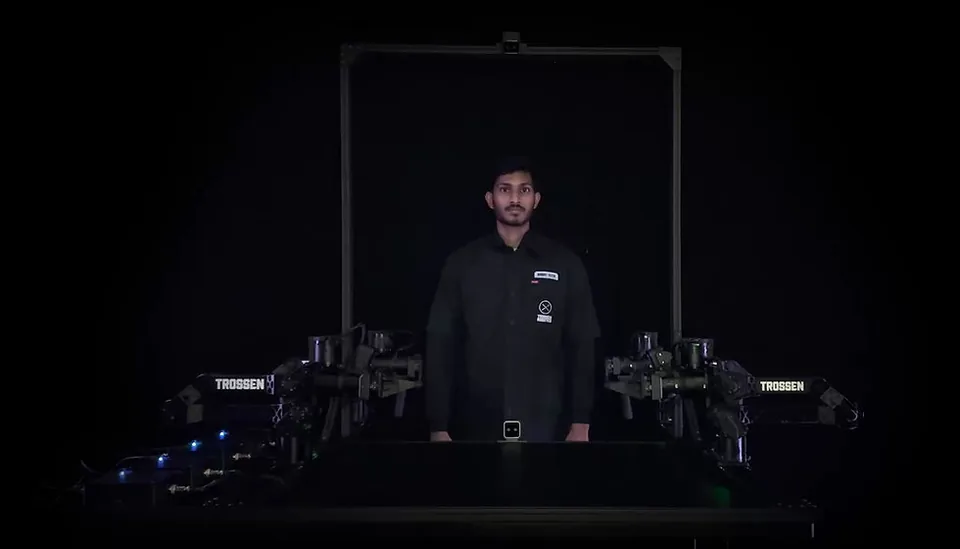
Trossen AI Stationary, successor to ALOHA, at $23,996: a research platform for imitation learning.
Based in Downers Grove, Illinois, Trossen Robotics built its brand around commercializing the open-source ALOHA platform, originally created at Stanford and Berkeley for research on imitation learning.
Today the company sells it as the Trossen AI family in Stationary, Solo and Mobile variants; the model described here is the Trossen AI Stationary, the successor to ALOHA, available for $23,996 (about 93,013 PLN (≈ EUR 21,310 at NBP rate 4.3641 of 21 October 2026)).
It is hardware aimed at robotics labs and research teams working on dual-arm manipulation, not at industrial or consumer customers; in that respect it competes more with academic platforms such as Tokyo Robotics' Torobo than with commercial cobots. The advantage is a ready, documented software ecosystem with university roots; the weakness is a high entry price for niche hardware. No distribution in Poland.
Trossen Robotics is based in Downers Grove, Illinois, and has built its brand around commercialising the ALOHA platform. ALOHA is an open-source project that originated at Stanford University and Berkeley, devoted to imitation learning in two-armed manipulation. Rather than developing a robot from scratch, the company took a solution familiar to machine-learning researchers and turned it into hardware that can be bought. Today it sells that hardware as the Trossen AI family in Stationary, Solo and Mobile variants. The product page of the original ALOHA Stationary is marked as discontinued, and the Trossen AI line has taken its place. It is a good example of how a university result becomes a commodity. The year the company was founded is not publicly confirmed, so we do not state it, nor headcount or funding. What we do know is who the offer is aimed at: robotics laboratories and research teams, not industrial or consumer customers. That niche explains the sales approach, in which credibility with researchers matters more than a marketing campaign. The wider educational and research context is covered in “Educational Robots for Schools and Universities”.
The core of the offer is the Trossen AI family, and the model described here is Trossen AI Stationary, the successor to ALOHA. It is a stationary platform for bimanual teleoperation and imitation learning: an operator drives two arms, and the collected demonstrations are used to train models of the kind discussed in “VLA Models: How AI Controls Humanoid Robots in 2026”. The kit is electric and ships with a preinstalled Linux laptop and a ROS 2 stack, so work can start straight out of the box. Typical uses are imitation learning, two-handed manipulation and a controlled lab setting, that is laboratories and universities. The price calls for caution. On the maker's site the Stationary AI tile carries no fixed price, only a “Get a Quote” button, and the figure of $23,995.95 that was sometimes attributed to this model actually belongs to a higher configuration of the Solo AI variant. Alongside Stationary the range includes Solo and Mobile, whose details we do not describe because we have no confirmed data for them. The whole line sits within educational robots. For a research team this saves time: instead of assembling a station from separate parts, it receives a coherent kit that is immediately suitable for collecting training data.
Trossen Robotics competes in a narrow segment of laboratory hardware, not against commercial cobots. The two-arm configuration and ready-made software justify a higher budget than single educational arms, and the buyer is a team working on manipulation algorithms. The closest point of comparison is an academic platform such as Tokyo Robotics Torobo from Tokyo Robotics, rather than a collaborative robot from Universal Robots, whose logic is explained in “What Is a Cobot and How Does It Differ from an Industrial Robot”. The biggest asset is continuity with the ALOHA project, well regarded in the ML community, and turnkey readiness: the kit reaches the lab with software that many researchers already know. The weakness is the lack of a public price, because before buying you have to contact sales and ask for a quote. We have no independent performance comparisons or sales figures, so we do not assess market share. This position works for researchers, not for schools or hobbyists.
In Poland, Trossen Robotics has no confirmed official distributor. We also know of no deployments or orders involving the company on the Polish market. A purchase is probably possible only directly from the US maker with international shipping, which means customs, tax and a longer delivery time, as well as no local service. Before deciding it is worth asking for a quote and warranty terms, because the price is not public. Polish universities and schools looking for an easier way into robotics will find a survey in “Educational Robots for Schools and Universities”. You should also expect that any technical help will mean contacting an overseas support team.
Trossen AI Stationary is a sensible choice for research teams that want to work with ALOHA without building hardware from scratch. Its strengths are continuity with a respected project and a ready ROS 2 stack. Its weaknesses are no public price and no distribution in Poland. For schools and hobbyists the entry bar is too high. Before deciding, ask for a quote and delivery terms to Poland, because without them costs cannot be compared with other research platforms.
Trossen Robotics