on sale
Data from manufacturer datasheets and product pages; median over the models of this category in the database.
Hitachi's EMIEW 2 (2007) is a prototype office service robot: 80 cm, 13 kg, 25 DOF, up to 6 km/h. It never went on sale.
Price from
Hitachi built the second-generation EMIEW more than twice as small and light as its 2005 predecessor: 80 cm tall and 13 kg, against 130 cm and 70 kg. The name, short for "Excellent Mobility and Interactive Existence as Workmate," sums up the project's aim: a mobile office assistant rolling on wheels at up to 6 km/h (1.67 m/s), faster than an average human walk.
The design uses 25 degrees of freedom and a basic vocabulary of about 100 words for simple voice interaction, backed by obstacle avoidance. The model was unveiled in January 2007 as a research prototype from the Japanese industrial group listed on the Tokyo exchange (code 6501). It never went on sale, and the EMIEW series ended with later demonstration iterations.
Among the other service robots in this comparison, EMIEW 2 stands out for the age of the project: it is one of the oldest designs described here, shown nearly two decades before the current wave of humanoids. There is no data on payload, battery or price; as a prototype it never had an official price list. Not available in Poland.
no data
There is nothing to price as a purchase: EMIEW 2 never had an official price list because it was not sold. The manufacturer also publishes no data on payload or battery, so there is no way even to calculate running costs reliably.
For a sense of scale, look at a contemporary from the same era: Wakamaru cost about $14,300, or roughly PLN 55,400 (≈ EUR 12,690 at NBP rate 4.3641 of 21 October 2026) at conversion. That is a historical figure, not an offer. The cost of designing and building a prototype of such a robot at a large corporation was of course many times higher, but Hitachi does not disclose the amount, so we do not guess it.
If you are considering a service robot today, as a rough order of magnitude expect a purchase price in the range of several tens of thousands of zloty for a simple wheeled unit, plus a software subscription and service; that is only an order of magnitude to verify in a distributor's offer. Training? For a prototype, not applicable.
No confirmed distributor in Poland
EMIEW 2 was a wheeled assistant meant to work alongside people in an office, not behind a barrier; Hitachi showed it in January 2007. The name is short for "Excellent Mobility and Interactive Existence as Workmate."
The uses envisioned for it were an interactive companion in the workplace and obstacle avoidance: the robot was meant to understand around 100 words, respond to simple commands and move quickly around the office, at up to 1.67 m/s, or about 6 km/h. At 80 cm tall and 13 kg it fit where its 2005 predecessor (130 cm, 70 kg) would have been an obstacle. Today we would describe the same scenario as a hotel receptionist (hotels) or an information point in a shopping mall (retail), and for that role the world later tried designs such as Pepper or PAL Robotics ARI.
But let's be plain: EMIEW 2 was a research prototype and never went on sale. You cannot buy it, rent it or deploy it. Its value lies elsewhere. It shows how early Hitachi began thinking about a wheeled service robot, and which design choices (small scale, wheels instead of legs, 25 degrees of freedom, see “Degrees of Freedom (DOF) in Humanoid Robots”) work in tight interiors. It is a good starting point if you want to understand where the whole service robots category came from and why it began to earn real money only two decades later.
Yes: for readers who want to learn the history of service robotics, such as students, journalists, authors of presentations on the development of the industry, and designers wondering what proportions an office robot should have. Also for collectors of facts: EMIEW 2 is one of the oldest designs described on this site, shown nearly two decades before the current wave of humanoids.
No: for companies looking for a robot to deploy. Hitachi does not offer it commercially, there is no price list and no distributor in Poland. Not for purchasing departments or integrators. If you need a robot today that greets guests, carries orders or cleans floors, look at service robots with a real offer and service, such as Pudu BellaBot in restaurants or the overview in “Service Robots in Restaurants and Hotels”. Before comparing the parameters of different models, the cheat sheet “How to Read a Robot Datasheet” is also handy.
EMIEW 2 was purely a demonstration prototype and never reached commercial customers.
If you are interested in where service robots actually work, look at the category: Pudu BellaBot and similar designs carry dishes in restaurants, and Starship Delivery Robot has more than 10 million deliveries in more than 300 cities to its name, although it is not yet available in Poland. We have gathered Polish companies active in robotics on the map “Polish Robotics Companies”.
Since EMIEW 2 cannot be bought, "alternative" here means robots that fill the same niche and that you can actually get to know or order.
Pepper is a humanoid reception robot on wheels (120 cm, 28 kg), made in about 27,000 units and withdrawn from production in 2024. The closest conceptual relative of EMIEW 2 that actually reached people.
Wakamaru is Mitsubishi Heavy Industries' home receptionist robot from 2005, withdrawn as early as 2008. Interesting as an EMIEW contemporary: it appears in our catalog at about $14,300, which shows how expensive such experiments were then.
PAL Robotics ARI is a newer social and service design from PAL Robotics (165 cm, speaking more than 20 languages) for reception and human-robot interaction research; price on request.
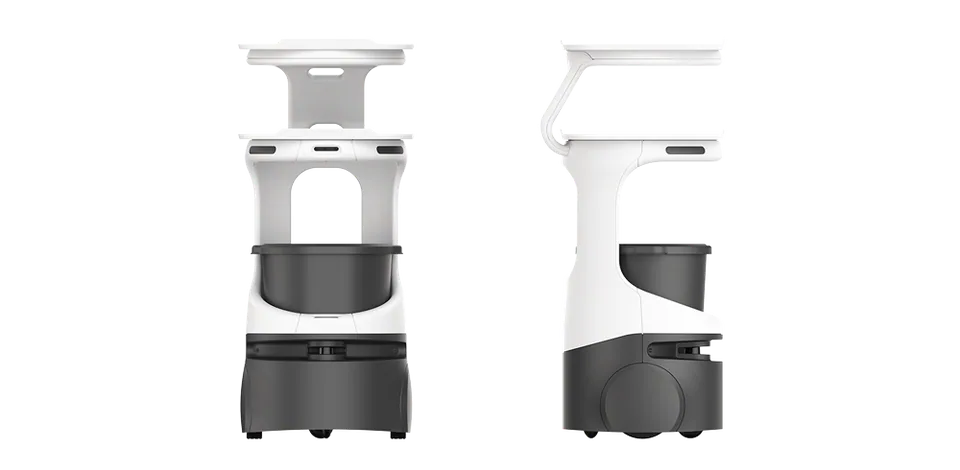
Pudu BellaBot is the practical successor to the idea of "a robot that moves nimbly among people": today it does not chat about the weather but carries dishes around a restaurant. Priced at about PLN 56,205 (≈ EUR 12,880) in our catalog.
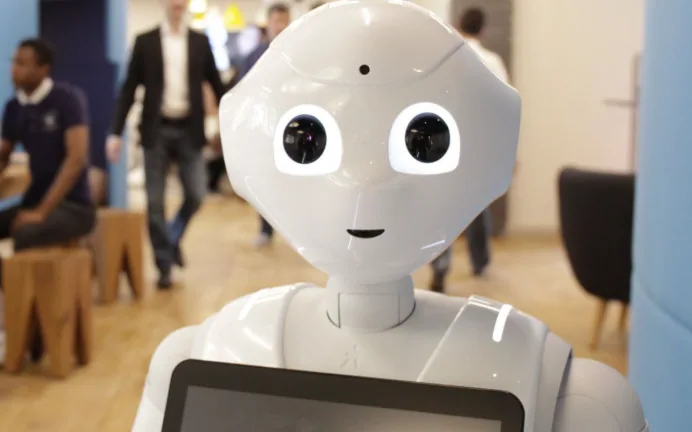
Aldebaran / SoftBank Robotics / United Robotics Group (now Maxtronics)
Hitachi showed the first EMIEW in 2005: 130 cm tall and 70 kg, a solid, large research design. Two years later, in January 2007, came the second generation, radically smaller and lighter: 80 cm and 13 kg. That was not cosmetics but a change of philosophy, from a robot that impresses with size to a robot that fits in an office and does not frighten people. It was announced with speeds up to 6 km/h and simple conversation based on about 100 words.
Development of the EMIEW series ended with later demonstration iterations; the robot never went on sale. Hitachi is an industrial conglomerate listed on the Tokyo stock exchange (code 6501), founded in 1910, so EMIEW was one of the projects showcasing the company's capabilities, not a product for the shelf. Despite the lack of a commercial finale, the set of ideas (wheels, small dimensions, voice communication, obstacle avoidance) returned later in many service robots.
Model unveiled
No. The EMIEW 2 is a prototype or research platform with no commercial offer in Poland; any sale would be announced by the manufacturer (Japan).
Up to 1.67 m/s, or about 6 km/h, faster than the average human walking pace.
No. It remained a Hitachi research prototype from 2007 and never entered the commercial lineup.
It was much smaller and lighter: 80 cm and 13 kg, against 130 cm and 70 kg for the 2005 predecessor.
Shop links may become affiliate links in future, details: How we make money · How we check