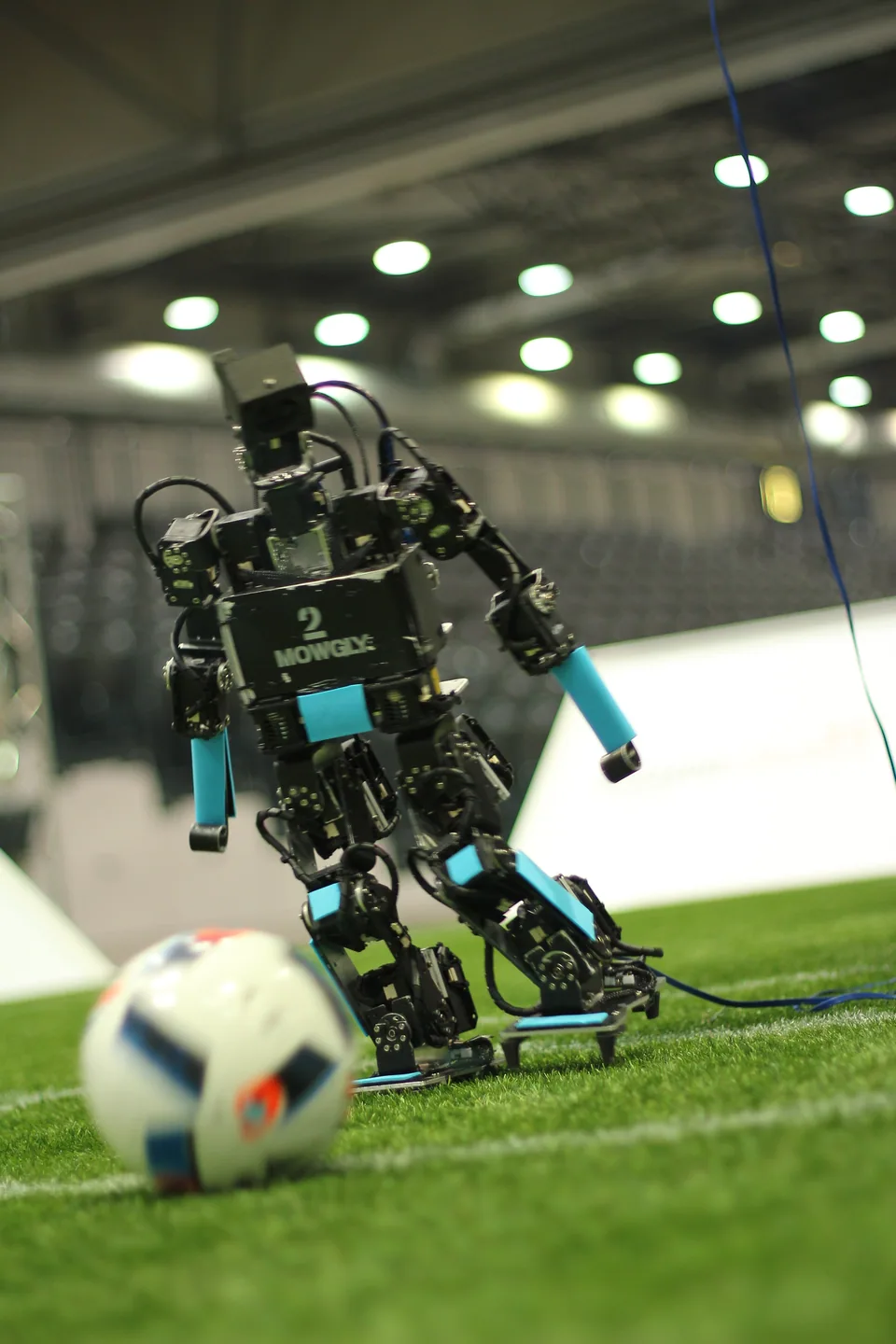
prototype
Rhoban Football Club (Bordeaux INP / Universite de Bordeaux)Educational robots
SigmaBan
- 70 cmheight
- 7.5 kgweight
- —price
Manufacturer
Little is known about Rhoban at the moment beyond the fact that it is a French robotics team or project that publishes its work on GitHub under the name Rhoban, with no official company website and no details on headquarters, founding year or business model.
The name appears mainly as part of a general overview of smaller, less documented players in robotics, not as the result of direct verification on a manufacturer's site. Not confirmed are the country of registration beyond the general designation FR, any specific robot models, funding, headcount, or any commercial contact or distribution in Poland.
Those interested should check the Rhoban repository on GitHub directly, as it is currently the only reliable, publicly available source of information about the team. The open nature of its GitHub publications suggests, however, an academic or hobbyist environment closer to open-source culture than to a classic commercial startup.
Rhoban Football Club is a team from Bordeaux, linked to Bordeaux INP and the Université de Bordeaux, that builds humanoid robots for RoboCup competitions. It is not a company in the usual sense: the project gives no founding year, legal form, financial data or team size, and our collected sources show no official corporate website. It does publish its work on GitHub and on the project site, including a description of the SigmaBan design and the specification submitted to the tournament. This way of working has clear roots in academic culture: the designs exist to win competitions and to be used by others, not to enter a sales catalog. According to the available information the team is a five-time world champion in the KidSize class, meaning competitions of robots a few dozen centimeters tall. We cannot verify that number independently beyond the project's own materials, so we treat it as the team's own claim. For the reader the context is worth grasping: RoboCup has for years been a proving ground for walking on two legs, balance and perception, as we explain in “How Does a Humanoid Robot Work”. We have collected the basic terms in “Robotics Glossary: 65 Terms with Polish Equivalents”. Beyond this team there is little to say about its history, and we say so honestly.
The only model described here is the SigmaBan, a kid-size humanoid robot built for football within RoboCup. It is 70 cm tall, weighs 7.5 kg and has 20 degrees of freedom, whose meaning we explain in “Degrees of Freedom (DOF) in Humanoid Robots”. Its status is prototype: it is a research project with no commercial sales, so there is no price or price list, and our overview has no delivery date either. Walking and quick movements depend on actuators, whose role is discussed in “Actuators in Humanoid Robots”. The SigmaBan is intended for research and educational work, and typical places of use are a university and a laboratory. Anyone who wants to build a similar machine can use the published materials, but must expect their own mechanical and programming work. We describe the whole category in educational robots. The sources give neither battery runtime nor payload, so we do not enter them. For a university team it also matters that the documentation published for the tournament lets you compare your own solutions with a design that has won many times. Anyone planning to enter RoboCup should study these materials first.
Rhoban does not operate in the market in the classic sense, since it sells no robots, and its competition is other tournament teams. The closest commercial answer to the same need is ROBOTIS with the ROBOTIS OP3, available as a ready-made platform for research and competitions. At universities a similar role is played by projects such as Stanford University — Hybrid Robotics Lab, creator of ToddlerBot, and by Unitree Robotics, whose cheaper humanoids are gaining popularity in laboratories. Rhoban's strength is a proven sporting record, its weakness the lack of an offer, support and availability data. Our sources do not show whether the team plans to make hardware available outside its own circle. The team's standing is therefore measured in medals and publications, not market share. Such a project can nevertheless be a valuable source of inspiration for people learning to design humanoids.
Rhoban has no confirmed presence in Poland: it does not sell robots, has no distributors and we found no Polish deployments. Polish university teams can, however, use its publications as a model when building their own robots for competitions. Those interested should check the project repository directly. Tips for beginners are in “How to Start Learning Robotics in Poland”. For students who want to start from the basics, the concept of degrees of freedom explained in our glossary will be a good complement. It is also worth checking the KidSize class rules before planning your own design.
Rhoban is a source of knowledge, not a commercial offer. For a university or student club that wants to build a RoboCup robot, it can be a valuable point of reference. Anyone looking for a ready-made machine should compare the ROBOTIS OP3 and ask about availability. The biggest plus is documented success in competitions, the biggest minus the lack of a commercial offer, price and servicing. Treat this project as a model to learn from, not as a product to order.
Rhoban Football Club (Bordeaux INP / Universite de Bordeaux)
Rhoban Football Club (Bordeaux INP / Universite de Bordeaux)Educational robots