on sale
Manufacturer
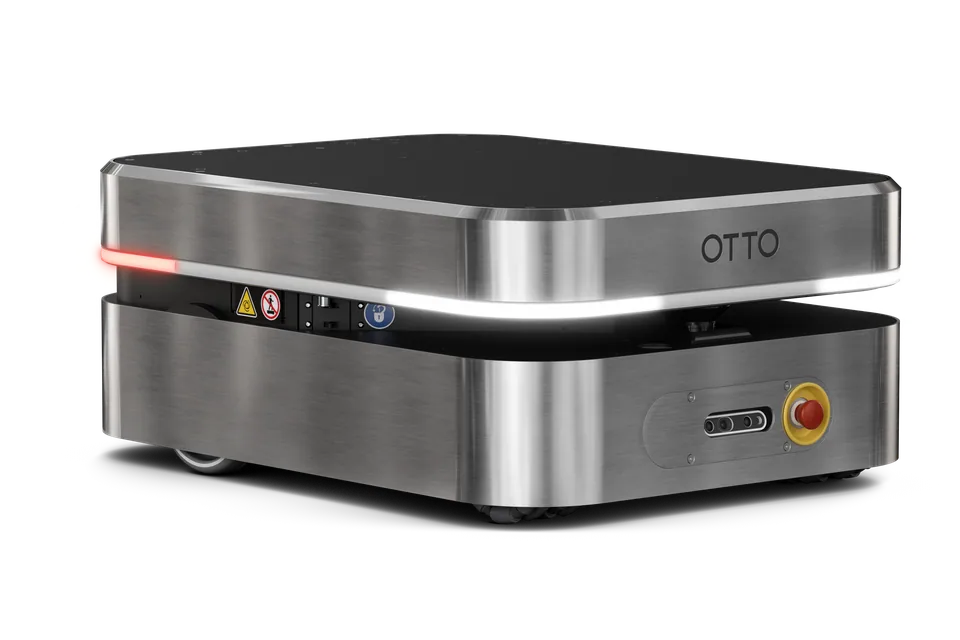
Canadian OTTO AMRs (100 to 1500, up to 1,900 kg) from Rockwell Automation, VDA5050 compliant.
Canadian Otto Motors, founded in 2008 in Kitchener, Ontario, has belonged since 2023 to the American group Rockwell Automation (NYSE: ROK) and operates under the brand OTTO by Rockwell Automation. Its portfolio covers four autonomous mobile robot models of increasing payload: the light OTTO 100 (150 kg), the OTTO 600, the heavy OTTO 1500 (up to 1,900 kg) and the OTTO Lifter for lifting loads.
All have a metal, industrial construction compliant with the VDA5050 standard, which eases integration with fleets from other manufacturers. Among the companies covered here is Japan's Omron with a similar LD/MD/HD range but no stated maximum payload; on that point the OTTO 1500 is better documented.
Rockwell Automation Polska conducts sales in the country, but it has not been independently confirmed whether that includes distribution of OTTO mobile robots specifically, rather than just the rest of the automation range.
OTTO Motors is the story of a robot that has payload instead of a camera and finesse. The Canadian company from Kitchener, Ontario, founded in 2008, builds autonomous mobile robots (AMRs) that haul pallets and heavy carts around production halls. In 2023 it came under the wing of the American group Rockwell Automation (NYSE: ROK) and now operates as OTTO by Rockwell Automation. For industrial customers that is an important change: the robot is no longer the product of an independent startup but part of the offering from an automation supplier whose controllers and supervisory systems may stand in the same hall. The metal, industrial construction and compliance with the open VDA5050 standard, which describes communication between a fleet and its supervisory system, make it easier to mix robots of different brands. That matters, because one hall rarely has a single supplier. Detailed data on revenue, headcount or funding rounds is not available in the sources. You can find more on how mobile robots work in warehouses in “AMR Robots in the Warehouse”. It is also an example of a mature market: the VDA5050 standard was created so the customer would not be held hostage by a single manufacturer.
The range covers four models of increasing payload. We list the two ends of the scale. OTTO 100 is a light AMR for loads up to 150 kg, aimed at production. OTTO 1500 is the heavy class: payload up to 1,900 kg at a dead weight of 627 kg, speed of 2 m/s and about 10 hours of battery life. Between these models there are also the OTTO 600 and the OTTO Lifter, which lifts the load itself; they do not yet have separate pages here. Prices are not in the sources. Applications are factories and warehouses. For a broader comparison of AMRs, see the category “Mobile robots (AMR)”. An important practical note: the 1,900 kg payload is a maximum load value, not a claim that every application will use it fully; in practice stacking height, floor surface and the way the load is handed over also matter. With machines like these, the key is a risk assessment of the whole workstation, not just the robot; “Robot Safety Standards” is a good introduction.
In capital terms, OTTO stands behind Rockwell Automation, listed on the New York Stock Exchange (NYSE: ROK), an anchor of stability that young startups lack. There is no separate valuation for the company and no funding rounds. The biggest competitor in this class is Denmark's Mobile Industrial Robots with the MiR1350 and Japan's Omron Robotics with the LD/MD/HD series; in our directory we have Omron LD-60/90. Our catalog gives no maximum payload for the Omron series, while the OTTO 1500 has a documented 1,900 kg. KUKA, for its part, offers its own platforms, such as the KUKA KMP 1500P. Competition is strong, and OTTO's edge is heavy loads. A comparison on paper does not decide the choice: with AMRs, integration with the warehouse system, time to deployment and availability of service count. A brand backed by an automation group usually has a simpler path here, because the customer can buy the robot together with the controls, though that means dependence on a single supplier.
Rockwell Automation Polska conducts sales in the country, but we have not independently confirmed whether that includes distribution of OTTO mobile robots specifically, rather than just the rest of the automation range. No Polish deployments or Polish integrator for OTTO were found in the sources. A practical step for a plant is to inquire at the local Rockwell branch. We have collected Polish robotics companies in the overview “Polish Robotics Companies”. For the conversation, prepare three numbers: pallet weight, route length and number of work shifts. Without them, no supplier can sensibly price a fleet. It is worth starting the inquiry with the route the robot is to cover and the type of load, as that will shorten the sales conversation.
OTTO is serious equipment for industry, backed by a large group and with a clear integration standard. Data on prices and the number of deployments has to be obtained from the supplier. For a Polish factory with heavy pallets, it is one of the first brands to consider. Before you ask about price, work out your own routes: they will decide how many robots you actually need. An overview of the whole class is in the category “Mobile robots (AMR)”. For smaller plants the question is whether such a heavy class is needed at all; the lighter OTTO 100 or a competitor may be enough.