on sale
Manufacturer
Japanese maker of the HAL exoskeleton, listed on the Tokyo exchange, controlled by bioelectric signals.
Cyberdyne Inc. was founded in 2004 in Tsukuba as a spin-off of the University of Tsukuba by Professor Yoshiyuki Sankai. The company is listed on the Tokyo Stock Exchange and has a subsidiary in Germany (Cyberdyne Care Robotics GmbH) and an entity in the US.
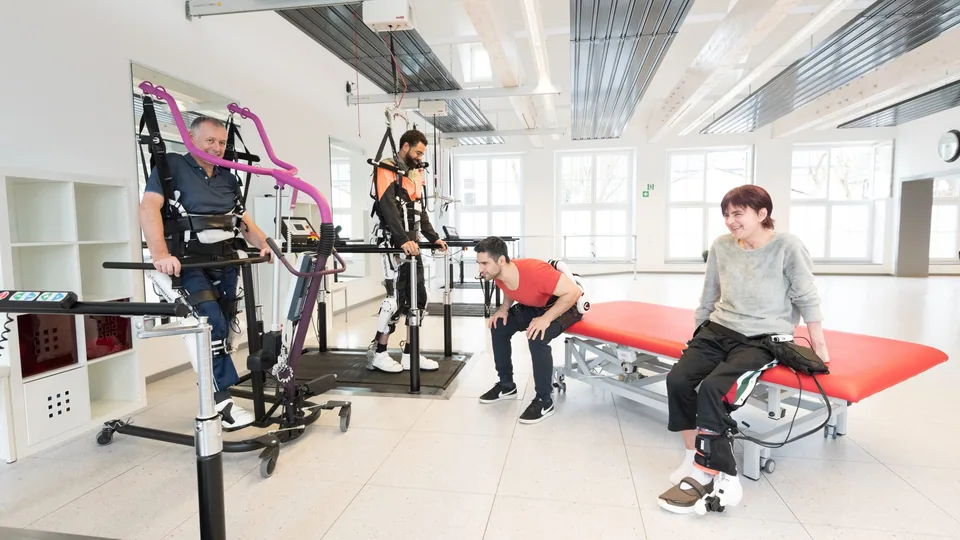
Its flagship product is HAL (Hybrid Assistive Limb), an exoskeleton that assists walking and is used in neurological rehabilitation and heavy physical work. Compared with other medical exoskeletons such as Ekso Bionics, Cyberdyne stands out for control based on bioelectric signals read from the patient's skin rather than on motion sensors alone.
Its weak side is limited availability outside Japan and Germany: no distributor has been confirmed in Poland. The price and terms of deployment in Polish rehabilitation facilities remain an open question.
Cyberdyne Inc. was founded in 2004 in Tsukuba, Ibaraki Prefecture, as a spin-off of the University of Tsukuba. It was set up by Professor Yoshiyuki Sankai, who is still associated with the whole idea today. The company is listed on the Tokyo Stock Exchange and has a subsidiary in Germany, Cyberdyne Care Robotics GmbH, and an entity in the US.
The flagship product, HAL (Hybrid Assistive Limb), reached the market in 2009. It is a wearable exoskeleton that assists movement, and it stands out for how it is controlled: it reads bioelectric signals from the user's skin, the impulse the brain sends to a muscle before the muscle moves. It therefore does not rely on motion sensors alone.
Neurological use, alongside physical work, is the main field of HAL. We write more about exoskeletons in the article “Exoskeletons in Rehabilitation and Industry”.
The portfolio has a single model: HAL. HAL assists walking and movement and is used in neurological rehabilitation and in heavy physical work. It has been on sale since 2009, and availability is based mainly on leasing, with no retail price list. That is important information for hospitals: you don't buy it off the shelf, you negotiate an agreement.
In this class it is worth comparing HAL with EksoNR, ReWalk Personal and Atalante X. All three are rehabilitation exoskeletons, but they differ in how they are controlled and in their target group. The stationary class of machines is represented by LokomatPro.
The whole field is gathered in the category “Exoskeletons”. The medical application is described on the page “Hospitals and rehabilitation”, and the industrial one on factories. The leasing model means the facility pays for access rather than buying the device outright. For Polish hospitals this matters for budgeting. It is worth asking the manufacturer about therapist training costs and service terms, since an exoskeleton requires trained staff. The category of movement-assist machines is gathered on the page “Exoskeletons”. Use in physical work is shown on the page “Construction Robots: What They Can Do in 2026”, although for HAL this is a secondary application next to rehabilitation.
We have no figures on Cyberdyne's valuation or revenue. We know the company is public, has branches in Germany and the US, and comes from an academic center. That is the profile of a mature but niche company.
Among other medical exoskeletons it stands out for control based on bioelectric signals. Competitors in our lineup are Ekso Bionics, Lifeward, Wandercraft and Hocoma. Other exoskeleton companies we cover are German Bionic Systems, US Bionics / SuitX and Sarcos Technology and Robotics.
Its weak side is limited availability of the device outside Japan and Germany. The leasing model may soften this, but it increases dependence on the manufacturer. Listing on the Tokyo exchange means reporting obligations, which gives insight into the company's results, but we found no concrete figures, so we don't quote any. To form your own opinion, turn to the company's materials, since it is a public entity.
There is no confirmed Cyberdyne distributor in Poland. We have no Polish price or list of facilities using HAL either, and the model is marked as unavailable in Poland. The question of price and terms of deployment in Polish rehabilitation facilities remains open.
The Polish thread in robotic rehabilitation is represented by EGZOTech from Gliwice, a maker of rehabilitation robots controlled by an EMG signal. It is a different class of device, but it shows that the country has its own community in this field. A facility that wanted to check out HAL should start by contacting the German company Cyberdyne Care Robotics GmbH, because it is the closest official entity in Europe.
HAL is one of the most recognizable exoskeletons, with interesting bioelectric control and a track record since 2009. For a Polish facility, however, a confirmed distributor and a public price are missing. Compare it with EksoNR before you start talks with the manufacturer. Anyone considering an exoskeleton for rehabilitation should compare several manufacturers, ask about leasing and check the availability of therapist training. Read “Exoskeletons in Rehabilitation and Industry” before you start comparing prices. Also look at Atalante X as an alternative.
Cyberdyne Inc.